Imagine you’re a homeschooling parent, dreaming of a peaceful library filled with educational materials. Now, look at your browser. It’s cluttered with free PDFs, app trials, and a feeling of chaos.
This isn’t a lack of effort. It’s a design problem. Finding the right online literacy tools feels like trying to drink from a firehose.
Let’s change how we think. Creating a literate home environment isn’t about collecting everything. It’s about carefully choosing materials that spark joy and support learning.
Forget the flashy worksheets. True literacy growth for young kids depends on two things. First, inclusive materials that match their level. Second, making reading a part of everyday life through stories and talks.
Imagine a mix of Marie Kondo and The Dead Poets Society for your bookshelf. Let’s start curating.
Key Components of a Home Literacy Program
Think of a home literacy program as a blueprint for a young mind. You wouldn’t build a house by just piling bricks randomly. So why would you educate a child with a stack of busywork? The difference between occupation and education is architecture. Let’s look at the four essential pillars.
1. Developmental Alignment
This is the foundation. Giving a third-grader Moby Dick is like giving a fish a bicycle. It’s not about challenging them; it’s about confusing them. Resources must match the child’s cognitive and emotional readiness.
Look for curricula that scaffold skills. A good program introduces phonics before complex narratives. It offers chapter books only when stamina is built. Companies like Blossom & Root excel here. Their literature-based guides are segmented by age and ability, not just grade level.
2. Hands-On & Interactive Learning
Screens have their place. But if your child’s primary reading partner is a cartoon owl, we have a problem. Literacy is a full-body, messy, human experience. It’s about turning words into worlds.
This means projects, discussions, and yes—crafts. It’s acting out a scene from a book. It’s building a diorama for a story’s setting. The goal is to move information from the page into the hands and heart. Torchlight Curriculum is a masterclass here, weaving Socratic seminars and art analysis into its book lists.
These aren’t buzzwords. They are the windows and doors of your literacy house. A child’s bookshelf must reflect the vast, complicated world they live in—not a sanitized, mono-cultural version of it.
Inclusive resources feature diverse protagonists, authors, and family structures. Secular content focuses on critical thinking and ethics without doctrinal prescription. This pillar builds empathy and analytical skills. It asks, “Whose story is being told?” and “Why?”
4. Comprehensiveness
A single textbook is not a program. Comprehensiveness means covering all the domains: decoding, fluency, comprehension, and critical analysis. It also means having a plan for variety—genres, formats, and difficulty levels.
This is where well-organized printable book lists become your best friend. They are the flexible, updatable backbone of a plan. A great list isn’t just titles; it’s a curated pathway with themes, discussion prompts, and tie-in activities.
How do these pillars work together? The table below lays it out plainly.
| Component | Core Principle | Common Mistake | Real-World Example |
|---|---|---|---|
| Developmental Alignment | Match content to the child’s cognitive stage. | Pushing advanced classics too early, causing frustration. | Blossom & Root’s age-banded literature units. |
| Hands-On & Interactive | Learning through doing, discussing, and creating. | Passive consumption via apps or videos only. | Torchlight’s Socratic discussion guides for picture books. |
| Inclusive & Secular | Reflect global diversity and foster independent critical thought. | A bookshelf filled with only classic, canonical Western authors. | Curricula highlighting global folktales and contemporary diverse authors. |
| Comprehensive | Systematically cover all literacy skills with varied materials. | Relying on a single reading workbook or textbook. | Using thematic, multi-genre printable book lists as a flexible syllabus. |
So, what does this look like in practice? Your weekly plan might include:
- A developmentally-appropriate novel.
- A hands-on project related to the book’s theme.
- Discussion questions that probe ethics and perspective (thank you, inclusivity pillar).
- And a structured, yet adaptable, printable book list to guide the next month’s journey.
The magic isn’t in any single resource. It’s in the intentional interplay of these four components. Build this framework first. Then, every book, every app, every worksheet you choose becomes a purposeful brick in a much grander structure.
Where to Find High-Quality Book Lists
Finding a great book list is like searching for a needle in a haystack, but the haystack is on fire. “You might also like” suggestions are like fortune cookies. To build a real library, you need a map, not a random number generator.
So, where do the savvy curators hide their treasures? Let’s skip the digital noise and find sources that treat children’s literature as art.
Your search should focus on three distinct types of goldmines:
- Digital Libraries with Curation Chops: The Netflix-for-books model is tempting, but quality varies wildly.
- Author-Led Experiences: When the storyteller becomes the guide.
- Structured Curriculum Guides: The heavy lifters that connect literature to the wider world.
Digital Libraries: Beyond the Infinite Scroll
Platforms like Epic Books and Vooks offer vast collections. Use their curated collections and search filters, not just the homepage. Is it a library or a labyrinth? That depends on your strategy.
Then there’s the granddaddy of free, Project Gutenberg’s children’s collection. It’s a paradise for classic literature. But, you’re the librarian. Without a reading curriculum guide or thematic list, it’s just a pile of brilliant, but disconnected, texts.
Sites like Storyline Online, where actors read stories, or authors doing their own read-alouds, offer something unique. It’s part performance, part personal connection. It’s both genius intimacy and a clever celebrity cameo. This can ignite a passion for a specific writer’s voice, leading you to their broader bibliography.
The Thematic Power of a Curriculum Guide
This is where the heavy lifting gets done. Resources like Build Your Library or Torchlight provide literature-based curricula. They sequence books chronologically or thematically, tying Johnny Tremain to the American Revolution and big ideas about freedom.
A robust reading curriculum guide acts as your intellectual architect. It answers the “why” behind the “what.” The lists are diverse, often introducing global perspectives and modern voices alongside the classics. This is the antidote to a scattered approach.
So, what’s the winning strategy? Hybridize. Use a structured guide as your spine. Supplement with deep dives into an author discovered via Storyline. Use Epic or Project Gutenberg to access specific titles from your plan. This method moves you from reactive consumer to proactive curator.
You’re not just finding books. You’re building a world. One where the list is both a mirror for your child’s experience and a window into others. That’s the art form. And it’s far more satisfying than anything an algorithm could ever guess.
Digital vs. Print Resources
Choosing between a Kindle and a paperback is like picking between a scalpel and a hammer. Both are useful, but they work best for different tasks. It’s not a fight between old-fashioned and new-tech lovers. It’s about choosing the right tool for the job.
Digital tools like Khan Academy Kids, Prodigy, and BrainPop have big advantages. They adjust to how well a child does their homework. This quick feedback helps a lot. For kids who don’t like reading, these tools make it fun.
But screens have downsides. Too much screen time can be tiring. The constant alerts and blue light can make it hard to focus. Digital tools are like a quick energy boost, but too much can be bad.
Print materials, on the other hand, offer a different experience. Tools like Oak Meadow curricula and real books are great for this. They let you touch the pages and think deeply. This makes learning more enjoyable and helps you remember things better.
So, when should you use each? Digital tools are good for quick practice and getting started. Print materials are better for deep reading and creative work. Mix both, like using Outschool for classes and printables for hands-on learning.
Think of your literacy plan as a mix of digital and print. Monday might be digital grammar practice. Tuesday could be reading a novel with a print guide. Wednesday might be a video followed by a workbook project.
Here’s a quick guide:
| Resource Type | Best For | Watch Out For | Example |
|---|---|---|---|
| Digital Tools & Apps | Personalized practice, instant feedback, engaging reluctant learners, multimedia content. | Screen fatigue, passive consumption, distraction. | Khan Academy, Prodigy, Epic! digital library. |
| Print & Physical Materials | Deep focus, tactile learning, annotation, reducing eye strain, offline access. | Can be static, requires more parent-led organization. | Oak Meadow workbooks, library book lists, printable activity sheets. |
The smart homeschooler doesn’t stick to one way. They pick the best tool for the task. It’s about knowing when to use digital or print. Your best tool is your own judgment and a mix of both.
Scheduling and Routine Advice
By Wednesday, homeschooling can feel like a chaotic scene from Lord of the Flies. It’s not about a strict plan. Instead, aim for a rhythm that guides your days without being too rigid.
- Alternate the Intensity: Avoid marathon reading on Monday to prevent burnout. Mix deep days with light ones. For example, practice phonics then write about a bug in your backyard.
- Use Tools as Anchors, Not Shackles: Your schedule should be strong but flexible. Printable book lists and activity sheets help. They offer structure and choice, not strict rules.
- Build in “White Space”: This is key. The best learning moments often happen when you’re not expecting them. Make sure to include breaks, fresh air, and time for reflection.
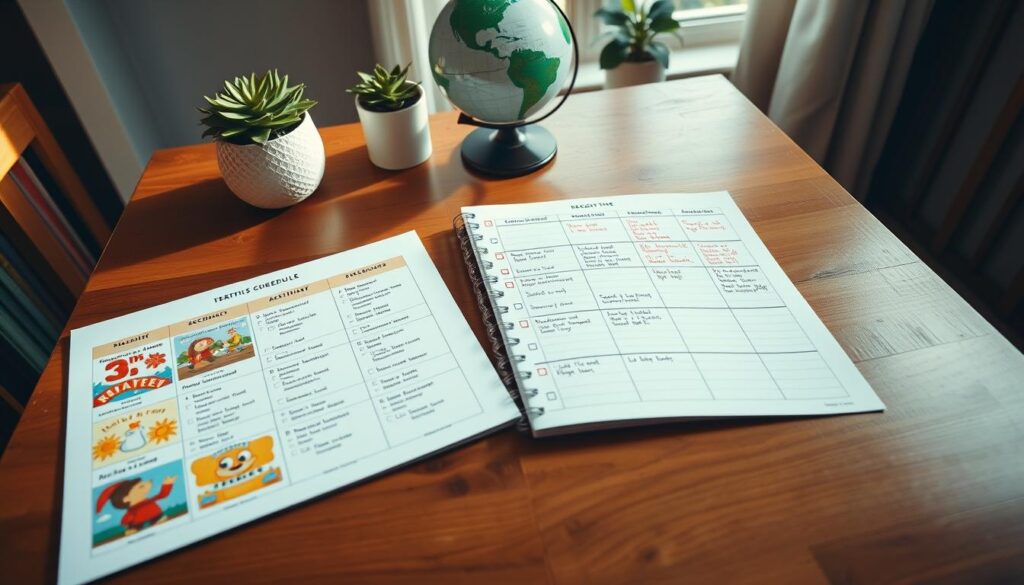
Look at a sample weekly rhythm for early learners. It’s great because it alternates. A focused “Reading Fundamentals” day can be followed by a “Library & Listen” day. This lets young brains process and connect, avoiding that glazed-over look.
Your printable book lists are a big help here. They offer a selection for your “Library Day.” Kids get to choose, making the journey as important as the destination.
Don’t forget about white space. Source 2 advises taking breaks, getting outside, and learning through everyday tasks. Why? Literacy isn’t just about sitting at a desk. Talking about tomato plants or following a recipe are all ways to learn.
Creating a sustainable rhythm is more about finding a flow than following a strict plan. For more ideas, check out these family learning routines. The goal is to make your schedule work for you, not the other way around.
Adaptive Resources for Struggling Readers
When you see your child’s reading struggle isn’t a flaw but a curriculum mismatch, you become a literacy detective. Standard methods are like a monologue; your child’s brain craves a dialogue. If phonics drills and leveled readers don’t work, it’s not a failure. It’s a sign.
Your task is to find the right key to unlock reading for your child. This changes your reading curriculum guide from a broad map to a focused toolkit for neurodiversity. We’re moving from generic encouragement to evidence-based, alternative paths.
An adaptive resource does more than offer easier books. It opens a different door into literacy. The key is developmental alignment. Does the program meet the child where they are today? Let’s look at the specialized tools for a truly adaptive arsenal.
Logic of English is a scholarly, multi-sensory approach. It treats English as a logical code to be cracked. It engages sight, sound, and touch at the same time. This isn’t just learning letters; it’s feeling the language. For a child who thinks in 3D, this can be revolutionary.
Then there’s Nessy, the clever gamifier. It’s designed for dyslexia, making intensive intervention fun. It disguises practice as play. It’s like turning homework into a secret agent mission. Substance meets style here.
For a cost-effective, evidence-based start, the University of Florida Literacy Institute (UFLI) is a hero. Their free, downloadable resources for dyslexia intervention are top-notch tools without the cost. This is the open-source software of literacy—powerful, peer-reviewed, and accessible.
Programs like All About Reading complete the picture with a mastery-based system. It’s scripted for parents, removing guesswork. Success is built into every lesson. It builds confidence as it builds skill.
So, how do these pieces fit into your plan? Think of them as specialized modules for your reading curriculum guide. The table below shows the core differences.
| Resource | Core Approach | Ideal For | Key Differentiator |
|---|---|---|---|
| Logic of English | Multi-sensory, rules-based (Orton-Gillingham) | Learners who need logic & structure | Teaches English as a decodable system |
| Nessy | Game-based intervention | Children with dyslexia; motivation challenges | Makes repetitive practice engaging |
| UFLI Foundations | Explicit, systematic phonics (free) | Budget-conscious, evidence-seeking families | University-developed, no-cost materials |
| All About Reading | Mastery-based, incremental lessons | Parents who want a fully scripted guide | Zero-prep, confidence-building design |
With this knowledge, you become a literacy detective. You’re no longer asking, “Why can’t my child read this?” You’re asking, “Which tool will help my child’s brain want to read this?” That’s the power of an adaptive reading curriculum guide. It gives you the keys, one alternative pathway at a time.
Parent Testimonials/Success Stories
Theory is a clean map, but homeschool literacy is a real journey. It’s like a muddy trail that’s best explored through stories. Let’s listen to those stories in our minds.
Meet Sarah, a former teacher who now homeschools her child. “I brought all my ‘best practices’ home,” she laughs. “It was a disaster. My six-year-old saw worksheets and shut down. The tears were real.”
She changed her approach. She used a game-based online literacy tool. “It was ‘Teach Your Monster to Read.’ Suddenly, reading time wasn’t my battle. It was his request. The game provided the structure; I provided the cuddles and real books afterward.”

The magic wasn’t just in the digital tools. It was in the relief of not being the strict teacher. The right online literacy tools act as a neutral tutor, never getting impatient.
Then there’s David, a secular homeschool dad who used resources “by feel” for years. His victory came from ditching the traditional approach. “I bought this expensive, all-in-one reading curriculum guide. It felt like programming a robot,” he recalls. “We lasted two weeks.”
He found success with a library card and a podcast. Inspired by a podcast on project-based learning, he let his daughter’s love for frogs guide their reading. They read every frog book they could find.
“She wasn’t ‘doing reading,'” David notes. “She was being a herpetologist who needed to read. The motivation was intrinsic. The curriculum was life.”
These stories show different paths to success. Sarah’s story shows how digital tools can help. David’s shows the power of following your child’s interests. The key is to listen to your child more than the experts.
The homeschool literacy journey is real and personal. Success comes from finding the right approach, whether it’s tech or traditional. For more stories, you can see more transformative stories from real families. Your family’s victory lap is waiting to be written.
Sample Home Literacy Plan
Enough theory—let’s get practical. We’re going to create a literacy plan that’s easy to follow. Think of it as building a literacy plan from scratch, like assembling furniture from IKEA.
We’ll mix digital tools, physical books, and hands-on projects. The goal is to create a balanced plan. It should include time for deep reading, skill-building games, and creative projects.
This plan is for Pre-K to Grade 3. It’s all about finding a balance. We’ll mix silent reading with interactive phonics and virtual field trips with quiet book clubs.
| Day | Morning Focus | Afternoon Activity | Key Resource |
|---|---|---|---|
| Monday | Phonics & Foundational Skills | Sustained Silent Reading (SSR) | Printable book lists for decodable readers |
| Tuesday | Non-Fiction Exploration | Hands-on Science Project | NASA Kids’ Club |
| Wednesday | Author Study & Narrative | Virtual Author Visit (recorded or live) | Scholastic Learn at Home |
| Thursday | Math-Literacy Integration | Game-Based Learning | Prodigy Math |
| Friday | Creative Response & Sharing | Family Book Club Discussion | Shared read-aloud title |
Monday is for mechanics. Start with a 20-minute phonics game from a printable book list. It’s not just drill-and-kill; it’s a puzzle. The afternoon is for Sustained Silent Reading. Everyone, including parents, reads a book.
Tuesday is about the real world. Use NASA Kids’ Club to explore space. Then, build a model rocket and write a mission log. This connects non-fiction reading to hands-on creation.
Wednesday is all about stories. Read two books by the same author in the morning. The afternoon brings a virtual visit. It answers the question, “But where do ideas come from?”
Thursday mixes literacy with math. Use Prodigy Math’s games, but have your learner read the quest narratives and problem descriptions aloud. The literacy is in the instructions.
Friday is the payoff. The morning is for creative response. Write a short play based on Monday’s read-aloud. The afternoon is your family book club. Discuss the shared read-aloud over snacks. Keep it light. What was the funniest part? Who was the bravest character?
Printable book lists are your strategic reserve. Use them to stock the SSR basket or find a perfect sequel for your author study. Their power is in curation, not volume.
This plan isn’t a rigid schedule. It’s a rhythm. Swap days. Condense activities. The key advantage is the variety. It prevents burnout and touches every facet of literacy. Digital tools provide novelty, physical books offer depth, and hands-on projects cement learning.
So, take this blueprint. Tear it apart. Adapt it. The goal isn’t to replicate this week perfectly, but to see how the pieces can fit together into a flow that feels less like school and more like a curious, engaging life at home.
Conclusion
The search for the perfect resource ends with a process, not a product. You’ve looked at lists, compared digital and print, and maybe even planned a sample. The real treasure is the method you now have.
The most powerful tool in your homeschool is you. You’re an informed parent who can use a reading curriculum guide as a map, not a cage. Literacy isn’t just about sitting at a desk. It’s about talking while cooking or looking at the clouds.
Balance is key. Mix the free resources from your public library with a dedicated program. Make learning meaningful. Your reading curriculum guide gives the structure. You and your child add the heart.
Keep the joy of the story at the center. Be flexible, curate, and remember, you write the final chapter.
