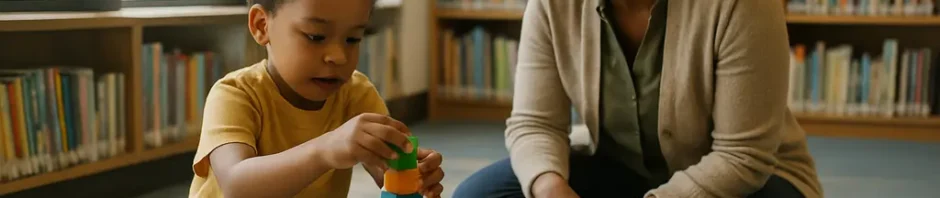
Public libraries have become practical homes for early childhood STEM because they already welcome babies, toddlers, preschoolers, caregivers, and educators in the same place. A library program does not need to look like a school lab to be serious science learning. For children from birth through age six, sorting shells, testing ramps, noticing shadows, listening to a story about weather, or programming a small screen-free robot can build the habits that later support math, engineering, and scientific reasoning.
The most useful library models treat young children as capable thinkers and caregivers as learning partners. That matters because early learning is not a solo performance. A three-year-old asks, drops, stacks, predicts, repeats, and argues with gravity. A caregiver gives language to the experiment: heavier, lighter, faster, slower, again. Public libraries can make those exchanges more frequent by offering materials, prompts, storytimes, kits, and multi-week series that families can join without needing school enrollment or paid enrichment classes.
For community groups, schools, and family literacy teams, the lesson is direct: STEM for young children works best when it is social, language-rich, and easy to repeat. Families looking to expand on library experiences can also visit the Stuyvesant youth site for additional ways local programs support children beyond traditional classrooms.
Why Early Childhood STEM Fits Public Libraries
Early Childhood STEM As Family Practice
Public libraries are well positioned for young learners because they are already built around access. Families come for storytime, books, computers, safe indoor space, homework help, and community information. STEM programming can grow from those same habits instead of competing with them. A book about insects can lead to magnifiers and drawing. A block area can become a test of balance. A song about rain can become a conversation about clouds, puddles, and measurement.
This connection between reading and science is useful for educators. Children do not separate literacy from inquiry. They learn new words because something has caught their attention. They ask questions because a story, object, or tool gives them a reason to talk. That is why public libraries can combine picture books, caregiver prompts, and simple investigations without making the experience feel like a worksheet.
From One-Time Events To Series Learning
One clear example came from San Marcos Public Library in Texas. With support connected to a National Science Foundation grant through the Expressive STEM Centers initiative, the library moved around 2025–2026 from isolated STEM events toward multi-week “Families Learning Together” series for children ages three to five and their caregivers. The Texas State Library and Archives Commission described the model as using tools such as Scratch, Micro:bit, Makey Makey, and screen-free robots in family learning sessions at the San Marcos library.
The shift matters. A one-day event may spark interest, but a series gives families time to return, try again, build vocabulary, and see growth. It also gives librarians time to observe which prompts work, which materials need adjustment, and where caregivers need more support. For districts and nonprofits considering similar work, grant planning can connect library efforts with school goals; Leap Year Publishing has also covered NSF STEM curriculum planning as a related issue for K-12 partners.
What Library STEM Looks Like For Ages 0-6
Materials, Talk, And Repetition
For babies and toddlers, STEM often begins with sensory comparison: soft and hard, full and empty, near and far. For preschoolers, it can include counting collections, building structures, predicting what will roll, testing magnets, planting seeds, or using simple coding toys. The strongest activities are not the most expensive ones. They are the ones that invite children to make a prediction, test it, talk about it, and try again.
That pattern supports early childhood STEM without asking four-year-olds to act like older students. A library station might ask children to build the tallest tower that can stand for ten seconds. Another might invite them to sort leaves by shape, then by size, then by color. A storytime might pause before a page turn and ask what the character should try next. These small choices teach children that thinking can be revised.
Equity Through Familiar Places
Libraries also reduce barriers. A family may not be able to pay for a camp, buy robotics materials, or travel to a museum often. A local branch can offer repeated access to shared tools. That access is especially important for caregivers who want to help but do not see themselves as science or math people. Library staff can model simple language: “What do you notice?” “What changed?” “How could we test that?” Those questions are free, portable, and useful at home.
The research notes for this topic described several local models, including toddler and preschool STEM stations, maker-centered programs, and outreach with robotics and building materials. The common thread is not a single device. It is a public setting where young children can handle real materials and adults can learn how to extend the conversation.
Evidence Libraries Can Use Without Overclaiming
What The Research Grant Signals
One useful sign of national interest came in 2026, when Indiana University Bloomington received about $434,691 through the Laura Bush 21st Century Librarian Program to study books for children ages zero to six on advanced STEM topics, including artificial intelligence and quantum physics. The Institute of Museum and Library Services award description says the project focuses on how caregivers and librarians use these books with young children through the IMLS grant award.
This does not prove that every advanced-topic picture book improves later achievement. It does show that researchers, librarians, and funders are asking a timely question: how do adults make difficult ideas approachable for very young children? A picture book about quantum physics may not lead to formal mastery, but it can help children practice curiosity, analogy, observation, and careful language.
What Counts As Useful Local Data
Libraries should be careful about claims. Attendance is helpful, but it is not the same as learning. A better local evidence plan can combine simple measures: how many families returned for more than one session, which age groups attended, whether caregivers reported trying an activity at home, which materials were reused, and what questions children asked during sessions. These measures are not perfect, but they give staff better information than head counts alone.
For funders and library boards, this kind of evidence can support responsible decisions. If families return for a four-week series, staff can examine what made it work. If attendance drops after the first week, the team can ask whether the time, transportation, age range, instructions, or materials created a barrier. Program improvement should be treated as part of the learning process, not as a sign of failure.
Practical Planning Steps For Library Teams
Start With Caregivers, Not Gadgets
A thoughtful library plan begins with the adults who bring young children. Caregivers need to know that they do not have to be engineers to support inquiry. Librarians can open each session with one or two prompts, model how to wait for a child’s response, and send families home with a low-cost repeat activity. The goal is not to impress families with equipment. The goal is to help them continue the thinking on the bus, in the kitchen, at the laundromat, or during bedtime reading.
- Pair every activity with a short caregiver question, such as “What changed?” or “How do you know?”
- Use materials that can be reset quickly, especially for toddlers who need repetition.
- Offer some screen-free choices so families with different technology comfort levels can participate.
- Connect each station to a book, song, or rhyme to strengthen language and memory.
- Track repeat participation and caregiver feedback before expanding a pilot program.
Connect STEM With Literacy
Library STEM should not compete with reading. It should strengthen it. A read-aloud can introduce the problem. The activity can let children test an idea. A closing conversation can help them name what happened. This structure works because young children learn through cycles: hear it, see it, touch it, say it, repeat it.
For early childhood STEM, that cycle is especially helpful. A child who cannot yet write a sentence can still compare two ramps. A toddler who cannot count to ten reliably can still notice “more” and “less.” A preschooler who struggles to sit through a long book may stay engaged when the story leads to building, sorting, or movement. The library’s strength is its ability to connect all of those entry points.
Public Libraries And Early Childhood STEM
The practical promise of public library STEM is not that every child will become a scientist because of one program. The more grounded claim is better: libraries can give families repeated, welcoming chances to ask questions, use materials, share language, and see young children as thinkers. The San Marcos example shows how a library can move from separate events to family learning series. The Indiana University Bloomington grant shows that researchers are studying how books and adult support can introduce advanced ideas to children from birth through age six.
For educators and library teams, the next step is steady planning. Build programs around caregiver participation. Keep activities short enough for young attention spans and open enough for repeated testing. Use books as anchors. Collect local data without overstating results. Invite partners when they can add expertise, materials, or outreach to families who are not yet using the library.
Handled this way, early childhood STEM becomes part of a community literacy strategy. It helps children talk about the world before they can fully explain it. It gives caregivers language for everyday science. It lets public libraries do what they have long done well: place shared tools, shared stories, and shared questions within reach of more families.
