
Michigan has reached a major milestone in its statewide literacy initiative, with 8,019 educators completing intensive reading instruction training and thousands more enrolled. The effort is part of a broader strategy to improve early literacy, strengthen teacher preparation, and help more children become confident readers.
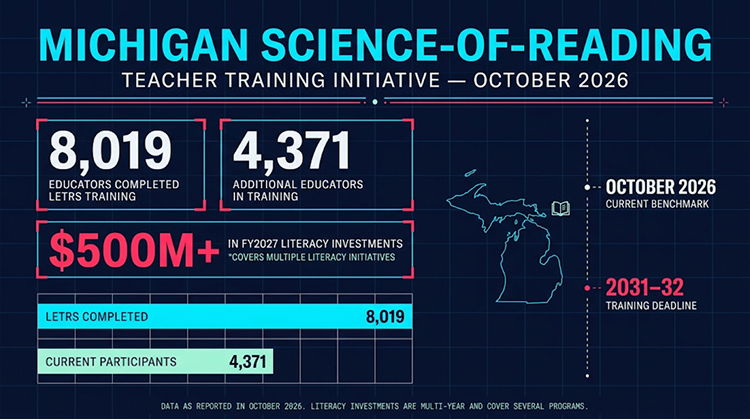
Michigan has reached a significant milestone in its efforts to improve reading instruction: 8,019 educators have completed intensive science-of-reading training, while another 4,371 teachers were participating as of October 1, 2026.
Governor Gretchen Whitmer highlighted the achievement on October 7, 2026, describing the training initiative as part of the state’s long-term commitment to improving literacy outcomes for elementary school students.
The program uses Language Essentials for Teachers of Reading and Spelling (LETRS), a professional development course designed to help educators understand how children learn to read and how to provide evidence-based instruction.
Michigan’s fiscal year 2027 education budget also includes more than $500 million in literacy-related investments, supporting initiatives such as teacher training, instructional materials, and reading interventions.
The announcement comes as the state implements new requirements for educators responsible for teaching reading in kindergarten through fifth grade. Under Public Act 26 of 2026, qualifying science-of-reading professional development must be completed by the 2031–32 school year.
For teachers, families, and school administrators, Michigan’s investment raises an important question: Can large-scale professional development translate into stronger classroom instruction and measurable improvements in children’s reading achievement?
Michigan’s Science-of-Reading Initiative: Key Facts
Educators completing LETRS
8,019
Additional educators in training
4,371
FY2027 literacy investments
$500M+
Training completion deadline
2031–32
Figures announced by the Michigan Governor’s Office on October 7, 2026. Training participation was measured as of October 1, 2026. The budget figure covers multiple literacy initiatives, not only LETRS training.
Michigan’s approach combines teacher professional development with changes to reading instruction, curriculum selection, and student support.
The state is attempting to ensure that educators understand the research behind reading development and can apply that knowledge consistently in elementary classrooms.
Although thousands of teachers have completed training, the state has not established that these completions alone have caused measurable improvements in reading achievement.
That distinction will become increasingly important as Michigan evaluates its literacy reforms.
What Is LETRS, and Why Is Michigan Training Thousands of Teachers?
LETRS, short for Language Essentials for Teachers of Reading and Spelling, is a professional learning program that helps educators understand the research behind reading development.
Developed for teachers, literacy specialists, and school leaders, the training covers the relationships between spoken language, written words, spelling, reading fluency, and comprehension.
Unlike a classroom reading textbook, LETRS primarily focuses on strengthening educators’ instructional knowledge.
Teachers learn how to recognize common reading difficulties, explain language patterns explicitly, interpret assessment information, and adapt instruction to students’ needs.
The five essential components of reading instruction
Michigan’s science-of-reading approach emphasizes five interconnected areas:
| Reading component | What students learn |
|---|---|
| Phonemic awareness | To identify and manipulate individual sounds in spoken words |
| Phonics | To connect letters and letter patterns with speech sounds |
| Fluency | To read accurately, smoothly, and with appropriate expression |
| Vocabulary | To understand the meanings of words |
| Reading comprehension | To construct meaning from sentences and longer texts |
For example, a first-grade teacher might begin a lesson by helping students identify the sounds in a word, then demonstrate how those sounds correspond to written letters.
Students could practice decoding unfamiliar words, reading short passages, and discussing their meaning.
The approach is intended to make foundational reading skills explicit rather than expecting every child to discover written-language patterns independently.
Science-of-reading instruction is particularly relevant for students who struggle with decoding or spelling, including some children with dyslexia.
However, it also encompasses language development, knowledge building, vocabulary, and comprehension. It is not limited to phonics alone.
Michigan’s New Literacy Law Requires K–5 Teacher Training by 2031–32
The training milestone comes during a significant transition in Michigan education policy.
On July 21, 2026, Governor Whitmer signed Public Act 26 of 2026, establishing statewide science-of-reading professional learning requirements.
The law applies to certified educators who provide, support, or oversee reading or language arts instruction in kindergarten through fifth grade.
This includes personnel working in:
- Traditional public school districts.
- Intermediate school districts.
- Public school academies, Michigan’s charter schools.
- General education and special education classrooms.
- Literacy coaching and instructional leadership positions.
The requirement is not limited to teachers who independently deliver reading lessons. Other certified professionals responsible for supporting or overseeing K–5 reading instruction may also be covered.
Does every teacher have to complete LETRS?
No. Michigan’s law requires qualifying science-of-reading professional learning, but LETRS is not the only approved pathway.
On October 22, 2026, the Michigan Department of Education announced that CORE Learning had been selected as a second provider.
CORE Learning will offer its Online Language & Literacy Academy professional development program.
LETRS, offered by Lexia, remains an approved option and is the provider with a dedicated state funding allocation.
This distinction is important because the state’s training requirement is broader than enrollment in one commercial program.
The law establishes instructional expectations, while approved providers deliver professional learning intended to meet those requirements.
Michigan Releases a Statewide Implementation Plan in October 2026
Michigan’s literacy initiative advanced again on October 22, 2026, when the Department of Education announced the completion of its Science of Reading Professional Learning Statewide Implementation Plan.
The plan explains how school districts will transition toward the mandatory professional learning requirements.
Rather than requiring every district to begin training simultaneously, the state will use a phased approach.
Districts that already have sufficient staffing, scheduling capacity, leadership support, and internal planning can begin earlier.
Other districts will enter the process according to their assigned implementation stage.
Michigan’s Science-of-Reading Training Timeline
- July 21, 2026 — New law signedPublic Act 26 establishes statewide professional learning requirements.
- October 7, 2026 — Training milestone announcedMichigan reports 8,019 LETRS completions and 4,371 additional educators participating.
- October 22, 2026 — Implementation plan releasedThe state outlines phased district participation, reporting requirements, and approved training options.
- 2031–32 school year — Statewide requirementCovered K–5 educators must have completed qualifying professional learning.
How will Michigan monitor implementation?
The statewide plan includes annual reporting requirements for districts.
Schools will need to provide information about the number and percentage of required staff who have completed professional learning, along with associated costs and funding sources.
The Michigan Department of Education will also publish annual statewide reports identifying implementation progress, remaining needs, and potential policy or funding adjustments.
These reports should make it easier to distinguish actual training completion from announced enrollment targets.
State Superintendent Dr. Glenn Maleyko, State Board of Education President Dr. Pamela Pugh, and Deputy Superintendent Dr. Delsa Chapman have emphasized the importance of consistent, evidence-based professional learning as the state expands the initiative. Michigan.gov
How Michigan Is Investing More Than $500 Million in Literacy
Michigan’s fiscal year 2027 budget includes more than $500 million in literacy-related investments, described by the governor’s office as the state’s largest one-time literacy investment.
The funding supports several different priorities, including early learning, professional development, curriculum improvement, and additional help for students.
Importantly, the full $500 million is not exclusively dedicated to LETRS.

The state has identified $75 million specifically for LETRS professional learning under Section 35a of the fiscal year 2027 State School Aid Act. Michigan.gov+1
Michigan organizes its broader literacy strategy around three priorities, described in the state’s Every Child Reads plan.
1. Early Starts
Expanding early learning opportunities and helping families support language and literacy development before children enter elementary school.
2. Proven Methods
Supporting evidence-based reading curricula and professional learning so teachers can deliver effective literacy instruction.
3. Extra Help
Providing tutoring, small-group instruction, and additional academic support during the school day, summer, and before- or after-school programs.
These priorities recognize that teacher knowledge is only one part of effective literacy instruction.
Even well-prepared educators need appropriate classroom materials, time to assess student progress, and access to intervention resources.
The broader investment is intended to support these conditions alongside professional learning.
Why Michigan’s Reading Scores Make Literacy Reform a Priority
Michigan’s reading achievement data provide important context for the state’s investment.
According to the 2024 National Assessment of Educational Progress (NAEP), Michigan fourth-grade students recorded an average reading score of 209, compared with the national public-school average of 214.
Only 25% of Michigan fourth graders performed at or above the NAEP Proficient level.
Nationally, approximately 30% of fourth-grade public-school students reached that benchmark.
Michigan Fourth-Grade Reading: 2024 NAEP Results
Michigan average score
209
National average score
214
Michigan at or above Proficient
25%
National at or above Proficient
30%
Source: National Center for Education Statistics, 2024 NAEP Reading State Snapshot. NAEP Proficient is a national assessment achievement level, not the same as Michigan’s grade-level proficiency standard. National Center for Education Statistics+1
The results highlight the scale of the literacy challenge.
Michigan’s 2024 fourth-grade average was not statistically significantly different from its 2022 average, but it remained below the national average.
These figures also predate the October 2026 training milestone.
They should therefore be treated as background information rather than a measure of the newly expanded professional learning requirement.
Why early reading achievement matters
Reading is foundational to learning across academic subjects.
By third and fourth grade, students increasingly encounter texts that require them to understand scientific explanations, historical events, mathematics problems, and unfamiliar vocabulary.
Students who continue to struggle with decoding may have difficulty keeping pace with these demands.
Evidence-based instruction and timely intervention can help educators identify learning needs and provide more targeted support.
However, improvements in reading achievement depend on more than the completion of teacher training courses. Classroom implementation, curriculum quality, instructional time, and students’ individual needs all matter.
Which Michigan School Districts Are Moving Ahead With Teacher Training?
Michigan’s statewide literacy initiative includes school districts that have publicly committed to expanding science-of-reading professional learning.
In August 2026, Governor Whitmer recognized 17 districts that had established goals to train all elementary educators.
By the October 7 announcement, additional districts had joined the effort.
The governor’s office named several participating districts and educational organizations, including:
- Grand Blanc Community Schools — Genesee County.
- Kentwood Public Schools — Kent County.
- Chippewa Hills School District — Mecosta and Isabella counties.
- Evart Public Schools — Osceola County.
- Pine River Area Schools — Osceola County.
- Saginaw Intermediate School District — Saginaw County.
- Montcalm Area Intermediate School District — Montcalm County.
- Rudyard Area Schools — Chippewa County.
These examples demonstrate participation across urban, suburban, and rural school systems.
Districts may differ considerably in their staffing, existing instructional practices, and professional development schedules.
The October announcement documents their commitment to training but does not establish that all educators in these districts have already completed the required professional learning. Michigan.gov
How Science-of-Reading Training Could Change Michigan Classrooms
For elementary teachers, the most important result of professional development is how it influences daily instruction.
A teacher who understands reading development may be better prepared to identify why a student is struggling and select an appropriate response.
Consider three common classroom situations.
A kindergarten student struggles to identify sounds
A teacher might use explicit phonemic awareness activities to help the child recognize and manipulate individual sounds in spoken words.
These activities can be followed by instruction connecting sounds to letters.
A second-grade student has difficulty decoding unfamiliar words
The teacher may assess which spelling patterns the student understands and provide systematic instruction with guided practice.
Progress monitoring can help determine whether the intervention is working.
A fourth-grade student reads accurately but struggles with comprehension
The teacher may focus on vocabulary, background knowledge, sentence structure, and strategies for understanding complex texts.
These examples show why literacy instruction requires more than a single technique.
Different reading difficulties call for different instructional responses.
Professional learning can help teachers make these decisions more systematically, but schools also need time and resources to support effective implementation.
What Michigan’s Literacy Training Means for Students With Dyslexia
Michigan’s reforms are closely connected to its broader work on dyslexia screening and reading intervention.
Students with dyslexia often experience persistent difficulties with accurate or fluent word recognition, decoding, and spelling.
Explicit, systematic instruction in the relationships between sounds and written language can be particularly important for these learners.
Michigan has adopted literacy and dyslexia-related requirements intended to strengthen early identification and instructional support.
The science-of-reading training requirement can complement these efforts by helping educators understand how to recognize reading difficulties and respond with appropriate instruction.
However, professional development alone does not replace comprehensive evaluation, individualized intervention, or special education services when they are needed.
Families concerned about a child’s reading development should continue working with schools to understand screening results, available interventions, and the process for requesting additional evaluation.
Can Training 8,000 Teachers Improve Reading Achievement?
Michigan’s training milestone is substantial, but the relationship between professional development and student achievement requires careful evaluation.
Completing LETRS or another approved course demonstrates participation in professional learning. It does not, by itself, establish that a teacher’s classroom practice has changed or that students’ reading scores have improved.
The initiative’s success will depend on several factors.
| Area to evaluate | Important questions |
|---|---|
| Training completion | How many covered educators finish approved professional learning? |
| Teacher knowledge | Do participants demonstrate stronger understanding of reading development? |
| Classroom instruction | Are evidence-based practices implemented accurately and consistently? |
| Student progress | Do reading assessments show sustained improvement? |
| Reading intervention | Are students who need extra support receiving appropriate instruction? |
| Equity of access | Are rural, urban, and high-need districts receiving sufficient resources? |
The state’s annual implementation reports will help track educator participation.
Student achievement data, classroom observations, and independent evaluations will be needed to understand the initiative’s broader effects.
Policymakers should also distinguish between improvements associated with professional learning and those influenced by other investments, such as tutoring, curriculum changes, or expanded early childhood education.
What Parents and Teachers Should Know About Michigan’s Literacy Changes
For parents, Michigan’s reforms may eventually influence how reading is taught, assessed, and supported in elementary classrooms.
Families can ask their child’s school about its reading curriculum, how teachers identify literacy difficulties, and which interventions are available when students need additional help.
For educators, the new requirements mean that approved professional learning will become a statewide expectation for covered K–5 personnel.
Teachers should consult their district or intermediate school district for information about training schedules, approved providers, and professional development support.
The Michigan Department of Education’s October implementation plan establishes a phased approach, so individual districts may begin or complete their training at different times.
Families and educators should not assume that every school will immediately change its curriculum or that every teacher must enroll in LETRS specifically.
Frequently Asked Questions
How many Michigan teachers have completed science-of-reading training?
As of the October 7, 2026 announcement, 8,019 Michigan educators had completed LETRS training. Another 4,371 were participating as of October 1.
What is LETRS training?
LETRS stands for Language Essentials for Teachers of Reading and Spelling. It is professional development that helps educators understand reading science and apply evidence-based literacy instruction.
Is science-of-reading training mandatory in Michigan?
Yes. Public Act 26 of 2026 requires covered certified K–5 educators who provide, support, or oversee reading instruction to complete approved professional learning by the 2031–32 school year.
Does every Michigan teacher have to take LETRS?
No. LETRS is an approved option, but Michigan has also selected CORE Learning’s Online Language & Literacy Academy as another professional learning provider.
How much is Michigan investing in literacy?
Michigan’s fiscal year 2027 budget includes more than $500 million in literacy-related investments, including $75 million specifically allocated for LETRS professional learning.
What percentage of Michigan fourth graders are proficient in reading?
According to the 2024 NAEP assessment, 25% of Michigan fourth graders performed at or above NAEP Proficient. This national benchmark is not identical to the state’s own grade-level proficiency measure.
Will the training help students with dyslexia?
Science-of-reading professional development can strengthen teachers’ understanding of decoding, phonics, and reading intervention. Students with dyslexia may benefit from effective structured instruction, although individual needs and outcomes vary.
Has Michigan already improved reading scores because of the new training requirement?
The state has not established a causal relationship between the 2026 training requirement and improved student reading achievement. Future assessments and evaluations will be necessary to measure its effects.
Conclusion: Michigan’s Next Challenge Is Turning Teacher Training Into Reading Progress
Michigan’s announcement that 8,019 educators have completed LETRS training represents an important step toward expanding evidence-based literacy instruction across the state.
With another 4,371 educators participating, a new statewide professional learning requirement, and more than $500 million in literacy-related budget investments, Michigan is pursuing a broad strategy to improve reading education.
The October 22 implementation plan adds structure to that effort by establishing approved training options, phased district participation, and annual reporting requirements.
But training completion is only the beginning.
The long-term significance of Michigan’s investment will depend on whether educators can apply their knowledge effectively, whether students receive timely intervention, and whether reading achievement improves across communities.
For schools and families, the central lesson is that strong reading instruction requires knowledgeable teachers, evidence-based methods, appropriate resources, and sustained attention to student progress.
