
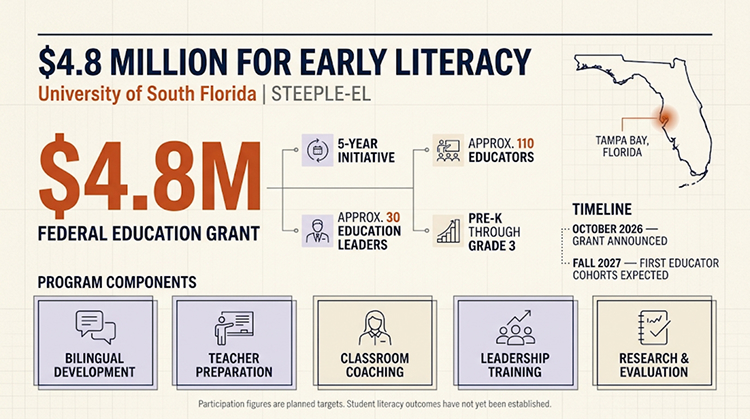
The University of South Florida has secured a five-year federal grant to strengthen early literacy instruction for multilingual children across Tampa Bay. The STEEPLE-EL initiative will prepare approximately 110 educators, train 30 educational leaders, and investigate how research-based teaching practices can improve learning from preschool through third grade.
Tampa, Florida — The University of South Florida (USF) has received a $4.8 million grant from the U.S. Department of Education to improve how teachers and school leaders support young English learners across the Tampa Bay region.
Announced on October 5, 2026, the five-year initiative is called STEEPLE-EL, short for Strengthening the Training of Early Education Professionals to Enhance the Learning Environment for English Learners.
Led by Dr. Lisa López, professor of Educational Psychology at USF’s College of Education, the project will strengthen language and literacy instruction for children from prekindergarten through third grade.
The initiative brings together USF’s College of Education, its College of Behavioral and Community Sciences, and four community education partners serving Hillsborough and Pinellas counties.
Its approach extends beyond traditional professional development workshops. The project will establish a graduate certificate in bilingual development, create a pathway for new elementary teachers, provide classroom-based instructional coaching, and train school and organizational leaders.
USF expects to support approximately 110 educators through two graduate preparation pathways, alongside a separate Leadership Academy for about 30 educational leaders. The first educator cohorts are expected to begin in fall 2027.
Researchers will also investigate whether improved teacher preparation leads to stronger classroom practices and, ultimately, better language and literacy outcomes for children.
The initiative addresses an important challenge in American early education: many children are developing English proficiency while simultaneously learning foundational reading skills, building vocabulary, and acquiring the language needed for classroom participation.
For these students, effective instruction must account for both literacy development and the experience of learning through more than one language.
The central question is whether preparing teachers and school leaders to understand bilingual development can produce more effective early literacy instruction—and measurable improvements in children’s learning.
University of South Florida’s $4.8 Million Literacy Initiative: Key Facts
Federal grant
$4.8M
Project duration
5 years
Educator participants
~110
Leadership Academy
~30
Figures are based on the University of South Florida’s October 5, 2026 announcement. Participation numbers are approximate targets, not completed enrollments or demonstrated student outcomes. University of South Florida
| Project detail | Verified information |
|---|---|
| Lead institution | University of South Florida |
| Federal funding agency | U.S. Department of Education |
| Grant amount | $4.8 million |
| Project name | STEEPLE-EL |
| Duration | Five years |
| Geographic focus | Tampa Bay, Florida |
| Target grades | Prekindergarten through third grade |
| Principal investigator | Lisa López |
| Co-investigators | Sophia Han, Matthew Foster, Molly Hamm-Rodríguez |
| Educator preparation target | Approximately 110 educators |
| Leadership training target | Approximately 30 leaders |
| New credential | Graduate Certificate in Bilingual Development in Early Childhood Education |
| First anticipated educator cohorts | Fall 2027 |
| Main priorities | Bilingual language development, early literacy, teacher preparation, coaching, classroom evaluation |
| Announcement date | October 5, 2026 |
The grant funds a planned educational improvement and research initiative.
It does not mean that 110 educators have already completed training, that 30 leaders have graduated from the academy, or that participating children’s reading scores have improved.
Those outcomes will need to be evaluated as the project progresses.
Why Tampa Bay Is Investing in Early Literacy for English Learners
Tampa Bay schools and early childhood programs serve children from families with diverse linguistic and cultural backgrounds.
Some children speak Spanish at home while developing English proficiency in preschool or elementary school. Others may grow up using additional languages.
These children bring valuable language knowledge and experiences into classrooms, but their educational needs may not always be fully addressed by instructional approaches designed primarily for monolingual English speakers.
The STEEPLE-EL initiative is intended to strengthen educators’ understanding of how bilingual language development interacts with early learning.
Learning English and learning to read are connected, but different
A child entering kindergarten may already understand stories, recognize concepts, and communicate confidently in a home language.
However, the same child may still be learning the English vocabulary used in classroom instructions, books, and assessments.
Teachers need to distinguish between difficulties related to learning English and difficulties with foundational literacy skills.
For example, a student who does not recognize an English vocabulary word may still understand the underlying concept in Spanish.
Another student may have difficulty connecting letters with sounds, blending phonemes, or recognizing printed words.
These situations can require different instructional responses.
An educator trained in bilingual development may be better prepared to identify what a child already knows, determine which skills need support, and select appropriate teaching strategies.
Why the preschool-to-third-grade period matters
The initiative focuses on a critical stage of language and literacy development.
During preschool, children strengthen oral language, vocabulary, listening comprehension, and early awareness of sounds and print.
Kindergarten and first grade typically introduce increasingly systematic instruction in letter-sound relationships, decoding, spelling, and early reading fluency.
By second and third grade, students encounter more demanding texts and are expected to develop greater independence in reading and understanding academic information.
For English learners, these literacy demands occur alongside continued English language development.
Effective instruction must therefore support both the mechanics of reading and the language needed to understand what is read.
What Is STEEPLE-EL?
STEEPLE-EL stands for Strengthening the Training of Early Education Professionals to Enhance the Learning Environment for English Learners.
It is an interdisciplinary project combining teacher preparation, professional development, instructional leadership, classroom coaching, and educational research.
The initiative will involve both practicing educators and people entering the teaching profession.
Rather than focusing exclusively on a single classroom program, it aims to improve the broader educational systems that support young multilingual learners.
Five major components of the initiative
- Graduate preparation in bilingual developmentCreate a new certificate program to help educators understand language and literacy development among young multilingual children.
- A pathway for future elementary teachersCombine the bilingual development certificate with USF’s Master of Arts in Teaching in Elementary Education for eligible new entrants to teaching.
- Leadership AcademyProvide professional learning and collaboration opportunities for approximately 30 school, district, and organizational leaders.
- Classroom-based instructional coachingSupport participating educators through observation, feedback, and ongoing assistance with instructional practices.
- Research and evaluationExamine how teacher preparation affects classroom practices and children’s language and literacy outcomes, including the development of an expanded classroom observation tool.
Summary of the program components described in USF’s official October 2026 announcement. University of South Florida
The five components are intended to reinforce one another.
University coursework can provide teachers with research-based knowledge. Coaching can help educators apply that knowledge in classrooms. Leadership development can help schools sustain changes.
Research and evaluation will then examine whether those activities produce meaningful improvements.
A New Graduate Certificate Will Prepare Approximately 110 Educators
One of STEEPLE-EL’s most significant components is the creation of a Graduate Certificate in Bilingual Development in Early Childhood Education.
The certificate will help practicing educators deepen their knowledge of how young children develop language and literacy skills across multilingual environments.
It will also form part of a preparation pathway for career changers and others entering elementary education.
USF expects the grant to support approximately 110 educators across the two pathways, with the first cohorts beginning in fall 2027.
This number represents the combined participation target, not 110 participants in each pathway. University of South Florida
Pathway 1: Professional learning for current educators
Practicing teachers and other eligible educators will be able to pursue the new graduate certificate.
The program is intended to strengthen expertise in bilingual development and improve educators’ ability to support English learners in early childhood settings.
Relevant instructional knowledge may include language development, classroom interactions, culturally responsive teaching, and the relationship between oral language and literacy.
The university has not yet published a complete course-by-course curriculum in the October announcement.
Pathway 2: Preparing new elementary teachers
People entering the teaching profession will have a pathway combining USF’s Master of Arts in Teaching in Elementary Education with the new graduate certificate.
This structure is designed to help future teachers develop general elementary teaching skills alongside more specialized preparation for working with multilingual children.
The approach reflects a broader challenge in teacher education.
Teachers may enter classrooms with general knowledge of literacy instruction but limited practical experience supporting children who are learning English while developing reading skills.
Integrating bilingual development into teacher preparation could help address that gap.
Why graduate-level preparation matters
Short professional development sessions can introduce educators to new concepts.
However, understanding bilingual language development requires knowledge of multiple interacting processes, including language acquisition, early childhood development, assessment, and literacy instruction.
A structured graduate program can provide opportunities for sustained study and guided application.
Whether the new certificate improves instructional quality will depend on its content, implementation, participant engagement, and subsequent classroom practice.
These are among the questions STEEPLE-EL’s evaluation efforts will need to address.
The Four Tampa Bay Education Partners Supporting STEEPLE-EL
The University of South Florida will work with four established education organizations serving children, families, and educators in the Tampa Bay region.
These partnerships are important because the initiative aims to connect university research with the practical needs of schools and early childhood programs.
| Partner | Geographic focus | Role in the initiative |
|---|---|---|
| Hillsborough County Public Schools | Hillsborough County | School district partnership and educator recruitment |
| Redlands Christian Migrant Association (RCMA) | Florida communities served by RCMA | Early childhood education partnership |
| Early Learning Coalition of Hillsborough County | Hillsborough County | Early learning provider collaboration |
| Early Learning Coalition of Pinellas County | Pinellas County | Early learning provider collaboration |
All four organizations are named in the university’s announcement. University of South Florida
Hillsborough County Public Schools
Hillsborough County Public Schools is a major public school district serving Tampa and surrounding communities.
Its participation connects STEEPLE-EL with educators working in elementary schools where English learners may need coordinated language and literacy support.
District collaboration can help ensure that professional development addresses actual classroom conditions rather than remaining exclusively theoretical.
Redlands Christian Migrant Association
The Redlands Christian Migrant Association (RCMA) provides early childhood education and related support to families in Florida, including agricultural and rural communities.
Its participation brings an important early childhood perspective to the project.
Children in preschool and community-based early learning settings may have different instructional experiences from those already enrolled in public elementary schools.
Including these programs can help researchers examine language development and teaching practices across multiple educational environments.
Early Learning Coalitions in Hillsborough and Pinellas
The Early Learning Coalition of Hillsborough County and the Early Learning Coalition of Pinellas County support early childhood education systems within their respective counties.
Their involvement creates opportunities to connect professional learning with the educators and providers who work with children before kindergarten.
This matters because language development and early literacy do not begin when children enter elementary school.
Preschool teachers and early childhood professionals help establish important foundations through conversation, shared reading, vocabulary development, and age-appropriate literacy activities.
USF Will Establish a Leadership Academy for 30 Education Leaders
STEEPLE-EL will also create a Leadership Academy for approximately 30 school, district, and organizational leaders.
The academy will be developed in partnership with USF’s David C. Anchin Center for the Advancement of Teaching.
Its purpose is to help educational leaders understand research-based approaches to English learner education and create supportive conditions for teachers.
This component addresses a common challenge in school improvement: teachers may receive high-quality professional development but lack the institutional support needed to apply new practices consistently.
Why school leadership matters for literacy improvement
A teacher who wants to strengthen bilingual literacy instruction may need appropriate materials, assessment tools, planning time, and opportunities to collaborate with colleagues.
Principals and program directors influence whether those resources are available.
School leaders also make decisions about professional learning priorities, instructional schedules, and how student progress is monitored.
By preparing educators and administrators together, STEEPLE-EL aims to create greater alignment between classroom instruction and organizational leadership.
What the Leadership Academy will provide
According to USF, the academy will emphasize professional development, collaboration, and networking around research-based approaches to educating English learners.
Its potential value extends beyond the 30 leaders who participate directly.
Those individuals may be able to support additional educators through instructional planning, mentoring, and organizational decision-making.
However, the university has not announced a verified number of teachers or students who will be indirectly reached through the academy.
Any broader impact will depend on how participants apply what they learn.
Meet the University of South Florida Researchers Leading the Initiative
STEEPLE-EL brings together researchers from education, early childhood development, instructional assessment, and social foundations of education.
The interdisciplinary team reflects the project’s emphasis on both classroom instruction and the systems supporting multilingual learners.
Dr. Lisa López: Principal investigator
Dr. Lisa López, professor of Educational Psychology at USF, is the principal investigator.
Her research examines the educational development of Latino dual-language learners, including school readiness, home and classroom environments, curriculum, and assessment.

She has worked with Head Start programs in the Tampa Bay region and studies how early learning experiences can better support children from multilingual backgrounds.
Her leadership connects STEEPLE-EL with a research agenda focused on improving educational opportunities for young dual-language learners. University of South Florida
Dr. Sophia Han: Early childhood teacher preparation
Dr. Sophia Han, professor of Early Childhood Education, serves as a co-investigator.
Her involvement supports the project’s teacher preparation component, including the development of professional learning pathways for educators working with young children.
This expertise is important because early childhood teaching involves developmentally appropriate instruction as well as understanding children’s emerging language abilities.
Dr. Matthew Foster: Assessment and intervention evaluation
Dr. Matthew Foster is a co-principal investigator and associate professor in USF’s Department of Child & Family Studies.
He brings expertise in assessment development and intervention evaluation.
His role is particularly relevant to determining whether the project’s professional learning activities translate into observable changes in classroom instruction.
The evaluation will also examine whether changes in teaching practices are associated with better outcomes for children.
Dr. Molly Hamm-Rodríguez: Cultural and international education
Dr. Molly Hamm-Rodríguez, assistant professor of Social Foundations of Education, is another co-principal investigator.
She will contribute to the project’s planned international learning component, which includes a study abroad experience in the Dominican Republic.
This experience is intended to help participating educators develop a deeper understanding of educational systems and cultural experiences that may be relevant to children from Caribbean backgrounds.
STEEPLE-EL Research Team
| Researcher | University role | Project contribution |
|---|---|---|
| Lisa López | Professor of Educational Psychology | Principal investigator and bilingual development research |
| Sophia Han | Professor of Early Childhood Education | Teacher preparation and early childhood education |
| Matthew Foster | Associate professor, Child & Family Studies | Assessment and intervention evaluation |
| Molly Hamm-Rodríguez | Assistant professor, Social Foundations of Education | International and cultural education component |
Source: University of South Florida, October 5, 2026. University of South Florida
How Classroom Coaching Could Improve Literacy Instruction
University coursework can strengthen teachers’ understanding of bilingual development, but applying that knowledge requires practical experience.
For this reason, STEEPLE-EL will include instructional coaches who work directly with participating educators.
Coaches will observe classroom practices and provide ongoing feedback.
This approach creates opportunities to connect research-based ideas with actual teaching decisions.
An example of how coaching might work
Consider a fictional first-grade classroom where several children are developing English proficiency.
During a shared-reading lesson, the teacher introduces a story containing unfamiliar vocabulary.
Some children understand the story’s events but have difficulty expressing their ideas in English.
A coach observing the lesson might help the teacher consider additional visual supports, structured discussion opportunities, or ways to connect new vocabulary with children’s existing knowledge.
The teacher and coach could then review how students respond to the revised instruction.
This is an illustrative example, not a documented STEEPLE-EL classroom observation or a required coaching procedure.
Why observation and feedback matter
Effective professional learning involves more than knowing which instructional practices are recommended.
Teachers must decide when and how to use those practices with particular students.
Classroom observations can provide information about the language opportunities children receive, the quality of instructional interactions, and whether lessons are responsive to students’ needs.
Feedback can help educators refine their approach over time.
The STEEPLE-EL research team intends to examine whether this combination of graduate preparation and coaching leads to stronger teaching practices.
A New Classroom Observation Tool Could Have National Implications
One of the initiative’s most distinctive research components involves collaboration with the National Institute for Early Education Research (NIEER).
USF plans to expand an existing classroom observation tool designed for settings serving bilingual children.
The researchers intend to extend its application through third grade and make it suitable for classrooms serving children who speak languages beyond English and Spanish.
Why existing observation tools may be insufficient
Classroom observation tools help researchers and educators examine teaching practices.
However, an observation framework developed primarily for monolingual classrooms may not fully capture the instructional interactions occurring in multilingual environments.
For example, a teacher may use children’s home languages strategically, encourage connections between languages, or provide additional opportunities for oral language development.
These practices may be important for understanding instructional quality.
A tool that does not adequately recognize multilingual learning experiences could provide an incomplete picture of classroom instruction.
What the expanded tool aims to accomplish
The proposed expansion will help researchers examine teaching practices across a wider range of grade levels and language backgrounds.
Potential areas of analysis include how educators support oral language, create opportunities for meaningful communication, and respond to children’s different language abilities.
The university’s announcement does not provide a finalized set of observation categories or a completed validation study.
The tool remains part of the planned research and development work.
Why this research could matter beyond Florida
If researchers develop and validate a useful observation instrument, it could eventually inform professional development and educational research in other states.
Schools across the country serve students who speak many different languages.
An observation framework that accounts for multilingual instruction could help researchers better understand which teaching practices are associated with positive learning outcomes.
However, nationwide adoption is not a confirmed project outcome.
The initial work is focused on STEEPLE-EL’s Tampa Bay partnerships.
Why the Dominican Republic Is Part of the Project
STEEPLE-EL also includes plans for an international learning experience in the Dominican Republic.
Participating graduate certificate students will have an opportunity to examine local educational systems, teacher preparation, and the experiences of children in the country.
The component will be supported by Dr. Molly Hamm-Rodríguez.
Its purpose is to help educators develop cultural and educational understanding that may be relevant when working with children from Caribbean backgrounds in Tampa Bay classrooms. EBS PublicNow
Connecting cultural knowledge with classroom practice
Children’s experiences outside school can influence how they communicate, participate, and respond to instructional activities.
Educators who understand the diversity of family experiences may be better prepared to build respectful relationships with students and caregivers.
However, cultural knowledge should not become a collection of assumptions about individual children.
Families from the same country may have very different linguistic, socioeconomic, and educational experiences.
The value of international learning depends on whether educators use it to strengthen curiosity, communication, and responsiveness rather than generalizing about students based on their backgrounds.
The university has not confirmed the number of educators who will participate in the Dominican Republic experience or the specific travel dates.
How USF Will Measure the Initiative’s Success
The five-year grant includes an evaluation component designed to examine both educator development and student outcomes.
Researchers will investigate whether the approaches taught through STEEPLE-EL produce changes in classroom practice and whether those changes contribute to stronger language and literacy development among children.
This distinction is important.
Completing a graduate certificate does not automatically demonstrate that an educator has improved classroom instruction.
Likewise, improved teaching practices do not automatically establish that children’s literacy outcomes have improved.
Both need to be studied.
| Evaluation area | Key question |
|---|---|
| Educator preparation | Do participants develop stronger knowledge of bilingual language and literacy development? |
| Classroom practice | Do educators apply research-based instructional strategies more consistently? |
| Instructional coaching | Does observation and feedback help teachers improve their practice? |
| Leadership development | Do participating leaders create more supportive instructional environments? |
| Language development | Do children demonstrate progress in appropriate language measures? |
| Early literacy | Do students improve in relevant reading and pre-reading skills? |
| Observation tool | Can the expanded instrument reliably capture multilingual classroom practices? |
| Sustainability | Can partner organizations maintain improvements after the grant period? |
These are appropriate evaluation questions based on the project’s stated goals, not a published list of final outcome measures.
Why measuring English learner progress requires care
Young multilingual children may develop skills at different rates across their languages.
An English-only assessment may not fully capture a child’s conceptual knowledge or abilities in a home language.
Researchers therefore need to consider whether assessment instruments are appropriate for the students being evaluated.
They must also distinguish between language proficiency and reading difficulties.
A child who is still learning English vocabulary should not automatically be classified as having a reading disability.
Conversely, persistent decoding difficulties should not be dismissed simply because a child is multilingual.
The initiative’s emphasis on bilingual development and improved observation methods may help researchers address these challenges.
What would count as meaningful success?
A strong outcome would involve evidence that participating educators improve their instructional practices and that children demonstrate corresponding gains in language or literacy development.
Researchers would also need to consider whether improvements are sustained and whether the instructional approaches can be implemented in ordinary educational settings.
As of November 5, 2026, USF has not published final student achievement results from STEEPLE-EL.
The grant supports a planned intervention and evaluation effort; it does not establish that the program has already improved reading performance.
STEEPLE-EL Timeline: From the 2026 Announcement to Future Evaluation
The university has confirmed the project’s five-year duration and the expected start of its first educator cohorts.
It has not published a complete annual implementation schedule.
Project Timeline
- October 5, 2026 — Federal grant announcedUSF announces its $4.8 million award and identifies the project’s research team, partners, and planned activities.
- 2026–2027 — Program developmentThe project prepares its educator pathways, leadership training, and research activities. Specific operational milestones have not been fully published.
- Fall 2027 — First educator cohorts expectedParticipants are expected to begin entering the graduate preparation pathways.
- Subsequent project years — Coaching and evaluationResearchers plan to examine classroom practices and student outcomes as the initiative progresses.
- End of the five-year initiative — Longer-term findingsThe research team aims to assess the effectiveness and sustainability of its approach. A final report publication date has not been announced.
Timeline based on USF’s October 5, 2026 announcement. Dates other than the announcement and anticipated fall 2027 cohort start are general planning periods, not confirmed milestones. University of South Florida
What the $4.8 Million Grant Means for Teachers and Families
For educators, STEEPLE-EL creates new opportunities to develop specialized knowledge about teaching young English learners.
Practicing teachers may gain access to graduate-level preparation and ongoing coaching.
Future teachers may enter the profession with stronger preparation for multilingual classrooms.
School leaders may also gain a clearer understanding of the organizational conditions needed to support effective language and literacy instruction.
For families, the project’s potential benefits are more indirect.
Children may eventually experience classroom instruction that better recognizes their language development, builds on existing knowledge, and provides appropriate reading support.
However, the initiative is not a direct cash assistance program for families, and USF has not announced a universal enrollment program for all English learners in Tampa Bay.
Participation will initially be organized through the university’s education partners.
What parents can ask about their child’s literacy development
Families of young English learners can benefit from discussing both language development and reading progress with teachers.
Useful questions include whether their child is developing foundational reading skills, how English language proficiency is assessed, and what instructional support is available.
Parents can also ask how schools recognize and support children’s home languages.
Shared reading, conversation, storytelling, and access to books in familiar languages can provide valuable opportunities for language development at home.
These activities complement classroom instruction but should not replace specialized educational support when a child needs it.
Could STEEPLE-EL Influence Bilingual Education Beyond Tampa Bay?
The project is initially focused on educators and educational leaders connected to its Tampa Bay partners.
Nevertheless, several components could have relevance outside Florida.
The graduate certificate may provide a model for preparing educators to work with multilingual children.
The Leadership Academy may offer insights into how schools and organizations can support teachers.
The expanded classroom observation tool could contribute to research on bilingual and multilingual instruction.
Most importantly, the evaluation may provide evidence about whether combining teacher preparation, coaching, and leadership development produces stronger educational outcomes.
USF researchers have expressed interest in extending aspects of the work to neighboring districts.
Such expansion remains a possibility rather than a confirmed statewide or national rollout. EBS PublicNow
Frequently Asked Questions
How much funding did the University of South Florida receive?
USF received a $4.8 million grant from the U.S. Department of Education for a five-year initiative supporting early childhood educators and young English learners.
What does STEEPLE-EL stand for?
STEEPLE-EL stands for Strengthening the Training of Early Education Professionals to Enhance the Learning Environment for English Learners.
Which students are the focus of the initiative?
The project focuses on English learners from prekindergarten through third grade.
Who is leading the project?
Dr. Lisa López, professor of Educational Psychology at USF, is the principal investigator. The research team also includes Sophia Han, Matthew Foster, and Molly Hamm-Rodríguez.
How many teachers will receive training?
USF expects the grant to support approximately 110 educators across two graduate preparation pathways.
When will the first educators begin the program?
The first cohorts are expected to begin in fall 2027.
What is the new graduate certificate?
The Graduate Certificate in Bilingual Development in Early Childhood Education is a planned credential intended to help educators strengthen their knowledge of language and literacy development among multilingual children.
Will school principals and administrators participate?
Yes. STEEPLE-EL will establish a Leadership Academy for approximately 30 school, district, and organizational leaders.
Which organizations are participating?
The project’s partners include Hillsborough County Public Schools, Redlands Christian Migrant Association, and the Early Learning Coalitions of Hillsborough and Pinellas counties.
Does the project include classroom coaching?
Yes. Instructional coaches will observe participating educators’ classroom practices and provide ongoing feedback.
Will the project study languages other than Spanish?
Yes. The research team plans to expand an existing classroom observation tool so it can be applied in settings serving children who speak languages beyond English and Spanish.
Has STEEPLE-EL already improved children’s reading scores?
No final student-outcome findings have been published. The initiative is designed to investigate whether improved teacher preparation and classroom practices lead to better language and literacy outcomes.
Conclusion: A $4.8 Million Investment in More Effective Multilingual Literacy Instruction
The University of South Florida’s $4.8 million STEEPLE-EL initiative represents a substantial investment in preparing educators to meet the language and literacy needs of young English learners.
Led by Dr. Lisa López, the five-year project will connect university researchers, public schools, early childhood organizations, and educational leaders across Tampa Bay.
Its planned activities include a new graduate certificate, preparation pathways for approximately 110 educators, a Leadership Academy for about 30 leaders, classroom coaching, and expanded tools for evaluating multilingual instruction.
The initiative recognizes that improving literacy for English learners requires more than teaching phonics or providing additional reading materials.
Educators must understand how language development, classroom interactions, early literacy instruction, and children’s existing linguistic knowledge work together.
The project also acknowledges that teachers need support from school leaders and educational organizations to sustain effective instructional practices.
Its long-term significance will depend on the evidence produced during implementation.
If STEEPLE-EL demonstrates that stronger educator preparation leads to better classroom instruction and improved language and literacy outcomes, its findings could inform how other schools and universities support multilingual learners.
For now, the confirmed achievement is the federal investment and the creation of a comprehensive research and professional development initiative.
The coming years will determine how effectively that investment translates into meaningful educational improvements for young children.
