
The University of Alabama’s new Project LIFT initiative will bring evidence-based reading interventions to 75 schools, focusing on young children whose literacy difficulties persist despite conventional instruction. Backed by a major federal grant, the five-year project will also test how rural schools can deliver and sustain intensive reading support.
Tuscaloosa, Alabama — The University of Alabama has received a $9.9 million federal grant to expand intensive literacy instruction for elementary school students who continue to struggle with reading, including children with dyslexia and intellectual or developmental disabilities.
The five-year initiative, called Project LIFT (Literacy Improvement through Focused Tutoring), will focus primarily on rural Alabama communities where access to specialized reading interventions can be limited.
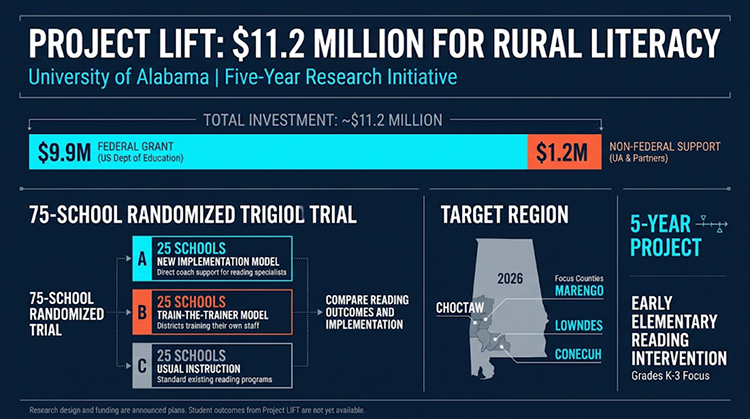
The funding comes from the U.S. Department of Education’s Education Innovation and Research (EIR) Mid-Phase program. Approximately $1.2 million in additional nonfederal support brings the total planned investment to roughly $11.2 million.
Led by Dr. Gregory J. Benner, the Helen and Pat O’Sullivan Professor of Special Education at the University of Alabama, the project will train educators to deliver an intensive structured literacy intervention called Friends on the Block.
The university’s October 28 and November 6, 2026, announcements describe a project designed to reach 75 elementary schools, with an emphasis on students who have not made sufficient progress through general classroom instruction or less intensive reading support.
The initiative will also investigate how schools can implement the intervention effectively, including whether a newly developed implementation model produces better results than traditional professional development.
Its central question is especially relevant for rural education: Can schools provide effective, intensive reading instruction to children with the greatest literacy needs without depending permanently on outside researchers or specialists?
University of Alabama’s $9.9 Million Literacy Grant: Key Facts
Federal grant
$9.9M
Total investment
~$11.2M
Schools in planned trial
75
Project duration
5 years
| Project detail | Verified information |
|---|---|
| Lead institution | University of Alabama |
| Project name | Literacy Improvement through Focused Tutoring (Project LIFT) |
| Principal investigator | Dr. Greg Benner |
| Federal funding | Approximately $9.9 million |
| Additional nonfederal support | Approximately $1.2 million |
| Total project investment | Approximately $11.2 million |
| Federal funding program | Education Innovation and Research, Mid-Phase |
| Project duration | Five years |
| Planned research scale | 75 schools |
| Main geographic focus | Rural Alabama |
| Named partner districts | Conecuh, Choctaw, Lowndes, and Marengo counties |
| Intervention | Friends on the Block |
| Instructional approach | Intensive structured literacy |
| Intended students | Young struggling readers, including children with significant disabilities |
| Study design | School-level randomized controlled trial |
| Latest university announcement | November 6, 2026 |
The university’s two announcements differ slightly in describing the initial grade range and typical lesson frequency. The October 28 article emphasizes kindergarten through second grade and three weekly sessions; the November 6 College of Education report describes kindergarten through third grade and three to four sessions per week.
The broader project therefore addresses early elementary students, approximately kindergarten through third grade, with specific eligibility and scheduling determined through implementation.
Why Rural Alabama Needs More Intensive Reading Support
Reading difficulties can affect students in every community, but rural schools may face additional challenges when trying to provide specialized intervention.
Smaller school systems may have fewer reading specialists, limited professional development opportunities, and less flexibility to assign staff to individualized instruction.
Families may also have difficulty accessing private tutoring or specialized educational services outside school.
These barriers can be especially significant for students whose reading needs are more intensive than those addressed through standard classroom instruction.
The students who continue to struggle
Many elementary schools use a tiered system of reading support.
Students receive core literacy instruction, while those who need additional help may participate in small-group intervention.
Some children make progress through these approaches.
Others continue to struggle despite receiving supplemental support.
Benner estimates that approximately 10% to 15% of students may not respond adequately to general reading instruction or less intensive interventions.
This estimate is presented by the university as a rationale for more intensive support; it is not a new statewide prevalence measurement produced by Project LIFT. College of Education
Students in this group may have persistent difficulties with recognizing letters and sounds, decoding unfamiliar words, reading accurately, or understanding written passages.
Some have diagnosed disabilities, while others may require more intensive instruction for different reasons.
The project is intended to support children based on their instructional needs rather than assuming that persistent difficulty means reading development is impossible.
Why early intervention matters
Reading is foundational to learning across academic subjects.
A child who cannot recognize common words or decode unfamiliar vocabulary may struggle to engage with science, history, and mathematics as schoolwork becomes more demanding.
Persistent reading difficulties can also affect classroom participation and confidence.
Project LIFT focuses on the early elementary years because this is a period when schools can address foundational skill gaps before students encounter increasingly complex academic texts.
The initiative does not replace Alabama’s existing literacy instruction. It is designed to provide additional, more intensive support for students who need it.
What Is Project LIFT?
Project LIFT stands for Literacy Improvement through Focused Tutoring.
It is a five-year effort to expand access to a structured literacy intervention while studying how schools can deliver that intervention consistently and sustainably.
The project combines three connected priorities: student instruction, educator preparation, and implementation research.
- Provide intensive reading instructionOffer targeted support to young students whose reading difficulties persist despite existing instruction.
- Train educators to deliver Friends on the BlockPrepare school personnel to use a systematic intervention addressing foundational literacy skills.
- Develop practical implementation resourcesWork with rural teachers and school leaders to create guidance that reflects actual classroom conditions.
- Evaluate different training modelsCompare a new implementation approach, traditional train-the-trainer preparation, and usual school instruction.
- Build long-term school capacityHelp participating schools continue effective literacy support after the grant period ends.
Based on the University of Alabama College of Education’s November 6, 2026 project description. College of Education
Unlike an initiative that simply purchases instructional materials, Project LIFT will investigate the conditions needed for schools to use an intervention successfully.
That distinction matters because a reading program can have strong research evidence yet produce inconsistent results if educators lack sufficient training, time, or ongoing support.
Friends on the Block: The Reading Intervention Behind Project LIFT
Project LIFT will use Friends on the Block, a structured literacy intervention developed for students with intensive reading needs.
The program was originally developed by researchers associated with Southern Methodist University.
Its instructional design emphasizes systematic teaching, repeated practice, and active student participation.
The intervention addresses several interconnected reading skills:
- Letter-sound correspondence.
- Decoding unfamiliar words.
- Accurate word recognition.
- Reading fluency.
- Reading comprehension.
The University of Alabama describes Friends on the Block as an intervention intended to supplement the instruction students already receive, rather than replace their regular reading lessons. College of Education+1
What a typical lesson looks like
The university reports that lessons generally last about 25 minutes and are delivered approximately three to four days per week, depending on the instructional arrangement described.
Students may receive instruction individually or in small groups of up to three.
A lesson can include explicit reading instruction, opportunities to respond, practice with text, and a brief game that reinforces the skills being taught.
The games are not simply recreational additions.
They provide structured opportunities for children to practice recently introduced reading skills while maintaining engagement.
Why systematic instruction matters
Students with significant reading difficulties may require more explicit explanations, additional practice, and carefully sequenced lessons.
A systematic approach introduces skills in an organized progression and provides repeated opportunities to apply them.
For example, students might practice connecting letters with sounds before using those patterns to decode words.
As accuracy develops, instruction can incorporate more complex words and connected reading.
This description illustrates the instructional principles involved; it is not a complete published lesson sequence for Friends on the Block.
Tier 3 reading support
The university identifies Friends on the Block as a form of Tier 3 intervention.
In a multi-tiered system of support, Tier 3 generally refers to individualized or highly intensive intervention for students with substantial academic needs.
| Instructional level | General purpose | Typical support |
|---|---|---|
| Tier 1 | Core instruction for all students | Classroom literacy curriculum |
| Tier 2 | Additional support for students needing intervention | Targeted small-group instruction |
| Tier 3 | Intensive support for persistent difficulties | Individualized or very small-group intervention |
These categories describe a common educational framework. The exact organization of support can vary among school systems.
Project LIFT is especially concerned with children whose needs remain significant after they have received other available instruction.
Previous Research Found Promising Reading Improvements
Project LIFT builds on earlier research evaluating Friends on the Block.
In April 2026, researchers published a peer-reviewed study in Remedial and Special Education examining the intervention’s effectiveness for elementary students with disabilities and intensive literacy needs.
The study involved 62 students, randomly assigned to one of two groups:

- 31 students received Friends on the Block instruction.
- 31 students continued with their schools’ usual instruction.
The research team included Gregory Benner, Keith Smolkowski, Jill Allor, Stephanie Al Otaiba, June Preast, Jason Small, Stephanie Hermecz, and Lisa Strycker.
The results favored Friends on the Block on several reading measures.
What did the study find?
| Reading outcome | Reported finding |
|---|---|
| Phonological awareness | Significant advantages on 2 of 5 measures |
| Decoding | Significant advantages on all reported measures |
| Word-reading fluency | Significant advantages on all reported measures |
| Reading comprehension | Significant advantages on all reported measures |
| Language and vocabulary | Generally no significant differences, except one listening comprehension measure |
These results suggest that intensive structured literacy instruction can help students with significant reading difficulties, including children with intellectual and developmental disabilities.
However, the findings also show that improvements are not necessarily uniform across every aspect of language development.
The distinction is important because word reading, vocabulary, oral language, and comprehension are related but different skills.
What the earlier findings do—and do not—prove
The 62-student study provides evidence supporting Friends on the Block under the conditions examined.
It does not establish that every student will achieve the same results, that all children will become fluent readers within a fixed period, or that the program will be equally effective in every school.
Project LIFT is intended to address a related but different question: Can schools implement this intervention effectively at a much larger scale, using training and support models that are practical for rural education systems?
The earlier study’s outcomes should not be presented as results from the new 75-school initiative.
Meet Dr. Greg Benner, the Researcher Leading Project LIFT
Dr. Gregory J. Benner is the Helen and Pat O’Sullivan Professor of Special Education at the University of Alabama.
He has extensive experience researching academic interventions, educator professional learning, and sustainable school improvement.
Before joining Alabama, Benner served as a professor and executive director of the Center for Strong Schools at the University of Washington Tacoma from 2012 to 2018.
According to his university faculty profile, he has held leadership roles in numerous sponsored research projects and has worked extensively on interventions designed to support students with complex educational needs. College of Education
A research focus on students with the greatest needs
Benner’s work emphasizes the importance of providing effective instruction to students who have not responded adequately to conventional approaches.
For Project LIFT, that includes children with intellectual and developmental disabilities who may have experienced limited expectations regarding their ability to learn to read.
In the university’s October announcement, Benner emphasized that a child’s location, disability, or level of instructional need should not determine access to effective reading support.
His approach challenges the assumption that some students should receive substantially reduced literacy instruction simply because they have significant disabilities.
Building on years of collaboration
Friends on the Block was developed through research associated with Southern Methodist University, including the work of Dr. Jill Allor and Dr. Stephanie Al Otaiba.
The University of Alabama subsequently participated in independent evaluation of the intervention.
That work helped establish the evidence base underlying Project LIFT.
The new grant represents a transition from evaluating an instructional program’s effectiveness toward investigating how to implement it across more schools.
Four Rural Alabama Counties Will Participate in the Research
The university has identified school districts in Conecuh, Choctaw, Lowndes, and Marengo counties as partners in the planned study.
These counties are located in rural parts of Alabama, including communities associated with the state’s Black Belt region.
Project LIFT’s Named District Partners
The map shows county-level locations, not individual participating schools. The university has not published a complete list of the 75 schools in its November 6 announcement.
Why these partnerships matter
Rural districts can provide researchers with direct insight into the realities of delivering specialized instruction where staffing and training resources may be limited.
For example, a small elementary school may not have a dedicated reading specialist available to work individually with every student who needs intensive intervention.
The school may instead rely on classroom teachers, special education personnel, and other trained staff.
Project LIFT aims to develop implementation resources that reflect these constraints.
The participating districts will therefore contribute more than locations for a research study.
Their educators and leaders will help shape how the intervention is introduced, supported, and maintained.
A 75-School Randomized Trial Will Compare Three Approaches
One of Project LIFT’s most important features is its planned randomized controlled trial.
The university reports that 75 schools will be assigned to three groups of 25 schools each.
The study will compare different approaches to implementing Friends on the Block.
Planned Study Design
25
New implementation model
Schools use the model developed with rural educators and researchers.
25
Train-the-trainer model
Schools use a traditional approach to preparing educators.
25
Usual instruction
Schools continue their existing literacy instruction and support.
Planned allocation of schools, as reported by the University of Alabama College of Education on November 6, 2026. College of Education
Group 1: A newly developed implementation model
Twenty-five schools will use an implementation approach developed during the project’s initial year.
The research team will work with rural educators, school leaders, and a national advisory board to create an implementation guide and accompanying resources.
This model is intended to incorporate both research expertise and the practical knowledge of school personnel.
Group 2: Traditional train-the-trainer preparation
Another 25 schools will use a conventional train-the-trainer approach.
Under this model, selected personnel receive preparation and then help train or support other educators.
The approach can allow professional learning to spread within a school system without requiring every staff member to receive direct instruction from outside researchers.
However, its effectiveness depends on training quality, consistency, and ongoing support.
Group 3: Business-as-usual instruction
The remaining 25 schools will continue their existing literacy instruction and intervention practices during the comparison period.
This group provides a benchmark for evaluating the effects of the two implementation approaches.
Researchers can then compare student reading outcomes and examine whether differences are associated with the intervention and its delivery model.
Why random assignment matters
Random assignment helps reduce the possibility that differences between groups are caused by preexisting characteristics rather than the intervention.
Because Project LIFT assigns schools rather than individual students, researchers will also need to account for similarities among students attending the same school.
A well-designed trial can provide stronger evidence about intervention effectiveness and implementation than simply comparing schools that voluntarily adopt different programs.
The new study will be especially valuable if it identifies not only which approach improves reading outcomes but also which approach schools can sustain.
The First Year Will Focus on Making the Intervention Practical for Rural Schools
Project LIFT’s initial year will emphasize collaboration with teachers and school leaders.
Researchers will gather input from educators who understand the day-to-day conditions in rural schools.
The team will also work with a national advisory board with expertise in literacy and implementation science.
Together, they will develop an implementation guide and resources intended to help schools use Friends on the Block effectively.
Why implementation research is important
A program may produce positive outcomes when delivered by highly trained researchers or specialists.
However, its effectiveness may change when implemented by school staff managing multiple responsibilities.
Educators need clear instructions, appropriate materials, opportunities to practice, and access to feedback.
School leaders must also consider scheduling, staffing, student identification, and progress monitoring.
Implementation research investigates how these conditions influence whether an intervention is delivered as intended.
From research evidence to everyday classroom practice
Consider a hypothetical rural elementary school with a small number of students requiring intensive reading support.
The school may have an effective reading program but limited time to train staff.
A practical implementation guide could help clarify which personnel need preparation, how lessons fit into the school day, and how progress should be reviewed.
Teachers could then use the intervention more consistently without depending on frequent visits from university researchers.
This example illustrates the type of implementation challenge Project LIFT aims to address. It is not a documented account from a participating school.
What the $11.2 Million Investment Will Support
The project’s approximately $11.2 million total investment combines the federal grant with nonfederal support.
Announced Funding Sources
Federal grant
~$9.9M
Federal: approximately 88.4%
Nonfederal: approximately 11.6%
Additional nonfederal support
~$1.2M
Percentages are calculated from rounded public funding figures and are approximate. The university has not released a complete line-item spending plan. College of Education
The investment will support the development, implementation, and evaluation of intensive literacy instruction across the participating schools.
Major project activities include educator preparation, implementation resources, research coordination, and evaluation.
The university has not published a detailed breakdown showing how much money will be allocated to each school, teacher, or student.
It would therefore be misleading to divide the total award by 75 schools and present the result as a guaranteed school-level grant.
The funding supports a coordinated research and implementation initiative, not 75 identical cash awards.
Why Project LIFT Matters for Students With Disabilities
Children with intellectual and developmental disabilities have sometimes faced lower expectations for literacy development.
In certain educational settings, instruction may emphasize functional or daily living skills while providing fewer opportunities for systematic reading instruction.
Project LIFT challenges the assumption that students with significant disabilities cannot benefit from ambitious, evidence-based literacy teaching.
Disability does not determine a fixed reading ceiling
Students with disabilities have diverse strengths and educational needs.
Some require more instructional time, different pacing, additional repetition, or individualized supports.
Others may benefit from highly structured routines and carefully selected reading materials.
A diagnosis alone does not establish how far a child can progress.
The earlier Friends on the Block research is important because it found positive reading outcomes among students with substantial learning needs.
However, these findings do not mean that every student will achieve identical proficiency or progress at the same rate.
Individual assessment and ongoing instructional adjustment remain essential.
Why high expectations must be matched with support
High expectations are valuable only when students receive the instruction needed to pursue them.
A school cannot simply expect stronger reading performance without providing appropriate teaching methods, sufficient instructional time, and progress monitoring.
Project LIFT combines the principle of ambitious literacy expectations with a specific instructional intervention and a plan for educator training.
That combination distinguishes it from initiatives focused primarily on awareness or policy statements.
How the Project Fits Into Alabama’s Science of Reading Reforms
Alabama has invested in early literacy improvement through statewide reading initiatives, teacher development, and policies emphasizing evidence-based instruction.
These efforts have contributed to a broader national conversation about the Science of Reading.
However, improving core instruction does not eliminate the need for specialized interventions.
Even in schools with strong literacy programs, some children will require additional support.
Project LIFT addresses this group.
Core reading reform and intensive intervention are complementary
| Statewide literacy improvement | Project LIFT’s intensive intervention |
|---|---|
| Strengthens general classroom reading instruction | Targets students with persistent reading difficulties |
| Serves broad groups of elementary students | Focuses on children requiring intensive support |
| Emphasizes teacher knowledge and curriculum quality | Emphasizes structured intervention and implementation |
| Supports early identification of reading difficulties | Responds when existing instruction has not been sufficient |
| Operates through schoolwide or statewide systems | Tests approaches across 75 schools |
A comprehensive literacy strategy needs both effective instruction for all students and additional support for those who continue to struggle.
Project LIFT is designed to help close that gap.
What Success Would Look Like After Five Years
Project LIFT’s ultimate value will depend on the evidence produced during implementation.
The university hopes to document meaningful improvements in reading while creating a model that schools can continue using with less direct assistance from researchers.
Several outcomes will be especially important.
| Evaluation area | Key research question |
|---|---|
| Decoding | Can students read unfamiliar words more accurately? |
| Word recognition | Do students become more efficient at identifying printed words? |
| Reading fluency | Can students read connected text more accurately and smoothly? |
| Comprehension | Do improvements extend to understanding written material? |
| Implementation quality | Are educators delivering the intervention consistently? |
| Teacher preparation | Which training model best prepares school personnel? |
| Sustainability | Can schools continue the program after the grant ends? |
| Rural accessibility | Can schools with limited specialist resources implement the approach? |
These are relevant evaluation questions based on the project’s goals, not a complete list of officially published trial outcome measures.
The importance of sustainability
One of the project’s stated priorities is ensuring that expertise remains within participating schools.
If an intervention depends indefinitely on outside specialists, its long-term reach may be limited.
A sustainable model would help schools train personnel, monitor instructional quality, and support new staff members as educators change roles.
This could be particularly important for rural districts where recruiting specialized personnel may be difficult.
Could Project LIFT expand beyond Alabama?
Benner and his team have expressed interest in pursuing additional funding that could eventually support expansion into other states.
That possibility will depend on future evidence, resources, and partnerships.
As of November 10, 2026, Project LIFT’s announced implementation and evaluation are focused on Alabama.
A national expansion has not been confirmed. College of Education
Project LIFT Timeline: From Research to Rural School Implementation
- April 9, 2026 — Earlier intervention research publishedA peer-reviewed randomized trial reports positive reading outcomes for students receiving Friends on the Block.
- October 28, 2026 — University announces Project LIFTThe University of Alabama introduces the $9.9 million federal initiative and its rural literacy objectives.
- November 6, 2026 — Detailed research plan publishedThe College of Education describes the 75-school trial, participating counties, and implementation approaches.
- Initial project year — Implementation developmentResearchers work with rural educators and advisers to create practical training and support resources.
- Subsequent project years — School-level evaluationThe team plans to compare the three study groups and evaluate reading outcomes and implementation.
- End of the five-year period — Sustainability and future researchResearchers aim to identify an approach that schools can maintain and potentially adapt for broader use.
The first three milestones are documented publication dates. Later milestones describe planned project phases; specific trial launch dates and final publication dates have not been publicly confirmed. College of Education+2
What Parents and Educators Should Know About Intensive Reading Intervention
For families whose children continue to struggle with reading, Project LIFT highlights the importance of identifying specific instructional needs.
A child may receive regular reading instruction and still need more individualized support.
Parents can ask schools how reading progress is assessed, what interventions are available, and whether the intensity of support matches the child’s needs.
Teachers can use assessment information to identify whether difficulties involve letter-sound knowledge, decoding, fluency, comprehension, or multiple areas.
Questions families can ask schools
- What do my child’s reading assessments show about specific strengths and difficulties?
- Which interventions have been provided, and how frequently?
- How is progress measured during intervention?
- What happens if my child does not respond adequately?
- Is an evaluation for a learning disability or additional educational support appropriate?
These questions are relevant to intensive literacy intervention generally. They do not establish eligibility for Project LIFT, which will operate through participating schools.
Students with disabilities may also have individualized educational plans that specify instructional services and supports.
Families should work with their schools to understand those plans and how reading interventions fit within them.
Frequently Asked Questions
How much funding did the University of Alabama receive?
The university received approximately $9.9 million in federal funding for Project LIFT. An additional $1.2 million in nonfederal support brings the total planned investment to approximately $11.2 million.
What is Project LIFT?
Project LIFT stands for Literacy Improvement through Focused Tutoring. It is a five-year initiative designed to expand intensive reading support in rural Alabama schools.
Who is leading the project?
Dr. Gregory J. Benner, the Helen and Pat O’Sullivan Professor of Special Education at the University of Alabama, leads the initiative.
How many schools will participate?
The university plans a randomized controlled trial involving 75 schools, divided into three groups of 25.
Which Alabama counties are involved?
The named school district partners are in Conecuh, Choctaw, Lowndes, and Marengo counties.
What grades will Project LIFT serve?
The initiative focuses on early elementary students. University announcements describe kindergarten through second grade as an initial emphasis and kindergarten through third grade as the broader target range.
What is Friends on the Block?
Friends on the Block is a structured literacy intervention for students with intensive reading needs. It addresses foundational skills including letter-sound correspondence, decoding, word recognition, fluency, and comprehension.
How long are the reading sessions?
The university describes sessions of approximately 25 minutes, generally delivered three to four times per week, either individually or in small groups.
Will Project LIFT help students with dyslexia?
The project is intended to support students with intensive reading needs, including some children with dyslexia and other disabilities. Eligibility and appropriate instruction will depend on individual student needs and participating school procedures.
Has Friends on the Block been tested before?
Yes. Earlier randomized research found positive results in decoding, word reading, fluency, and comprehension among participating students with disabilities.
Have the 75 schools already demonstrated improved reading scores?
No. The new 75-school implementation study is planned. Findings from earlier trials should not be presented as outcomes of Project LIFT.
Will the program become available nationwide?
The researchers have discussed possible future expansion, but no nationwide rollout has been announced.
Conclusion: Bringing Intensive Reading Instruction to Students Who Need It Most
The University of Alabama’s $9.9 million Project LIFT grant represents a major investment in improving literacy opportunities for children in rural communities.
Led by Dr. Greg Benner, the five-year initiative will build on previous research showing that intensive structured literacy instruction can improve reading outcomes among students with significant educational needs.
The project will use Friends on the Block to provide targeted support while preparing educators to deliver the intervention effectively.
Its planned 75-school randomized trial will also examine how training and implementation strategies influence student outcomes.
That research is important because an effective intervention must do more than work under controlled conditions.
It must also be practical for teachers, accessible to students, and sustainable for schools with limited resources.
Project LIFT addresses those challenges directly.
For children whose reading difficulties persist despite existing instruction, the initiative offers a research-based approach to expanding educational opportunities.
The project’s most important contribution may be demonstrating not only that students with intensive reading needs can make meaningful progress, but also how rural schools can provide the instruction necessary to support that progress.
The next five years will determine whether Project LIFT can turn promising research into a sustainable model for intensive literacy support.
