
Navigating educational regulation is like trying to understand a tax code written by uninspired poets. You’re trying to create a lively learning space, not break any rules.
The United States has fifty different education systems. It’s like a quilt made by fifty tailors, each with their own pattern. This is the complex world of curriculum policy compliance.
Some states have strict, detailed rules, like IKEA instructions. Others, like homeschooling, offer more freedom, like crafting a unique bookshelf from wood.
Both methods aim to build a place for learning. But the path and the risks are very different. This guide will help you navigate these challenges. We’ll explore compliance with the detail of a cartographer and the humor of someone who’s read too many “whereas” clauses.
Overview of Policy Compliance
Imagine education law as a big, 50-state adventure book. Each state’s rules are like a different chapter. Where you start affects your whole homeschooling path.
This world isn’t the same everywhere. It’s divided into four main levels of rules. Knowing your level is key to following curriculum compliance.
In No Regulation states, homeschooling is very free. You don’t need to show anyone your plans. But, you must make sure everything is okay on your own.
Low Regulation states are a bit more relaxed. You just need to tell them you’re homeschooling. Then, you’re mostly free to do as you wish.
Moderate Regulation states have some rules. They want you to tell them you’re homeschooling and check in once a year. It’s like a quick car check.
High Regulation states have strict rules. They want to see your homeschool plan and make sure it meets their standards. You need to follow specific rules, like:
- A formal Letter of Intent to homeschool.
- Submission of a detailed Educational Plan for approval.
- Specific curriculum compliance mandates, aligning with state-approved subjects.
- Teacher qualification requirements for the parent-educator.
- Meticulous record-keeping and annual reporting of progress and assessments.
Here, education law plays a big role in your daily planning. You must follow strict rules about what you teach and how you prove it.
Finding your way through this isn’t easy. It depends on your state’s rules. Knowing these rules can make your homeschooling journey smoother.
State and District Requirements
Understanding federal tax code is tough. But state mandates for home education are even more complex. Each state has its own rules, making it a patchwork quilt of school policy.
Every state is like its own educational sovereign. Pennsylvania might need 180 days of school. Ohio could ask for 900 hours. California wants specific subjects taught. Texas has its own rules.
First, you need to deal with the state. High-regulation states require three things. You must file a Letter of Intent, follow curriculum mandates, and keep detailed records. Missing one can be tough.
But then, your local school district adds its own twist. The state says “teach math.” The district might say which math, when, and how to prove it. They add local flavor to the educational recipe.
You need to understand both state and district rules. Know the broad state mandates. Then, learn your district’s specific rules. It’s like filing both federal and state taxes.
| State Example | Notification Requirement | Curriculum Mandates | Record-Keeping |
|---|---|---|---|
| New York | Annual Letter of Intent to district | 13 specific subjects including patriotism and citizenship | Quarterly reports, annual assessment |
| Florida | Initial notice to district superintendent | Required subjects but flexible on content | Portfolio review option available |
| Illinois | No state notification required | Teach language arts, math, science, social studies | Must maintain attendance records |
| Massachusetts | Approval from local school committee | Curriculum must be “thorough and efficient” | Annual progress reports required |
Notice the big differences? One state wants you to teach about patriotism. Another just wants the basics. Some require annual assessments. Others trust your portfolio. It’s 50 different views on education.
Your research must be very local. What works in Portland, Oregon, won’t work in Portland, Maine. Even within states, districts have different rules. You need to know your specific area.
Resources like Ontario’s policy program memorandum offer valuable insights. While specific to Canada, it shows how detailed educational policy can get. It reminds us that clear school policy benefits everyone.
The takeaway? Don’t assume. Research your state’s specific legal obligations. Then investigate your district’s rules. Talk to other homeschoolers. Speak with district officials. Read the actual statutes, not just summaries.
Remember, state mandates set the stage. But your local district writes the daily script. Master both, and you’re not just complying. You’re navigating the system like a constitutional scholar.
Policy Differences for Homeschoolers
For public schools, curriculum compliance is a must. Homeschoolers, on the other hand, follow their own path. This isn’t just about paperwork. It’s a clash of values in homes turned classrooms.
Imagine a spectrum of rules. Some states have a “Wild West” approach, with little oversight. Others have strict homeschool regulations and regular checks. Where you live affects your educational path.
| Regulation Level | Typical State Examples | Homeschooler’s Burden of Proof | Degree of Customization |
|---|---|---|---|
| Low/No Regulation | Texas, Oklahoma, Alaska | Often none required. The state assumes you’re educating. | Maximum. It’s a freestyle improv session. |
| Moderate Regulation | Florida, North Carolina | Annual notification, standardized test or evaluation. | High, within broad subject guidelines. |
| High Regulation | New York, Pennsylvania, Massachusetts | Detailed curriculum plans, quarterly reports, portfolio reviews, state-approved assessments. | Guided. It’s a tightly choreographed ballet. |
The main difference is control. Schools follow a set system. Homeschoolers, in some states, must create their own system that meets state standards. It’s not just about teaching. It’s about proving you’re doing more than just watching TV.
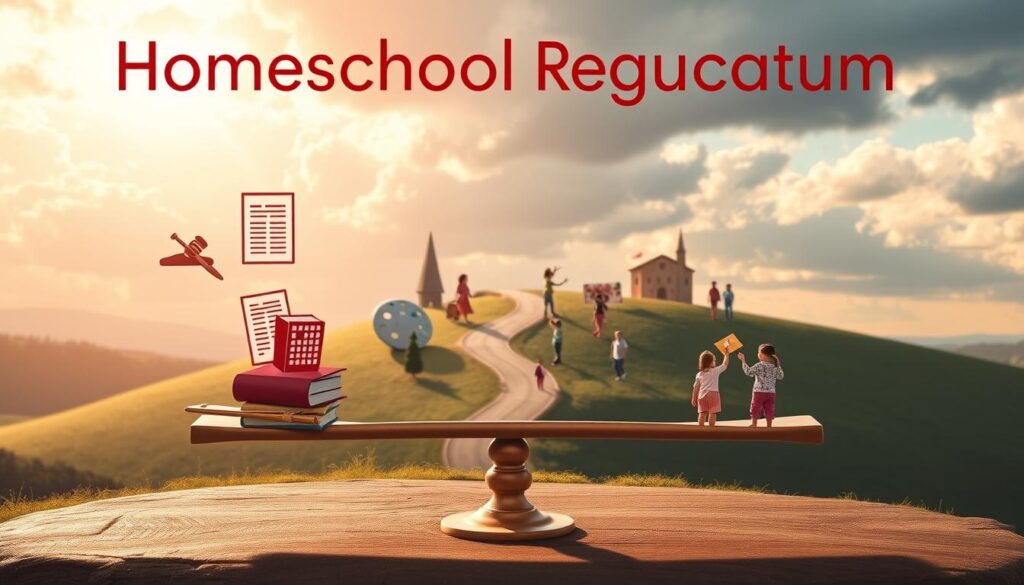
Homeschoolers see rules as guides, not barriers. They use them to create a unique learning experience. Your lesson on ancient Rome isn’t just history. In New York, it’s part of your official state guidelines report. That nature walk? It’s science in action.
This turns compliance into a strategy. How?
- Customization is Your Superpower. Use flexibility to match subjects with your child’s interests, making reports enjoyable.
- Document as You Go. Make progress tracking a habit. Save photos, quizzes, and trip reports right away.
- Know the Code. Understand if an “annual assessment” is a test or a teacher’s evaluation. This changes your whole year.
In short, schools follow rules. Homeschoolers create their own. One is about following a manual. The other is about writing your own.
Documentation and Reporting
Think of your homeschool records as the unseen parts of your child’s educational journey. It’s not just about filling out forms. It’s about telling a story. In the world of curriculum compliance, your records are like a scorecard. And in many places, officials might ask to see them.
Why do they care so much? Your lesson plans and logs show that learning is happening. They answer the big question: “Is education really happening here?” Your portfolio is your child’s most important story.
The Attendance Log is the first book. It shows you didn’t just declare a snow day. It’s the backbone of your school year.
Lesson Plans are your strategy. They don’t have to be perfect, but they should show what you’re doing. How does Monday’s math relate to Wednesday’s?
Student Work Samples are your achievements. These are essays, science projects, and more. They show what you’ve learned.
Assessment and Grade Records track your progress. They show how you’re doing over time.
For those who love details, here’s how these documents fit into your compliance plan:
| Document Type | Primary Purpose | The Sage’s Pro Tip |
|---|---|---|
| Attendance Record | Legal proof of instructional days; the baseline requirement. | Use a simple calendar. Color-code for field trips vs. home days. It’s data visualization for your life. |
| Lesson Plan Log | Demonstrates educational intent and curriculum compliance with state subjects. | A bullet-point list of topics covered is often enough. Think “Chapter 7: Revolution” not “45-min lecture on tea taxes.” |
| Student Portfolio | Tangible evidence of progress and application of learning. | Curate quarterly. Include “before” and “after” writing samples. Let the improvement tell the story. |
| Assessment Summary | Provides quantitative and qualitative measures of student achievement. | Mix standardized test scores (if required) with your own narrative evaluations. Context is king. |
Keeping detailed records does more than meet state requirements. It helps you see your child’s growth. That random Tuesday in October becomes part of a bigger story. Your records become a tool for planning and reflection.
When homeschool regulations ask for a review, they want to see your child’s educational journey. Make it a compelling story.
Staying Updated on Changes
The world of school policy changes quickly, like the earth’s plates or social media trends. Thinking last year’s rules are current is a big mistake. Why? Because state mandates are always being updated by laws and court decisions.
Keeping up with policy changes is essential. It’s not just about paperwork. It’s like running a news desk for educational laws.
Start by checking the official sources. Bookmark your state’s Department of Education website. Even better, sign up for their legislative updates or newsletters. This gives you direct access to the latest information.
But, official sources can be slow. For the latest news, turn to local groups. Your homeschool co-op or state advocacy group is like a compliance CIA. They share insights on bills, county evaluator experiences, and hidden policy changes.
Here’s a simple way to keep up:
- The Official Surveillance: Check your state DOE’s “homeschooling” or “non-public education” page often. Look for updates to handbook documents or new regulations. Set a reminder to do this every quarter.
- The Grassroots Intelligence: Join a local or online homeschool community. Listen for common questions or concerns. These often signal changes in school policy, even if the law hasn’t changed.
Legislative changes can be big or small. A deadline might shift by a few weeks. A subject might be redefined. These small changes can cause big problems if you miss them.
Being a policy watchdog means you’re always ready. You go from following rules to advocating for your education choices. This way, you’re not caught off guard by district letters.
You’ll be the one explaining new state mandates to others. Stay curious, stay connected, and keep your knowledge of education law sharp. It’s like maintaining a system that needs constant care.
Working with Education Authorities
Think of your local school district office as a place where rules are strict. But, it’s not about fighting. It’s more like asking for help at a library.
Learning about education law helps you speak their language. It’s not about winning arguments. It’s about asking for directions clearly.
Homeschool regulations guide you, not hold you back. Knowing what your state needs lets you act with confidence. You’re not just following rules; you’re doing it well.
When you know what’s needed, sending in your homeschool plan is easy. It’s like saying, “Hey, I’m doing this alternative thing.”
Being open and clear is better than hiding. Send in your homeschool plan like you’re renewing a license. It’s about being smooth, not making a fuss.
Good communication can turn officials into helpful people. They might not like their jobs, but they follow rules. Give them what they need, and they’ll do their part.
Where do you find the key education law info? Start with these resources:
- State Departments of Education: Their websites have the real rules. Read them like historical texts.
- Homeschooling Associations: They’re experts at dealing with officials. They know what works.
- Legal Defense Organizations: They’re your backup. They make sure you’re protected.
Local communities offer something manuals can’t: real advice. Your neighbor might know tips from the district office. Or about the new superintendent’s preferences.
This network helps you navigate homeschool regulations better. You’re not just following rules. You’re using them to your advantage.
Changing how you think about this is key. You’re not hiding. You’re working with the system using its own rules.
Understanding education law well lets you find the flexibility in strict rules. It’s all about knowing what’s allowed.
Most homeschool regulations have hidden ways to do things. The trick is knowing which are okay and which aren’t. Use the first to your advantage and quietly note the second.
Your letters should be clear and professional. Bureaucracy likes things that are dull and straightforward. Give them what they want.
Remember, the person handling your paperwork has a lot to do. They don’t want trouble. Make your paperwork easy for them.
This way, dealing with officials becomes routine. You’re just another file in the system. It works for everyone.
The goal isn’t to outsmart the system. It’s to play by its rules so well, they don’t even notice you’re playing.
Developing Internal Review Mechanisms
Think of your homeschool like a Fortune 500 company. You need a board of directors, even if it’s just you. The best school policy comes from within, not from the state. You should be your own toughest critic before anyone else checks in.
Creating an “educational enterprise architecture” is key. It’s not just about teaching fractions; it’s about running a learning organization. You need structured environments, realistic goals, and regular checks to build a strong foundation. Make your goals higher than the state’s minimums.
Do your learning goals match up? Is your curriculum engaging or just a checklist? Holding quarterly “board meetings” with yourself keeps you accountable. Use simple rubrics to measure success, like whether a science experiment worked or if your student can explain the Civil War.
Record-keeping is more than just for the state. It’s for your own review. Track your student’s progress like a stock analyst tracks the market. Notice when things go well or when they don’t. This turns documentation into a valuable tool.
Make sure your assessments inform your teaching, not just meet requirements. Ask your student for feedback, even if they’re young. Their insights might surprise you. This feedback loop makes your school policy dynamic and alive.
Hold these reviews every quarter. Treat them like investor meetings. Analyze what’s working and what needs improvement. Look for unexpected successes.
This approach changes everything. It turns compliance into a proactive pursuit of excellence. You’re not just avoiding trouble; you’re aiming for greatness. Your internal systems drive you beyond basic compliance to true mastery.
Building these review systems changes how you think. You start to welcome inspections as a chance to show off your work. Your detailed internal efforts make external reviews seem like a formality. You’ve already built a school policy that works for your unique educational needs.
Technology and Compliance
The secret to homeschool success is not a binder anymore. It’s technology. We’ve moved from paper cuts to password prompts, and it’s a big win. Technology changes the game in homeschool compliance.
Think about it. An online learning platform is like a 24/7 administrative assistant that never takes a break. It tracks attendance automatically when your child logs in. It organizes assignments with timestamps that would impress a forensic accountant. This makes curriculum compliance easy.
We don’t need to manually check textbooks against state standards anymore. Modern platforms do this for us. The lesson on fractions is already linked to your state’s math standard. The history unit on the Civil War is pre-aligned with social studies requirements. You’re not just teaching; you’re building a digital paper trail with every click.
Traditional vs. Tech-Enabled Compliance: A Side-by-Side Look
| Aspect of Compliance | Traditional Method | Tech-Enabled Compliance |
|---|---|---|
| Documentation | Physical binders, handwritten logs, printed worksheets. Prone to loss, damage, and disorganization. | Cloud-based digital portfolios. Automatic saving, easy organization, and access from any device. The “search” function is your best friend. |
| Alignment with Standards | Manual cross-referencing. You play detective, matching each lesson to a state code. Time-consuming and error-prone. | Built-in curriculum mapping. The platform’s content is pre-vetted and tagged to specific standards. Curriculum compliance is automated. |
| Attendance Tracking | Paper calendar or ledger. Requires daily manual entry. “Did I mark Tuesday?” becomes a recurring nightmare. | Digital login trackers. Automatic recording of session time and activity. Generates clean reports at the click of a button. |
| Evidence of Progress | Stored physical samples of work. A box of essays and art projects that grows heavier each year. | Digital repositories. Upload photos of projects, store essays as PDFs, link to multimedia presentations. Lightweight and permanent. |
The magic of curriculum compliance is in the data. When you show a report with 180 days of logged hours, you’re not just compliant. You’re unassailable. You’re speaking the language of clean data and clear metrics.
Many online academies handle the reporting for you. They act as an intermediary. You focus on teaching; their system handles the paperwork. This built-in alignment is the cornerstone of modern curriculum compliance. It turns a daunting checklist into a background process.
So, embrace the tech stack. A good learning management system is your Excalibur in the compliance arena. It provides structure, creates proof, and demystifies mandates. In the end, technology doesn’t replace your role as an educator. It liberates you from being a full-time clerk.
FAQs for Parents and Educators
Let’s get straight to it. Navigating homeschool regulations can feel like trying to read a legal document from another time. You’re bound to have questions, feel anxious, and search for clear answers. This FAQ is here to help, without any jargon.

We’re tackling big questions that both new and experienced educators have. This isn’t about memorizing laws. It’s about making education law easy to understand and use.
What’s the first thing I *actually* have to do? (The Notification Question)
It’s like starting a game. In most states, you must tell your school district you’re homeschooling. The details vary, from a simple letter to a detailed plan. Some states just want a heads-up, while others need a detailed plan. Always check your state’s homeschool regulations first. Missing this step is a common mistake.
Do I have to use the state-approved curriculum?
Here, you have a lot of freedom. In most states, no, you don’t have to use a specific curriculum. You can mix library books, online courses, and projects. But, you must teach the same basic subjects as public schools. So, you have freedom in how you teach, but what you teach is mostly set by education law.
“Do I really have to teach state history?”
Yes, often. It’s like exploring your local history, not just a boring task. Many states require teaching state history or civics. It helps your child understand their community’s story. You can make it fun, not a chore.
How do I handle assessments and testing?
Assessments and testing can be a challenge. Requirements vary, from no tests to annual ones. If tests are required, they might just be for your records. Remember, tests are just a snapshot, not the whole picture of your child’s education.
What records am I legally required to keep?
Your homeschool portfolio is important. Even in states with few rules, keeping records is essential. You should keep:
- Attendance records.
- A log of subjects covered and materials used.
- Samples of your student’s work (quarterly is a good rhythm).
- Assessment results, if applicable.
Think of it as proof of your education’s quality. It’s for your peace of mind.
Can the district visit my home?
In some states, yes, officials can visit or review your portfolio. But, it’s more of an audit than a raid. They check if you’re teaching the basics, not judging your teaching style or home. Knowing your rights under education law is key here.
What if my child has special needs?
Homeschooling a child with special needs requires effort and advocacy. You’re opting out of public school services. You must provide an appropriate education yourself. It’s wise to talk to your child’s former specialists and understand how to document their needs and progress. The law protects your right to homeschool, but it doesn’t automatically transfer public services to your home.
The bottom line?
Compliance isn’t about giving up. It’s about knowing the rules to play the game well. Your state’s homeschool regulations are the framework, not the blueprint. You fill the space with the education you envision. The law sets the boundaries, but you decide the path within them.
Conclusion
Think of curriculum policy compliance as the rulebook for the most important game in town. You’ve read the play-by-play. You know the referees. Now what?
It’s not wise to tackle every rule yourself. Instead, find a seasoned coach. Organizations like Northgate Academy are here to help. They handle the complex rules, so you can focus on teaching and learning.
This isn’t about following rules blindly. It’s about using them wisely. Knowing your state mandates lets you plan better. Working with experts gives you the freedom to innovate.
So, here’s the final score. Mastering state mandates frees you to be creative in education. You gain confidence to teach in new ways. Your real masterpiece is the educated mind that comes from following these rules.
