
Let’s be honest. The phrase “supplementary materials” often feels like the educational equivalent of a laugh track. It suggests stale handouts and obligatory drills—the filler tracks of the school day.
But what if those very tools could be your secret weapon? Imagine transforming your room from a standard lecture hall into a vibrant, intellectual workshop.
This isn’t about applying a pedagogical Band-Aid. We’re talking about open-heart surgery on student engagement itself. Inspired by thinkers like Carol Ann Tomlinson, it’s a fundamental shift. It moves from a one-size-fits-all recipe to a way of thinking.
The core philosophy is simple, yet radical: stop teaching a class and start teaching the individuals in it. Your curriculum isn’t a monologue. It’s a conversation.
This guide is your curated tour through that art. We’ll navigate how to choose resources that don’t just inform—they ignite. Think of it as moving from serving bland cafeteria food to crafting a chef’s tasting menu, perfectly tailored to every palate at the table. That’s the heart of truly engaging classroom content.
Role of Supplementary Resources
Supplementary resources in education do more than fill gaps. They build bridges between what students fear and what they can achieve. The traditional classroom can feel like a tightrope. Research by Bauer shows it’s often a “riskier” place than we think, where fear of looking foolish holds back creativity more than any red pen.
Enter the strategic supplement. These aren’t just extra worksheets. They are like scaffolding for learning, helping students reach new heights. Their main goal is to help students overcome fear and build intellectual courage.
True differentiation works on three fronts. The best grade appropriate resources change:
- The Content (the “what”): This isn’t about making math harder. It’s about making it different. For example, one student might learn algebra through games, while another learns it through blueprints.
- The Process (the “how”): How do students interact with the material? Does the resource offer choices? Does it use peer review to build trust?
- The Product (the “show what you know”): This is where the magic happens. Instead of one test, students might show what they know through podcasts, debates, or visual stories.
The key difference between a good supplement and a great one is dialogue. A good resource talks with students, not at them. When resources are truly grade appropriate, they speak the learner’s language.
For a third grader, this might mean hands-on materials and short, story-based problems. For a ninth grader, it could involve Socratic seminars and real-world data analysis. The resource fits the student’s learning level, not the other way around.
These materials are truly alchemical. They turn a single lesson plan into personalized learning. They change “I can’t” into “What if I try?” That’s not just extra—it’s essential.
Criteria for Engagement by Age
Choosing educational resources based on grade level is like casting a movie by height—it misses the whole story. I’ve seen many homeschool and classroom stories. The real casting call is for a specific stage of brain growth.
Forget the grade level on the cover. What really matters is the brain’s development. Is the child ready for hands-on learning or abstract thinking? Does their social self want to work together or be alone? Getting this right can make a big difference.
For kids in K-5, learning is all about senses. Their world is hands-on and straightforward. Interactive learning means using many senses at once. Think of colorful math tools, audiobooks, or acting out history with couch cushions.
“Think-pair-share” is great for this age. It lets kids think alone, then share with a partner. This helps them learn without feeling overwhelmed. Free time with different activities lets them explore without stress.
Then, middle school comes, ages 6-8. Kids here are very self-conscious and want to belong. Resources need to help them work together and also learn alone. Group projects are good, but each member must have a clear role.
Universal Design for Learning (UDL) is key here. UDL offers many ways to learn, like games or experiments. It balances teamwork with personal skills, avoiding embarrassment.
By 9-12, things change a lot. High schoolers want to know why what they’re learning matters. Resources should connect to their interests or future careers. They should also offer choices, like proposing their own project.
| Age Group | Cognitive Focus | Key Strategies | Primary Engagement Drivers |
|---|---|---|---|
| K-5 | Concrete, sensory understanding | Think-pair-share, learning stations, multisensory interactive learning | Novelty, tactile exploration, immediate feedback |
| 6-8 (Middle School) | Social-validation alongside skill mastery | UDL frameworks, defined group roles, blended solo/collab tasks | Peer recognition, clear personal contribution, avoiding “public failure” |
| 9-12 (High School) | Abstract reasoning & real-world application | Student-proposed projects, choice menus, relevance-based hooks | Personal relevance, autonomy, connection to future aspirations |
The main thing across all ages is respect for the student’s brain. A young child needs to touch and see. An eighth grader needs to belong and achieve. A senior needs to connect and self-direct. The best resource adapts to these changes.
When choosing a workbook or digital platform, ask better questions. Does it offer many ways to start? Does it balance group and solo work? Does it give meaningful choices to almost-adults? This is how you find the right resource for a child’s education.
Examples: K-5, 6-8, 9-12
Let’s dive into the real world of grade appropriate resources. From kindergarten crayons to senior year papers, the right materials make learning exciting. They change like educational chameleons to fit each age.
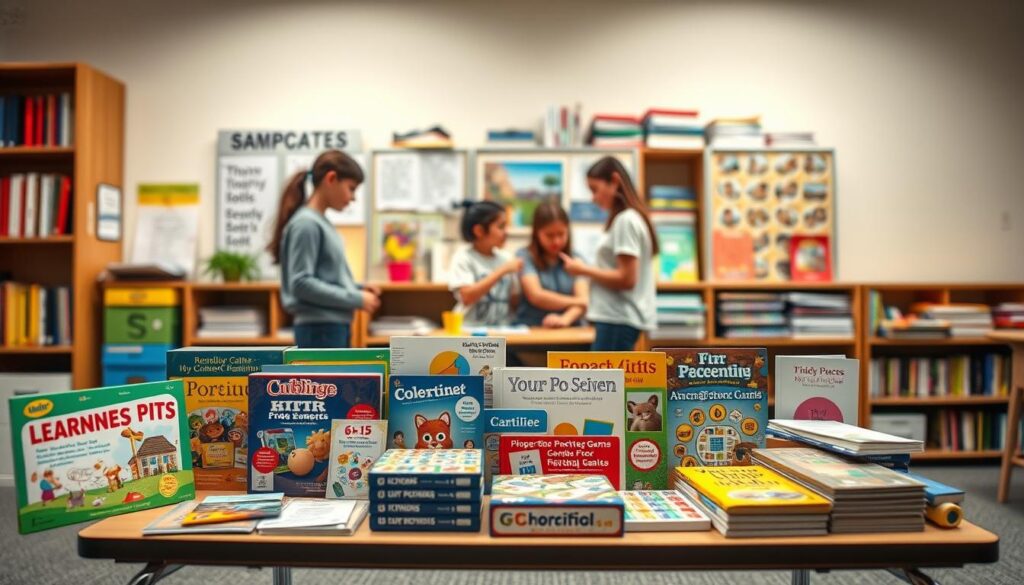
Imagine giving a five-year-old a college thesis or asking a high school senior to paint. It’s all about matching the tool to the task.
The K-5 Landscape: Building Foundations with Fun
In elementary school, keeping students engaged is key. Their attention spans are short, and they need to understand things in a real way. Supplementary materials help bridge play and learning.
Picture a “math museum” with task cards. Students solve problems like exhibits. Or, use Prodigy Math to make math practice a game.
One great strategy is the “background-knowledge probe.” Before learning about plants, ask students to draw what’s inside a seed. It shows what they think and gets them excited for the lessons ahead.
The 6-8 Crucible: Complexity and Choice
Middle school is where things get more interesting. Students want to make choices but need some structure. The best grade appropriate resources offer choices and chances to learn with others.
Try a choice board for a history unit on ancient Egypt. Students can create a timeline, write from a scribe’s view, or analyze hieroglyphics. They choose their path but all lead to learning.
Literature circles are powerful here. With discussion guides and roles, reading becomes a team effort. It’s like a book club with schoolwork.
The 9-12 Arena: Preparing for What’s Next
By high school, supplementary materials should challenge students like college work. They need to analyze, synthesize, and argue.
For a project on climate change, give a framework and let students create the rubric. They decide what makes evidence good and how to weigh solutions. This is the real grade appropriate resource.
Tools like Rewordify are game-changers. They help everyone understand complex texts, like Supreme Court opinions. Now, debates focus on ideas, not just words.
| Grade Band | Core Challenge | Example Supplementary Materials | Key Benefit |
|---|---|---|---|
| K-5 | Sustaining engagement, making abstract concepts concrete | Task card stations, Prodigy Math, background-knowledge probes | Transforms practice into play, builds foundational joy in learning |
| 6-8 | Balancing autonomy with structure, developing collaborative skills | Choice boards/learning menus, literature circle kits, primary source analysis guides | Fosters ownership and social learning; bridges concrete and abstract thinking |
| 9-12 | Preparing for independent, college-level work | Open-ended project frameworks, student-created rubrics, text-compaction tools (Rewordify) | Develops critical analysis and metacognition; ensures access to complex texts |
The key is to meet learners where they are. Materials offer the right amount of help, more in K-5 and less in 12th grade. This ensures learning is challenging but not frustrating.
It’s not just about the tech (though that helps). It’s about the design. A well-made task card for a second grader and a nuanced guide for a junior achieve the same goal. They turn passive learning into active creation.
Interactive and Digital Resources
Digital tools in education are more than just fancy projectors. They are like Swiss Army knives, each tool for a different learning need. But, using tech for its own sake is not effective. The real magic happens when we use these tools with precision.
Imagine a textbook versus a digital platform. A textbook tells one story. But a digital platform offers a choose-your-own-adventure experience. This is the essence of interactive learning.
Take current events, for example. In traditional classes, everyone gets the same article. This can be boring for some and hard for others. But, platforms like Newsela or the Smithsonian’s Tween Tribune change this.
They publish the same article at different reading levels. This way, everyone can join the discussion. It’s not just differentiation; it’s making learning inclusive.
Writing instruction also benefits from digital tools. The SAS Writing Reviser acts as a personal writing coach. It helps students improve their writing in different ways. This is something a single teacher can’t do for 30 essays at once.
Then, there’s the power of curation. Tools like BlendSpace or Google Classroom let teachers create interactive menus. Imagine a lesson on the Civil War with different activities to choose from.
Students pick their path. This makes them active learners, not just passive receivers. It’s like choosing from a gourmet buffet instead of a pre-set meal.
Games are another powerful tool. Not the kind that waste time, but engaging classroom content that looks like play. Platforms like Prodigy Math or iCivics make learning fun. Students practice skills in a game-like setting.
The key is to use digital tools with purpose. Does this tool do something a traditional method can’t? If yes, you’re creating interactive learning experiences.
| Digital Tool | Primary Function | Best For Differentiation In… | Key Benefit |
|---|---|---|---|
| Newsela / Tween Tribune | Multi-level current events articles | Reading Comprehension & Discussion | Same content at 5+ Lexile levels enables inclusive, whole-class dialogue. |
| SAS Writing Reviser | Digital writing coach & analyzer | Writing Skill Development | Provides personalized, immediate feedback on style, grammar, and structure. |
| BlendSpace / Learning Menus | Content curation & choice boards | Student Agency & Pacing | Allows students to choose their learning path, fostering ownership and engagement. |
| Prodigy Math / iCivics | Curriculum-based educational games | Skill Practice & Motivation | Game mechanics (quests, rewards) transform repetitive practice into compelling missions. |
| Flip (formerly Flipgrid) | Video discussion platform | Verbal Expression & Reflection | Gives voice to students who struggle with writing, allowing alternative demonstration of understanding. |
The table above is not a shopping list. It’s a strategic menu. The best classrooms choose the right tool for the job. Sometimes, you need a scalpel. Sometimes, a mallet.
The goal is not to go paperless. It’s to create a thought-full classroom. Digital tools, used wisely, open doors, amplify voices, and make learning dynamic. This is the promise of engaging classroom content in the digital age.
Teacher and Parent Reviews
Before you buy new classroom resources, listen to your students and parents. Online ratings for supplementary materials often focus on looks, not quality. It’s like judging a book by its cover versus reading it.
Research shows that what students say matters a lot. When a student says a graphic organizer helped, that’s valuable feedback. And when they don’t like a worksheet, that’s important too.
Follow Source 2’s advice: ask students specific questions. Ask if a method helped them understand better. This helps you learn what works best for your students.
For parents, the review process is different. Look for resources that are easy to use at home. Can parents use them without being a teacher? The best supplementary materials work well in both school and home.
But the best reviewer is you. Think about whether the resources match your teaching style. Ask if they help you teach better or just add extra work.
This way of reviewing makes you an expert. You learn to tell good resources from bad ones. You develop a sense for what works well in teaching.
| Review Source | What to Look For | Potential Pitfalls | Best Use Case |
|---|---|---|---|
| Student Feedback | Specific comments on usability, engagement, and comprehension | Peer influence skewing responses; “nice teacher” bias | Fine-tuning implementation; identifying friction points |
| Parent Perspectives | Clarity of home instructions; alignment with family routines | Overemphasis on entertainment value; misunderstanding of academic goals | Selecting resources for hybrid or homework scenarios |
| Professional Reviews | Alignment with pedagogical research; scalability across contexts | Academic jargon obscuring practicality; reviewer-sample mismatch | Initial screening and philosophical alignment check |
| Teacher Self-Reflection | Evidence of student growth; personal implementation efficiency | Confirmation bias; over-attribution to single factors | Long-term resource curation and professional development |
The table shows the importance of different types of feedback. Student feedback gives you immediate tactical data. Parent input adds contextual intelligence. But your own reflection helps you make smart choices about resources.
The best reviews come from students, parents, and your own journal. This feedback helps you choose resources wisely.
When you learn to review well, you start to ask better questions. You ask if a resource is good for your students, right now? This is how you use resources effectively, not just for show.
Balancing Fun with Academic Rigor
Have you seen students fully engaged in a game? That’s the perfect mix of fun and learning. It’s not by chance; it’s intentional. The idea that learning must be either fun or hard is a myth.
The “Teach Up” philosophy is key. It’s like educational jazz, starting with high goals and adding support as needed. It’s not about making things easy; it’s about making them interesting.

Math tic-tac-toe seems simple but is actually complex. It requires strategic thinking and problem-solving. The game is just a way to deliver learning in a fun way. Grade appropriate resources make sure the challenge is right for each student.
Every activity must support the main learning goals. A great activity should make students want to learn more. If it doesn’t, it’s just for fun.
Here are signs of a well-balanced activity:
- Cognitive Engagement Over Passive Consumption: Students are problem-solvers, not just spectators.
- Incremental Challenge: Tasks scaffold difficulty, creating that “just-right” level of struggle.
- Intrinsic Motivation: The activity itself becomes the reward, not stickers or points.
- Transferable Skills: What’s learned in the game applies beyond the game.
This approach makes interactive learning powerful. When students are fully engaged, they’re in a flow state. That’s deep learning. Learn more about creating this environment at home with resources on achieving rigor at home.
Instead of asking if something is rigorous enough, ask if it’s engaging. A good grade appropriate resource is both. It challenges students but also keeps them interested.
It’s not about making learning less challenging. It’s about making it more focused. The laughter shows that students are excited to learn. That’s when real learning starts.
Specific Strategies for Homeschoolers
Homeschooling is like being a master chef who can make do with whatever ingredients you have. Your “classroom” has no walls, and your schedule is flexible. This freedom is your superpower. The challenge is to design a learning plan that works for you and your student.
Let’s talk strategy. Forget about using the same lesson plans for everyone. We’re creating learning experiences that are tailored just for you.
First, let’s talk about individual learning contracts. This is a way to make learning personal. You and your student will create a plan together. You’ll decide what to learn, how to learn it, and how to show you’ve mastered it.
This approach makes learning more engaging and meaningful. It turns learning into a project that you and your student can work on together.
Next, let’s talk about compacting. If your child already knows something, you can skip over it. Instead, you can dive into something more challenging. This way, you can make learning more interesting and relevant.
Then, let’s talk about giving choices. Tools like choice boards can help you plan your week. You can choose from different activities, like watching a documentary or building a model. This way, you can learn in a way that interests you.
Learning with others is also important. You can join a homeschool co-op or participate in online forums. This way, you can learn from others and work together on projects.
Setting goals is also key. Instead of vague goals, you can set specific, measurable goals. For example, you might aim to read three documents and write an analysis by Friday. This gives you a clear direction and helps you stay focused.
The main idea is personalization. Homeschooling allows you to tailor learning to your needs. You’re not just following a standard plan; you’re creating a customized education.
This approach makes learning more engaging and relevant. You can explore topics that interest you and make connections between different subjects. For example, watching a documentary on ancient Rome can lead to debates, art projects, and cooking historical recipes.
Your ultimate tool is flexibility. You can use the world around you as your classroom. Your job is to design a learning plan that makes sense of all these possibilities. This is the homeschool advantage: designing an education that is truly yours.
Rotating/Updating Materials
The most dangerous phrase in education is, “This worked great last year,” spoken while clutching a faded printout. Your supplementary materials have a shelf life. That brilliant simulation from 2010 now feels as dated as a flip phone. The curse of relevance is constant, and student engagement is the first casualty.
So, what’s the strategy? It’s twofold: rotate and update. Think of it as managing a portfolio—some assets are long-term holds, others need frequent trading.
First, rotation. This is the simple act of preventing fatigue. Cycle your physical kits, poster sets, and even digital game links. If students see the same interactive learning station every month, it becomes background noise. A scheduled rotation keeps things fresh and signals that your classroom is dynamic.
Second, and more critically, update. This is where you combat obsolescence. It means actively seeking new formats and platforms that resonate with the current moment. Why rely on a textbook case study when you can use a content curator like Newsela? Its library is constantly refreshed with current events, adapted for various reading levels. It turns yesterday’s news into today’s lesson.
For crafting digital journeys, tools like MentorMob (or its modern equivalents) are game-changers. They let you build and—crucially—remix digital playlists. Found a better video? Swap it in. Need a more current article? Drop it in the sequence. Updating your interactive learning modules becomes as easy as editing a playlist on Spotify, not rebuilding a website from scratch.
This isn’t administrative busywork. It’s the core of reflective practice. Your analysis of what works and what flops (informed by those reviews we discussed) directly fuels this cycle. You’ll identify the timeless classics in your supplementary materials collection and gracefully retire the relics.
The difference between a static and a dynamic resource library isn’t subtle. It’s the difference between a museum and a lab.
| Aspect | Static Resource Management | Dynamic Resource Management |
|---|---|---|
| Core Mindset | Archive & Preserve | Curate & Evolve |
| Student Perception | Predictable, Possibly Dated | Fresh, Relevant, Engaging |
| Teacher Workflow | Set-and-Forget; High Effort to Overhaul | Continuous, Low-Effort Tweaks |
| Primary Tools | Filing Cabinets, Static Bookmarks | Content Platforms (Newsela), Playlist Tools (MentorMob) |
| Outcome | Resource Fatigue | Sustained Interactive Learning |
A living, breathing resource library is the hallmark of a dynamic educator. It tells students you’re paying attention—not just to them, but to the world you’re asking them to understand. Your supplementary materials should whisper “current,” not yell “retro.”
Conclusion
We’ve reached the end. Choosing classroom materials is more than just a task. It’s a constant conversation between your plans, your students’ growth, and the many tools out there.
Imagine yourself as a film director, not just a manager. You’re picking a team of characters, from Khan Academy’s lessons to National Geographic’s maps. Your goal is to create a mix of challenge and wonder in your classroom.
It’s important to have a critical eye and a creative touch. You look at resources from PBS LearningMedia to see if they meet standards. You want something that sparks a “lightbulb” moment. The best resources feel essential, not just extra.
Don’t let your classroom become a graveyard of worksheets. Create a living collection of tools. The best resources challenge and support your students, making learning an adventure.
Great teaching resources blend into the learning experience. They become the guide and the journey. Now, it’s time to start your next classroom adventure.
