
The debate surrounding children’s literacy has historically focused on a strict binary choice: the tactile permanence of traditional printed books versus the accessible portability of digital screens. For years, educators and parental figures heavily favored physical pages while viewing digital formats as inherently distracting shortcuts. However, shifting engagement trends have sparked a massive re-evaluation of how young learners interact with written language.
The launch of the global National Year of Reading 2026 campaign has formalized a major evolution in educational strategy. Spearheaded by a coalition including the Department for Education and the National Literacy Trust, this multifaceted initiative introduces the “print-plus” reading methodology. Rather than demanding a complete retreat from modern screen-based interactions, the print-plus movement intentionally blends physical print with high-quality digital audio, structured literacy applications, and interactive contextual tools to meet children where they naturally spend time.
This modern framework emerges at a critical turning point for youth literacy. Fresh data published in the National Literacy Trust Annual Literacy Survey 2026—which analyzed a massive cohort of 125,375 children across 479 schools—revealed a welcome recovery in student habits. Free-time reading enjoyment rose to 36.1% in 2026, marking the first definitive statistical increase since 2021. Daily reading metrics also experienced a concurrent lift, climbing to 20.3% among readers aged 8 to 18.
Despite this positive momentum, overall engagement numbers sit well below historical benchmarks from a decade ago. Literacy advocates point to this gap as clear evidence that traditional book-advocacy campaigns require modern updates. To build long-term, self-sustaining reading habits, families and educators are shifting away from rigid, print-only restrictions toward dynamic, multi-medium literacy ecosystems.
The Cognitive Architecture of the Print-Plus System

The foundational goal of a print-plus framework is to expand a child’s access points to rich vocabulary and deep narrative structures without succumbing to digital fatigue. In the past, interactive reading applications were often criticized for muddying comprehension with flashy animations or gamified distractions that pulled attention away from sentence structures. Modern print-plus tools avoid these pitfalls by prioritizing phonemic awareness and sound-to-letter processing.
Integrating curated text platforms allows reluctant readers to interact with stories across multiple sensory planes simultaneously. For example, a student can track physical text layouts in a chapter book while listening to high-tier audio narrations that model proper pronunciation and narrative cadence. This dual-coded processing minimizes the cognitive load required for decoding raw words, leaving more mental bandwidth available for deep story comprehension and contextual analysis.
| Strategic Literacy Tool | Functional Application | Target Cognitive Benefit |
| Tactile Print Layouts | Independent physical reading sessions | Promotes long-term visual focus and spatial mapping |
| Synchronized Audio Narration | Paired reading with complex texts | Enhances fluid phonetic pronunciation and vocabulary acquisition |
| Interactive Text Platforms | Controlled digital reading modules | Bridges engagement gaps for highly resistant learners |
This multi-tiered approach aligns cleanly with modern adaptations of the Science of Reading movement. According to recent curriculum reviews published by Reading Horizons, effective modern instruction requires integrating explicit decoding skills directly with authentic text immersion. The print-plus model operationalizes this concept at home by transforming screen interactions from passive, disjointed scrolling windows into structured, text-heavy comprehension labs.
Designing a Balanced Home Literacy Ecosystem
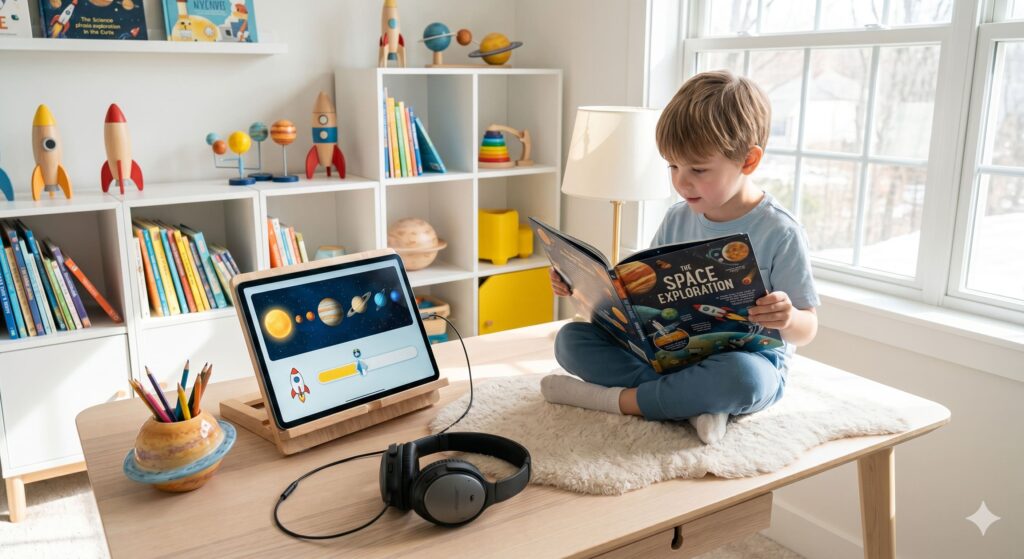
Successfully executing a print-plus framework requires establishing clear boundaries and intentionally matching media to a child’s current development phase. Digital components are most effective when utilized as initial engagement hooks or supportive bridges for complex vocabulary, whereas traditional printed books remain the gold standard for independent, deep cognitive focus.
When mapping out reading goals for younger children aged 5 to 8, the focus must remain squarely on sound-to-letter mapping and tracking print structures. Parents can introduce digital platforms like Pickatale to explore vibrant, illustrated books with active audio tracking. As the application highlights specific words in real time, children naturally master the left-to-right processing necessary for independent fluid reading.
Once a foundational vocabulary is firmly established, parents should transition the primary reading load over to physical library books, utilizing digital text generators or interactive word logs strictly for secondary research and writing extensions. This targeted sequencing ensures that technology remains a controlled tool for skill expansion rather than an automated crutch that replaces active mental effort.
Overcoming Reluctance Through Curated Topic Pathways

The overarching tagline for the 2026 campaign urges participants to “Go All In” on reading by anchoring literacy goals straight into a child’s real-world hobbies and interests. Reluctant readers rarely struggle with the conceptual idea of storytelling; instead, they pull away because the literature assigned to them feels utterly disconnected from their daily lives.
The print-plus framework solves this friction point by radically broadening the definitions of acceptable reading materials. Within this flexible system, tracking a sports analytics column, studying a complex cooking recipe, or analyzing a graphic comic strip carries legitimate academic weight. If a child demonstrates an intense fixation on technology or automotive engineering, a parent can easily source technical journals, biographies of industry pioneers, or digital design blueprints to capture their focus.
Once a student recognizes that printed and digital text serves as the ultimate key to unlocking things they already love, their natural academic avoidance patterns begin to fade. Introducing structured tracking tools, such as an analog family calendar command center, helps parents visually log these reading milestones and track multimedia goals alongside daily school assignments.
Sustaining the Reading Habit Across Formats
The long-term success of the print-plus shift relies entirely on consistency and systemic reinforcement within the home. Literacy cannot be treated as an isolated, transactional school subject that is checked off a list and forgotten; it must be integrated smoothly into a household’s broader lifestyle habits.
Establishing a sacred, distraction-free reading hour where every family member powers down their primary personal devices to engage with text sets a powerful behavioral standard. During these specific windows, the format of the material is secondary to the act of focused engagement. A parent tracking an informational article on a tablet, a teenager studying a print novel, and a younger child utilizing an early-years literacy application all contribute directly to a shared household culture of focused literacy.
As the current educational landscape continues to shift, the families who find the most success will be those who refuse to get caught up in rigid medium battles. By embracing a strategic print-plus workflow, parents can comfortably harness the undeniable convenience of modern tech platforms while firmly preserving the deep focus and cognitive advantages of traditional printed literature.
