
Navigating educational standards can be tough, like trying to put together IKEA furniture without instructions. Everyone says it’s key, but it’s hard to understand and frustrating.
But, when done right, aligning teaching materials with state standards is more than just following rules. It’s the secret sauce for making learning stick. It’s like the difference between a random playlist and a beautiful symphony.
This curriculum alignment is the heart of any good system. In today’s world, it’s vital for fixing learning gaps and making classrooms fair for everyone. It goes from a checklist to the base of real student success.
So, why is this important for your K-12 planning? We’re cutting through the confusion to show how clear teaching plans help teachers and students. We’ll look at the big picture and share practical ways to make your teaching materials work together with the main curriculum.
The Importance of Standards Alignment
Standards alignment is key in education, like a director making sure everyone knows their part. Without it, lessons might not match, leading to educational chaos. It’s like trying to perform a play with everyone doing different scenes.
Imagine using a GPS instead of a map. The GPS gets you where you need to go efficiently. Standards alignment works like a GPS, guiding students from where they start to where they need to end up.
For teachers, standards alignment brings clarity. They no longer guess what to teach. They know exactly what skills to focus on each day. This helps students face tomorrow’s challenges.
Students learn in a logical order, not in random chunks. Learning fractions and then seeing them in chemistry equations makes sense. This builds a bridge between different topics, creating a coherent learning path.
The benefits are huge when everyone follows the same plan. It makes education transparent for parents and helps administrators plan better. Most importantly, it ensures all students get the same chances to learn, no matter where they live.
This is more than just following rules. It’s about creating a clear learning path. Research shows that when reforms are connected, they work better. This means better learning for everyone.
Imagine having great materials for teaching reading but not using them well. This is what happens when different parts of education don’t work together. It’s like having a great car but not knowing how to drive it.
Alignment makes everything work together. It turns a bunch of lessons into a meaningful journey. It helps close gaps in learning and makes sure time is used wisely for student success.
Without alignment, it’s like every teacher is playing a different song. This leads to chaos, not harmony. Standards alignment gives everyone a shared goal, creating a beautiful symphony of learning.
What Are State Standards?
If education were a road trip, state standards would be the agreed-upon destinations, not the specific scenic routes each teacher takes. They’re the cognitive coordinates we’ve collectively mapped out. Think of them as the “what” in education’s eternal “what, how, and why” equation.
Let me explain. Your local teacher’s brilliant lesson on photosynthesis? That’s the “how.” The deep, philosophical discussion about why we study biology? That’s the “why.” But the fact that a tenth grader should understand cellular respiration? That’s the “what”—the standard.
These documents represent our national syllabus, minus the boring three-ring binder. They’re a consensus on essential knowledge. We’ve basically democratically decided, “Yes, an eighth grader should be able to analyze thematic development in a novel.” Or, “Absolutely, a fifth grader needs to grasp fractions as division.”
The most famous iteration is, of course, the Common Core. Call it educational Esperanto—an attempt to create a uniform language across 50 different educational dialects. Love it or hate it, it aimed for portability. A student moving from California to Maine wouldn’t face academic whiplash.
This brings us to the fascinating tension: local control versus national frameworks. It’s the educational version of states’ rights. Your state might use Common Core, or it might have its own homegrown state standards with a folksy name. The political theater around this is worthy of its own HBO series.
But strip away the rhetoric, and the core objective remains constant. These standards set high, clear academic expectations. They’re the benchmarks. Without them, curriculum alignment would be like assembling IKEA furniture without the picture—possible, but frustrating and likely wobbly.
The real magic happens in what they enable: equity and consistency. A student in a under-resourced rural school deserves the same academic targets as one in a wealthy suburb. State standards provide that level playing field. They’re the great educational equalizer, in theory if not always in practice.
Consistency is the other superpower. They ensure a fourth-grade teacher in September and a fourth-grade teacher in May are aiming at the same finish line. This creates coherence across classrooms, schools, and even states. It turns education from a series of disconnected episodes into a coherent narrative.
So what are they really? They’re our collective answer to a fundamental question. What should an educated American know and be able to do? The standards document that answer, grade by grade, subject by subject. They’re less about stifling creativity and more about ensuring no child gets a lesser education because of their zip code.
Understanding this is step one in mastering curriculum alignment. You can’t map resources to a destination you haven’t identified. The standards are the destination. Everything else—the textbooks, the apps, the field trips—is the vehicle. Now that we know where we’re going, let’s talk about what we’re driving.
The Role Of Supplementary Materials
Think of your textbook as the script, but supplementary materials add the special effects, costume design, and soundtrack. They make the learning experience come alive. It’s not just about adding decorations. It’s about creating a complete learning experience.
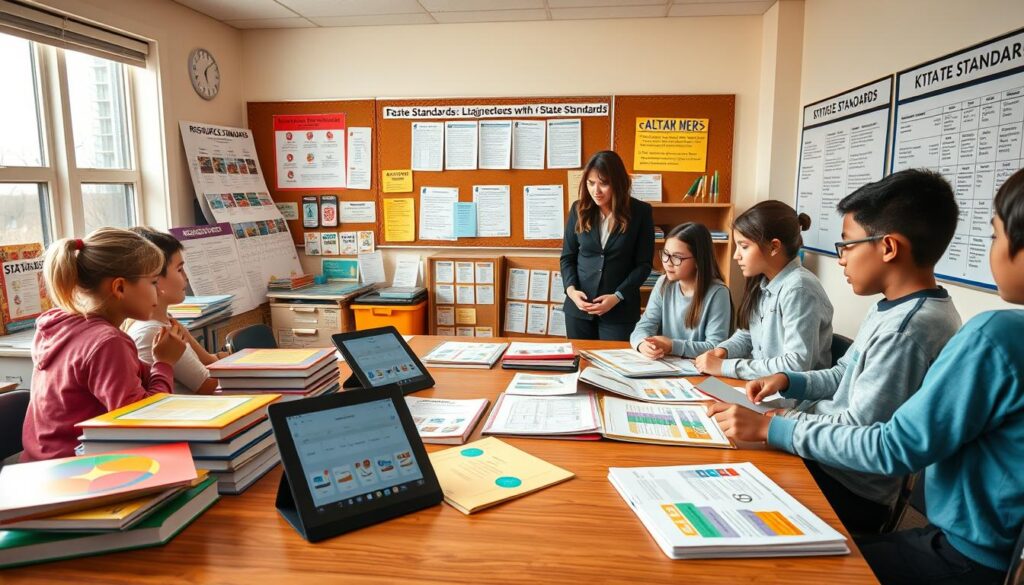
We’re talking about digital simulations that let students explore without harm. Like primary source letters that make history feel real. Or hands-on kits that make abstract physics real. These are your instructional materials beyond the basics.
Their main job is strategic amplification. A standard might say, “Understand the water cycle.” Your textbook has a diagram. But a supplementary interactive simulation lets students play with variables to see effects. They’re not just memorizing; they’re experimenting.
This is where K-12 planning gets practical. That simulation wasn’t chosen for looks. It was picked because it meets the learning objectives. It helps different learners and challenges advanced ones.
The internet is full of “fun educational activities.” But picking something just because it looks fun isn’t good. Good instructional materials selection is about finding resources that:
- Reinforce core concepts in different ways.
- Enrich understanding with depth and real-world context.
- Differentiate instruction for diverse learners in one classroom.
- Engage by making abstract ideas real and interactive.
When used well, these materials make education dynamic. They turn a one-way curriculum into a responsive ecosystem. The textbook gives you the “what.” The right supplementary materials show you the “why,” the “how,” and the “what if.”
Ignoring these materials is like serving a great steak on a paper plate. You’ve met the technical requirements, but missed the whole point. The standards are your recipe. Your supplementary resources are your presentation, seasoning, and ambiance. Master both, and you’re not just feeding information; you’re creating a memorable experience.
Steps for Aligning Resources
Aligning teaching resources to standards is not just about checking boxes. It’s like solving a mystery in the classroom. You’ve got the theory, now let’s get to the practical steps. This is about turning vague education compliance into a clear plan for teaching.
So, how do you do this without feeling overwhelmed? Follow this simple guide.
First, forget about searching for keywords. Your job is to deeply analyze the standards documents. Don’t just read them; really understand them. What does the real cognitive demand ask of students? Are they recalling facts, analyzing patterns, or creating original arguments?
Look for how learning builds over time. How does understanding in third grade lead to mastery in fifth? This step is about understanding the big picture, not just memorizing details. It’s like the difference between following a recipe and understanding the science behind baking.
Step 2: The Resource Audit (The Reality Check)
With your “essential standards” in mind, examine your current resources. This is the moment of truth. Do your lessons, worksheets, and activities really meet the target? Be honest.
Create a simple audit table. This isn’t just busywork; it’s gathering important information.
| Resource | Target Standard | Alignment Score (1-5) | Gap Analysis |
|---|---|---|---|
| Unit on Ecosystems | Analyze interdependent relationships | 4 | Strong on concepts, weak on data analysis component |
| Math Chapter 7 | Solve real-world volume problems | 2 | Only covers formula, lacks authentic application tasks |
| Historical Fiction Project | Evaluate multiple perspectives | 5 | Excellent depth, includes primary source analysis |
This audit shows where you’re doing well and where you need to improve. It’s the start of making your curriculum better.
Step 3: Design and Adaptation (The Creative Fix)
Now, it’s time to create or adjust. For gaps, make new lessons. For partial hits, adapt what you have. This is where teaching becomes an art. Maybe that math chapter needs a real-world challenge. Or perhaps the science unit needs a data set for students to interpret.
The goal is coherence. Every activity should serve the standard’s goal. No unnecessary activities that distract from learning.
Step 4: Assessment Alignment (Closing the Loop)
Don’t make the mistake of testing for analysis after only teaching identification. Your assessments must match the cognitive rigor of your instruction. If the standard demands synthesis, your test shouldn’t be multiple-choice recall.
Align your rubrics, projects, and quizzes from the start. This step makes your education compliance meaningful and measurable.
Step 5: Sequencing and Integration (The Grand Orchestration)
Lastly, arrange everything in a logical order. Think in two ways: vertical alignment across grade levels and horizontal alignment across subjects. Does the English research paper support the history deep dive? Does the 6th-grade math foundation prepare students for 7th-grade algebra?
This creates a smooth learning journey, not a series of disconnected lessons. It’s what turns a collection of lessons into a real curriculum.
This five-step process is key to effective curriculum alignment. Yes, it’s detailed work. It requires detective, artistic, and engineering thinking. But this effort is what makes compliance meaningful and improves student learning. The blueprint is now in your hands.
Evaluating and Selecting Materials
Alignment is more than just checking boxes. It’s a deep quality check. You’ve matched resources to your state standards. Now, you need to ask tough questions.
Does the resource teach what the standard requires, or just pretend to? This is key.
This step is what makes a good curriculum stand out. It’s where your teaching skills really matter.
Assessing for Depth and Rigor
It’s easy to get tricked. A resource might mention “the causes of the Civil War.” But does it really teach analysis, or just listing?
This is about Depth of Knowledge (DOK). DOK is about the thinking required, not just how hard it is.
A standard for analysis (DOK Level 3) is not met by simple recall (DOK Level 1). Your task is to match the material’s cognitive demand with the standard’s rigor.
| DOK Level | Cognitive Demand | Example for “Analyze causes of the Civil War” |
|---|---|---|
| Level 1: Recall & Reproduction | Remember facts, terms, simple procedures. | “List three causes of the Civil War from the textbook.” |
| Level 2: Skill/Concept | Use information, classify, organize, estimate. | “Organize these events into a timeline showing the path to war.” |
| Level 3: Strategic Thinking | Reason, plan, develop arguments, analyze complexity. | “Compare and contrast the economic and social arguments for secession. Which was more significant?” |
| Level 4: Extended Thinking | Investigate, synthesize, design, apply over time. | “Design a museum exhibit that argues for a primary cause of the Civil War, using primary sources to support your thesis.” |
That cool digital tool might not be as deep as it seems. True alignment needs careful checking.
Checking for Pedagogical Soundness
Imagine a resource that’s perfect for a standard on statistical probability. It’s rigorous and matches the content. But it’s a huge PDF in hard language for sixth graders. Is it good? No way.
This is about pedagogical soundness. It’s about if the resource will work with real kids. You need to check if it’s engaging, right for the students’ age, and uses proven teaching methods.
An AI can spot keyword matches. But it can’t tell if a resource is fun, relevant, or challenging for students. That’s up to the teacher’s eye.
Ask if the material is easy to get into, offers different ways to start, and is free from bias. Does it look like something students would want to do? The best resource is useless if students don’t use it.
Choosing materials is where you make sure your curriculum is not only aligned but also teachable. It’s the last check before your students see it.
Mapping Resources to Standards
Mapping is the key process of linking Resource A to Standard B. It’s where your K-12 planning comes to life. It’s not just about getting ideas. It’s about creating a clear path from September to June.

So, how do you create this map without losing your mind? The answer is by combining technology and human insight.
Using Technology and Tools
Manually checking every worksheet against a long standards document is exhausting. Technology helps a lot here. Modern curriculum alignment tools and AI are like super-fast interns.
They quickly scan content, tag standards, and find gaps. They help you see where you need more activities for “fractions” or “data interpretation.” This saves a lot of time, giving you a starting point.
But, AI can’t understand everything. It might match “evaporation” to a water cycle standard but miss the need to explain its weather impact. It also can’t tell if a simulation will really grab students’ attention.
The key is to work together. The table below shows how to do this in the mapping phase of K-12 planning.
| Mapping Task | AI Tool Strength | Human Reviewer Necessity |
|---|---|---|
| Initial Standards Tagging | High-speed scanning of text to suggest possible matches. | Verifying relevance and ensuring the connection meets the standard’s intent. |
| Identifying Coverage Gaps | Data analysis showing where standards lack resources. | Understanding the gap and planning to fill it. |
| Recommending Supplementary Materials | Suggesting resources based on keywords and metadata. | Evaluating if the resources are good for teaching and engaging. |
| Creating a Draft Curriculum Map | Generating a visual or document linking resources to standards. | Ensuring the map is logical and developmentally appropriate. |
The Human-in-the-Loop Review
This is the final, essential step. You become the editor, not just the creator. You add the magic that AI lacks.
You check if the sequence makes sense and if the resources are right for your students. You ensure the map is meaningful and unbiased. You are the storyteller.
This review makes sure your curriculum alignment is more than just technical. It ensures the connections are meaningful and spark learning. You are the final author of the map.
Common Mistakes to Avoid
Aligning instructional materials is not as simple as it seems. We face many challenges that can make this task difficult. These challenges can turn what should be a strategic process into a frustrating task.
The first mistake is called the Keyword Mirage. It happens when we think we’ve aligned materials just because they use certain words. For example, if a standard mentions “analyze character motivation” and we find the word “character” in a worksheet, we might think we’re done. But we’re not.
The real test is whether the material actually asks students to analyze or just to identify. Just looking for keywords is like matching wine by label color. It might work sometimes, but often it misses the point.
Another mistake is The Silo Effect. It’s when we treat alignment as a one-subject, one-grade task. This approach ignores the way skills build up over time and the connections between subjects.
A math standard on ratios should talk to a science standard on chemical equations. True education compliance listens to these conversations. It builds a cohesive curriculum, not just a list of isolated achievements.
Then there’s Set-and-Forget Syndrome. Standards change, student needs shift, and new research comes out. Materials that were perfect in 2018 might now be outdated. Keeping materials aligned is an ongoing task.
It’s like keeping your instructional materials in good shape. Ignore it, and you’ll soon find yourself stuck.
The last mistake is The Engagement Paradox. You might have to choose between a boring but perfectly aligned worksheet and a more engaging simulation that’s slightly off. The checklist says go for the worksheet.
But your teaching instinct might tell you to choose the simulation. Sometimes, the learning and fun from the simulation are worth a little alignment stretch. Don’t let perfection stop you from teaching well.
These mistakes come from seeing alignment as a static task instead of a dynamic process. The table below shows these pitfalls and how to fix them, turning obstacles into opportunities.
| Mistake | What Goes Wrong | The Fix |
|---|---|---|
| The Keyword Mirage | Matching vocabulary without verifying the level of cognitive demand required by the task. | Analyze the verb in the standard. Create or select materials that match that specific cognitive action (analyze, evaluate, create) instead of just topical keywords. |
| The Silo Effect | Aligning resources in isolation, ignoring how skills build vertically across grades or connect horizontally between subjects. | Map standards in progression. Collaborate across grade levels and departments to ensure instructional materials support a coherent, cumulative learning journey. |
| Set-and-Forget Syndrome | Failing to review and update aligned materials as standards, student demographics, or pedagogical best practices evolve. | Schedule annual or bi-annual alignment audits. Treat your resource library as a living document that requires periodic review and refresh. |
| The Engagement Paradox | Prioritizing perfect alignment on paper over student engagement and deeper learning opportunities in practice. | Use alignment as a guide, not a straitjacket. When a highly engaging resource is slightly off-perfect, weigh the pedagogical gain against the alignment gap. Often, the engagement wins. |
Avoiding these traps means changing how we think about education compliance. It’s not about finding resources that fit a mold. It’s about creating materials that bring standards to life. It’s the difference between a museum guard and a gardener.
The goal is to have a curriculum that is consistent but also flexible and teaching-focused.
Strategies for Homeschool Environments
Homeschooling is more than just an alternative to school. It’s a chance to design your own curriculum. You get to be the teacher, principal, and the one who decides if it’s good enough. While schools debate standards, you make them work in your living room.
Start by seeing state standards as a guide, not a limit. In schools, these documents often gather dust. But in your home, they help you avoid gaps in learning. They’re like the guardrails on a road, guiding you but also allowing for detours.
Your K-12 planning is like a dream for school administrators. You see the whole journey from kindergarten to high school. This lets you build skills step by step, like a novelist planning a series.
Using extra materials is your superpower. A documentary on ancient Rome can teach social studies. A community garden project teaches biology, environmental science, and math. The key is paying attention to how it all fits together.
Mapping out resources doesn’t need fancy software. A simple spreadsheet or notebook works great. It helps you see how everything connects, making learning clear and focused.
Assessments in your home are different from tests. You might see presentations, projects, debates, and portfolios instead. Your assessments could be like a Renaissance fair, where your child shows off their learning through fun activities.
Collaboration in homeschooling is unique too. Your “team” could be a co-op, online community, or even your student. This feedback loop is what teachers often wish they had but rarely get.
| Aspect | Traditional School Approach | Homeschool Advantage |
|---|---|---|
| Scope & Sequence | District-mandated, fixed timeline | Standards as flexible blueprint, personalized pacing |
| Resource Selection | Approved textbook lists, limited supplements | Curated from infinite sources, deeply integrated |
| Assessment Design | Standardized tests, quarterly exams | Authentic demonstrations, project-based evaluation |
| Collaboration | Department meetings, professional learning communities | Co-ops, online networks, student partnership |
| Implementation Speed | Slow, bureaucratic approval processes | Immediate adaptation, real-time refinement |
The irony is beautiful. While others talk about “student-centered learning,” you’re living it every day. Your K-12 planning is rigorous but flexible. You can change plans anytime and explore deeply when you’re passionate about a subject.
Remember, you’re not just copying school at home. You’re creating a unique learning environment. It’s a place where standards provide structure but don’t limit curiosity. Your homeschool is a place where learning meets real-world application, and you get to see it all happen.
Conclusion: Maintaining Curriculum Consistency
Think of curriculum alignment like tending a garden, not building a monument. It’s a living process that needs regular care. True consistency with state standards requires more than just an annual check-up. It needs a culture of ongoing review.
Use student data from platforms like Khan Academy as your guide. Listen to teacher feedback as your most valuable insight. Updates to Common Core or Next Generation Science Standards are not just changes. They are necessary adjustments.
Leadership is not about forcing compliance. It’s about promoting unity. The future combines AI’s analytical power with a teacher’s unique skill. This partnership creates a learning environment where everything works together.
This alignment is the key to long-term academic success. It’s the wise person’s main task. Apply careful analysis and smart strategies. Keep your eyes on the ultimate goal. We’re not just covering material. We’re uncovering understanding. That’s how every lesson becomes important.
