
AI literacy courses became a clear priority for New York City high schools after the city announced on September 2, 2026, that high school students would receive required instruction twice per year while younger students faced tighter limits on student-facing generative AI. For homeschool families, the news is more than a public-school policy update. It is a useful signal that families need to teach children how artificial intelligence works, where it can mislead, and how it may affect study habits, civic life, work, and writing.
New York City’s decision separated older students from younger ones in a deliberate way. Students in grades K-8 were placed under a temporary ban on generative AI tools, while high school students were set to receive required AI instruction intended to help them think critically before relying on the technology, according to the Associated Press report. That distinction matters for parents because it recognizes both developmental caution and the reality that teenagers are closer to college, trades, internships, and early employment.
As a homeschool advocate, I see this as an invitation rather than a command. Families do not have to copy a district policy word for word. They can study the public model, keep what is useful, and build a calmer home-based plan that joins technology literacy with history, civics, economics, writing, and ethics.
What NYC AI Literacy Courses Require
AI Literacy Courses And The Twice-Yearly Format
The city’s high school plan used short, repeated instruction rather than a one-time assembly. The mayor’s office described required high school modules as two 45-minute sessions per year covering what AI is and is not, bias, risks, ethical issues, and effects on careers and future skills. Students in pilot programs and career-training settings were expected to receive longer instruction, according to the city’s September 2026 announcement.
That format gives parents a practical benchmark. AI literacy courses do not need to begin with coding, advanced mathematics, or a large purchase. A family can start with two focused lessons in the fall and two more in the spring, then connect those lessons to regular reading and writing assignments. The key is not to make artificial intelligence seem magical or forbidden. The better aim is to help students ask careful questions before accepting an answer, image, chart, or summary.
What High School Students Need To Examine
The topics named by New York City are especially useful for homeschool planning because they cross subject lines. “What AI is and is not” belongs partly to computer science, but it also belongs to logic and media literacy. Bias belongs to social studies because students can examine how data, institutions, language, and historical inequality shape public decisions. Risks and ethics belong to family discussion because students need adult guidance on privacy, authorship, accuracy, and responsibility.
Career impact should not be treated as a scare tactic. Teenagers can study how tools change work without assuming that every job will disappear or that every new product is trustworthy. A balanced lesson might ask students to compare a human-written explanation with an AI-generated response, identify unsupported claims, check sources, and revise the final answer in their own words.
How The High School Pilots Were Structured
Teacher Supervision And Tool Choice
New York City also described limited high school pilot programs for up to about 50,000 students, roughly 5 percent of the public-school high-school population. The pilots were tied to five vetted tools under direct teacher supervision: Intel AI-Ready Schools for semester-long projects, Quill for text analysis, Edia in math, Brisk Teaching for guided teacher-selected content, and Playlab for cross-subject assignments.
For homeschool families, the names of specific tools are less important than the structure: supervised use, defined academic purpose, and adult review. A teenager should know why a tool is being used before opening it. Is the task to compare arguments, practice math, generate a study question, review grammar, or test the limits of a summary? If the purpose is vague, the learning often becomes vague too.
This is where parents can set a high standard without panic. A home lesson can require students to keep a simple AI-use log: the question asked, the tool response, what the student checked, what changed after verification, and what sources supported the final answer. That habit supports honesty and reduces the temptation to treat machine output as finished schoolwork.
Why Homeschool Families Should Pay Attention
A Parent-Led Social Studies Connection
AI literacy courses fit naturally inside a parent-led social studies program because artificial intelligence is not only a technical subject. It raises questions about citizenship, work, fairness, speech, evidence, and public trust. A high school government unit can ask who should set rules for AI use in schools. An economics unit can ask how automation changes training and hiring. A history unit can compare AI with past communication technologies and examine how society adjusted to printing, radio, television, and the internet.
Families following public-school policy changes may also find it helpful to read a related discussion of the NYC AI ban and K-8 curriculum, especially if they teach children at several grade levels. Older siblings may be ready for supervised analysis while younger children may benefit from screen limits, hands-on reading, oral discussion, and direct instruction from a parent.
Writing deserves special attention. Teenagers need practice forming claims, using evidence, quoting accurately, and revising for clarity. AI can weaken those habits if students outsource the hard parts too soon. It can also become a useful object of study when parents ask students to critique a generated paragraph, verify a citation, or explain why a source is credible. Families seeking broader writing-support resources can explore options at Top Ten Writing Services, ensuring they maintain authorship and academic integrity as core principles of student work.
Practical Home Lessons Parents Can Use
A Simple Four-Part Plan
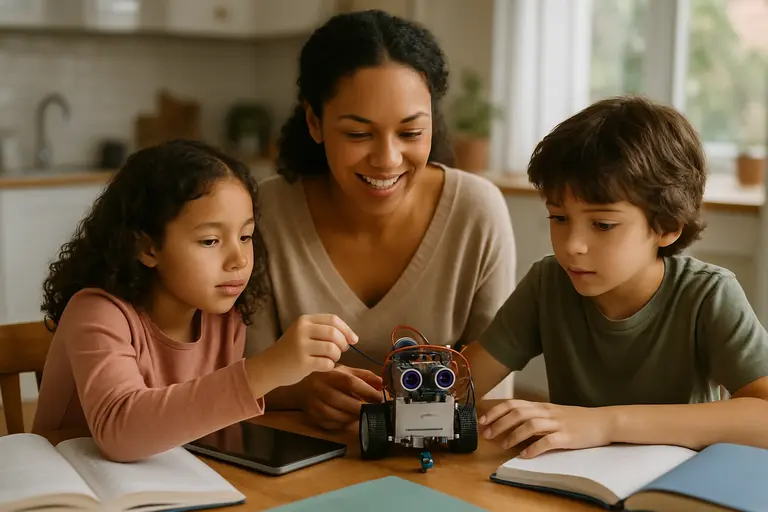
A homeschool plan does not need to imitate a large district. It can be smaller, steadier, and closely tied to family values. The following structure keeps the work concrete while matching the public emphasis on critical thinking, ethics, and future skills.
- Define the tool: Ask the student to explain, in plain language, what an AI system can produce and what it cannot truly know.
- Test for accuracy: Give the student a generated answer and require source checking before any claim is accepted.
- Discuss bias and fairness: Use a social studies topic to ask whose perspective is missing and what data may have shaped the response.
- Connect to work and citizenship: Ask how the same tool might help, harm, or confuse people in a workplace, classroom, newsroom, or public office.
This type of lesson can be completed in one hour, but it can also grow into a semester project. A student might investigate AI in medicine, agriculture, journalism, transportation, libraries, law, or local government. The parent’s role is to require evidence, slow down easy answers, and keep the student responsible for the final reasoning.
Keeping Reading And Discussion At The Center
The best home technology lessons still depend on reading. Students should compare AI output with books, primary sources, public reports, teacher notes, and carefully chosen articles. They should practice saying, “I do not know yet,” and then finding better evidence. That habit is part of literacy, not just technology use.
Parents can also ask students to present findings aloud. Oral explanation reveals whether a teenager understands the issue or merely copied fluent-sounding language. A short family presentation on bias, privacy, or career change can become a stronger assessment than a worksheet because the student must answer questions in real time.
AI Literacy Courses For Future-Ready Learning
New York City’s high school approach gives homeschool parents a timely model: teach older students to use judgment before tools, evidence before confidence, and ethics before convenience. AI literacy courses should not be treated as a passing trend or as a reason to hand education over to software. They should be treated as part of a broader literacy program that includes reading, writing, civic reasoning, family conversation, and practical skill-building.
For parents, the goal is clear. Help teenagers understand what artificial intelligence can do, where it can fail, and why human responsibility still matters. A student who can question a source, identify bias, protect privacy, revise original writing, and explain career implications is better prepared for the challenges ahead. That preparation starts well at home, especially when parents connect technology lessons to the larger human story.
