
The NYC AI Ban changed the immediate planning picture for curriculum teams serving New York City students in grades 2-K through 8. On September 2, 2026, Mayor Zohran Kwame Mamdani and Schools Chancellor Kamar H. Samuels announced a one-year moratorium on student-facing generative AI for the 2026-2027 school year, affecting nearly 600,000 public school students in those grades, according to the city announcement. For educators, the decision is not only about which apps can be opened. It affects lesson design, screen time expectations, literacy supports, teacher planning tools, and how schools introduce AI concepts without handing young students generative tools too early.
The policy is especially relevant for curriculum resource developers because it separates teacher use from student-facing use. Teachers and staff may still use approved AI supports for planning and operations, subject to privacy and procurement rules. Students in 2-K through 8th grade, however, may not use software that places generative AI directly in front of them. That distinction means curriculum materials need to be reviewed in two ways: first for what adults see and use, and second for what students are asked to do on screen.
Why The Policy Matters For Curriculum Resources
Curriculum resources are not neutral containers. They shape the tasks students see, the feedback they receive, the language practice they get, and the amount of time they spend on devices. A student-facing generative AI feature can change a reading lesson from teacher-guided practice into an adaptive exchange with a chatbot or automated writing assistant. Under the city’s moratorium, those features need to be removed, disabled, or replaced for K-8 students if they fall within the policy scope.
For literacy instruction, the effect may be felt most in supplemental tools. Many reading platforms now include automated suggestions, AI-generated prompts, conversational practice, or feedback features. Even when those tools are intended to help, curriculum leaders need to ask whether the student is receiving generative output directly. If the answer is yes, the resource may no longer fit the K-8 rules during the 2026-2027 school year.
This does not mean schools must return to paper-only instruction. It does mean they need clearer resource maps. A district-approved digital text library, a phonics practice tool, and a teacher planning assistant may each have different compliance issues. The practical step is to identify where generative AI appears, who uses it, what data it touches, and whether a non-generative setting is available.
How The NYC AI Ban Changes K-8 Resources
What The NYC AI Ban Covers
The city policy focuses on student-facing generative AI in grades 2-K through 8. That includes chatbots and similar tools that produce new text, images, explanations, or responses for students. The policy also allows limited high school pilots, which means curriculum teams cannot use one citywide rule for every grade. K-8 materials need one review process, while grades 9-12 need another.
The NYC AI Ban therefore pushes schools to make grade-band decisions with more care. A writing support that may be acceptable in an approved high school pilot may not be acceptable for a middle school class. A teacher-facing lesson-planning tool may remain available, while the companion student chatbot is not. Curriculum documentation should state those differences plainly so teachers do not have to interpret the rule one assignment at a time.
Screen Time Limits And Resource Selection
The AI decision also sits beside new screen time limits for grades 2-K through 8. NYC Public Schools guidance states that, during the 2026-2027 school year, grades 2-K through 2 have no 1:1 screen time, grades 3-5 have no more than 30 minutes per day, and grades 6-8 have no more than 45 minutes per day; the same guidance describes high school AI literacy modules, approved pilots, and tool vetting expectations through ERMA, the city’s Enterprise Request Management Application for educational technology review NYCPS guidance.
Those limits matter for curriculum design. If a fourth-grade class has only 30 minutes of 1:1 screen time in a day, digital resources must earn their place. A reading block may need to prioritize a short assessment, a fluency recording, or access to a digital text, but not all three on the same day. Curriculum maps should show where screen use is necessary and where a print, oral language, small-group, or teacher-led option would better serve the lesson.
For younger students, the no 1:1 screen time rule requires a stronger supply of offline materials. That includes decodable texts, picture cards, read-aloud plans, vocabulary routines, writing journals, manipulatives, and teacher observation tools. The shift is not simply a technology restriction. It asks schools to rebuild the daily balance between direct instruction, conversation, independent reading, handwriting, and teacher feedback.
Teacher Planning And Student Access
Planning Without Student-Facing Generative AI
Teachers still need planning support. The policy allows staff use of AI for instructional planning and operations when privacy and procurement rules are followed. That creates a workable path: teachers can use approved tools to draft lesson ideas, generate examples for review, or organize materials, while students receive teacher-selected tasks rather than direct AI interaction.
In practice, this means professional learning should focus on review habits. A teacher using AI to draft a vocabulary routine still needs to check word choice, grade fit, cultural context, and alignment to the curriculum. A lesson plan generated by a tool should not become the lesson until the teacher has revised it. Districts and schools can support this by offering checklists that ask: Does the task match the standard? Is the reading demand appropriate? Is the language clear for multilingual learners? Does the activity require a prohibited student-facing tool?
For teams comparing policy approaches in other states, Leap Year Publishing’s discussion of AI literacy in U.S. schools may help frame responsible use around clear goals, teacher support, and safeguards. The New York City approach is more restrictive for younger students, but it still leaves room for adults to learn how to evaluate AI-supported materials.
Equity Questions For Curriculum Teams
Equity concerns deserve direct attention. A school-based restriction affects students differently depending on what they can access outside school. Some children may encounter generative AI at home, in tutoring, or through family devices. Others may depend almost entirely on school for technology exposure. Curriculum leaders cannot resolve that difference with one software decision, but they can design instruction that builds underlying skills all students need: reading stamina, questioning, source evaluation, clear writing, oral explanation, and ethical judgment.
One fair response is to teach age-appropriate AI concepts without requiring student use of generative tools. Upper elementary and middle school students can discuss how automated systems may produce errors, reflect bias, or use data without fully understanding meaning. They can compare human-written explanations with teacher-provided machine-like examples. They can practice asking better research questions and verifying claims through approved sources. These lessons support future AI literacy while respecting the K-8 moratorium.
Community groups can also help families understand the difference between banning a student-facing tool and ignoring technology. Schools, libraries, after-school programs, and youth organizations can host plain-language conversations about privacy, screen time, reading habits, and homework expectations. Families interested in related community education work should explore the Stuyvesant Youth Council for youth-focused civic and learning topics.
High School Pilots And AI Literacy
What High Schools Can Test
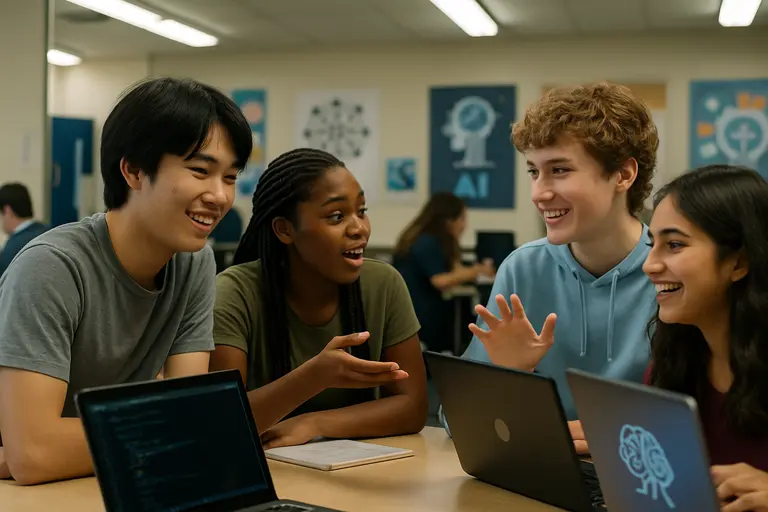
The high school provisions give curriculum teams useful contrast. All high school students are required to complete two 45-minute AI literacy modules each year. Students in approved pilot programs or career and technical education pathways may receive a longer 12- to 15-hour course covering topics such as AI, bias, ethics, and data privacy. The city has also identified pilot tools for high school classrooms, including Quill, Edia, Brisk Teaching, Playlab, and Intel AI-Ready Schools, with limits on use.
This structure signals that the city is not rejecting AI instruction outright. It is delaying broad student-facing use for younger students while testing more controlled models with older students. For curriculum designers, that creates a vertical planning challenge. K-8 resources should build foundational skills and digital judgment without direct generative AI use. High school resources can introduce more explicit AI practice where the school is approved to participate and where the activity fits the city’s rules.
The pilots also show why evidence matters. If a tool is used only briefly or within a limited number of assignments, schools should not overstate what it can accomplish. A pilot can help educators observe student behavior, teacher workload, privacy issues, and assignment quality. It cannot, by itself, prove that a tool improves learning across all classrooms. Resource decisions should be based on documented use, teacher feedback, student work samples, and compliance review.
Curriculum Planning Under The NYC AI Ban
The most useful response to the NYC AI Ban is a practical curriculum audit. Schools should list every digital resource used in K-8 classrooms, identify whether it contains student-facing generative AI, confirm whether that feature can be turned off, and provide teachers with approved alternatives. The audit should include literacy tools, math supports, writing platforms, tutoring programs, classroom management systems, and any supplemental apps used by grade teams.
Curriculum leaders should then revise lesson plans where a removed feature leaves a gap. If an AI tool previously offered writing feedback, the replacement might be peer review, teacher conferencing, sentence frames, or a rubric-based mini-lesson. If a reading platform used AI-generated conversation, the replacement might be partner talk, teacher-led questioning, or response journals. If a tool helped with practice pacing, the replacement might be a small-group rotation chart and a short formative check.
Documentation will matter. Teachers need simple guidance that says which tools are approved, which features are disabled, which grades may use a resource, and what to do if a platform update adds a new AI feature. Families need clear explanations that avoid technical language and focus on student privacy, learning goals, and screen time. Students need consistent routines so the shift does not feel like a loss of support.
The NYC AI Ban should also remind educators not to treat technology policy as separate from literacy instruction. Strong reading and writing resources still depend on skilled teachers, well-sequenced lessons, meaningful practice, and accessible materials. AI policy can set guardrails, but curriculum quality comes from the daily choices schools make about text, talk, feedback, and time. For the 2026-2027 school year, the task is to keep K-8 instruction steady while the city studies what responsible AI use should look like for older students and future school years.
