
Five federal education grants will expand reading tutoring, create new pathways into teaching, strengthen school leadership, improve student assessments, and connect classroom learning with career opportunities across New Mexico.
New Mexico has secured more than $44.2 million in federal education funding to address some of its most persistent public-school challenges, including reading difficulties, teacher shortages, and unequal access to educational opportunities in rural and tribal communities.
On October 20, 2026, the New Mexico Public Education Department (PED) announced five competitive federal grants supporting initiatives that will operate over three to five years.
The investments cover high-impact literacy tutoring, teacher recruitment and retention, school leadership, student assessment systems, and career exploration for middle and high school students.
The largest individual grant, approximately $12.45 million, will support a teacher leadership and retention initiative. Another $9.99 million will fund Project LEARN, a program designed to expand evidence-based reading tutoring, particularly in rural schools.
New Mexico Public Education Secretary Mariana D. Padilla described the awards as an opportunity to strengthen instructional support, improve the information available to educators, and create additional pathways into the teaching profession.
The announcement reflects a broader effort to connect education funding with practical changes inside classrooms. For students and families, the central question is whether these investments will produce lasting improvements in reading achievement, access to qualified teachers, and preparation for life after graduation.
New Mexico’s $44 Million Education Investment: Key Facts
Total federal funding
$44.23M
Competitive grants
5
Literacy tutoring investment
$9.99M
Longest grant period
5 years
The grants are intended to support different but related priorities. Some focus directly on student instruction, while others address the conditions that influence learning, such as teacher availability, professional development, and the quality of assessment information.
The state has not announced a single uniform implementation model for all five programs. Each has its own federal funding source, schedule, and objectives.
Where Will New Mexico’s $44.2 Million in Education Grants Go?
The funding is divided among five initiatives administered through different federal education grant programs.
| Initiative | Funding | Main purpose |
|---|---|---|
| NM ARC | $12,451,889 | Teacher leadership, staffing, and retention |
| Project LEARN | $9,986,328 | High-impact literacy tutoring |
| Career Exploration Initiative | $8,956,520 | Career pathways for grades 6–12 |
| NM-PATHs | $8,832,285 | Rural and tribal teacher preparation |
| ILIAD | $3,998,995 | Connected student assessment systems |
| Total | $44,226,017 | Five multi-year initiatives |
Grant amounts and purposes are drawn from the New Mexico Public Education Department’s October 20 announcement. New Mexico Tech Monitor
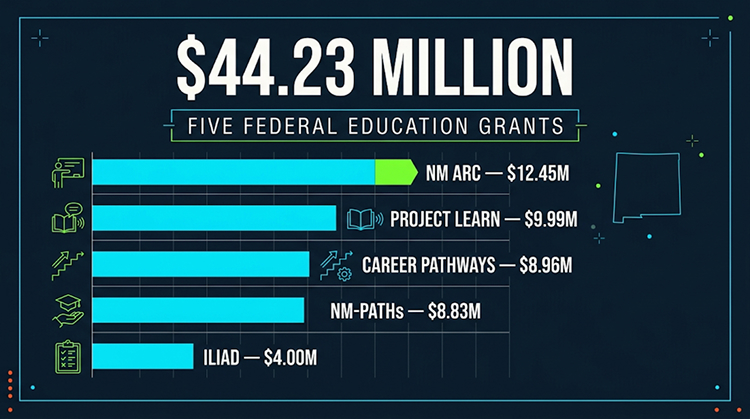
How the $44.2 Million Is Distributed
Amounts shown in millions of U.S. dollars, rounded to two decimal places. The grants span different award periods and should not be interpreted as annual spending.
Together, the programs create a strategy that extends beyond a single grade level or academic subject.
The literacy grant focuses on students who need reading support. The two teacher workforce initiatives address recruitment, retention, and instructional leadership. The assessment project aims to give educators more useful information about student learning, while the career exploration initiative connects classroom experiences with future opportunities.
1. Project LEARN: Nearly $10 Million to Expand Reading Tutoring in Rural Schools
One of the most directly relevant investments for early literacy is Project LEARN, which received $9,986,328 through the U.S. Department of Education’s Education Innovation and Research program.
Its full name is Literacy Expansion Through Accelerated Rural Networks: Building Reading Success with High-Impact Tutoring in a Rural State.
The three-year project runs from August 1, 2026, through July 31, 2029.
Project LEARN will expand evidence-based reading tutoring, with particular attention to rural communities and students who need additional academic support.
The initiative builds on New Mexico’s existing Summer Reading Program and its broader investments in high-impact tutoring.
What is high-impact literacy tutoring?
High-impact tutoring generally involves structured, frequent instructional sessions delivered individually or in small groups.
Unlike occasional homework assistance, effective tutoring is designed around specific learning goals and informed by assessments of students’ current skills.
For early readers, instruction may focus on phonemic awareness, phonics, decoding, reading fluency, vocabulary, and comprehension.
A student struggling to decode unfamiliar words, for example, may receive explicit instruction in letter-sound relationships and repeated practice using carefully selected reading materials.
The effectiveness of tutoring depends on factors such as instructional quality, session frequency, educator preparation, and alignment with classroom instruction.
Why rural communities are a priority
New Mexico’s geography creates challenges for delivering consistent educational services.
Small schools may have fewer reading specialists, limited access to professional development, or difficulty recruiting qualified tutors.
Long distances between communities can also complicate staffing and program coordination.
Project LEARN is intended to strengthen a statewide tutoring system that gives rural schools more reliable access to reading intervention.
According to PED, the initiative is expected to support thousands of students. However, the October announcement does not provide a verified final enrollment figure or demonstrate that the new grant has already improved reading scores.
Those outcomes will need to be measured during implementation.
2. NM-PATHs: $8.83 Million to Address Teacher Shortages in Rural and Tribal Communities
New Mexico also received $8,832,285 through the federal Teacher Quality Partnership program to support the New Mexico Pathways and Talent Hub for Schools, known as NM-PATHs.
The five-year initiative will run from October 1, 2026, through September 30, 2031.
Its purpose is to develop new teacher preparation pathways for rural and tribal communities and smaller school districts.
Creating a statewide Rural Preparation Hub
NM-PATHs will establish a Rural Preparation Hub connecting higher education institutions with school districts.
The hub is designed to expand access to:
- Virtual and hybrid teacher preparation coursework.
- Yearlong classroom co-teaching experiences.
- Mentorship from experienced educators.
- Pre-apprenticeship and registered apprenticeship pathways.
- Educator Fellow opportunities.
- Local recruitment programs.
These pathways are intended to help people prepare for teaching careers while maintaining connections to their communities.
Why local teacher recruitment matters
Traditional teacher preparation programs can create barriers for aspiring educators who live far from universities or cannot relocate.
For adults already working in schools, leaving employment to complete a full-time degree may be financially difficult.
Programs that combine coursework with paid or supervised school-based experiences can create alternative routes into the profession.
They may also help districts develop teachers who understand local languages, cultures, and community needs.
In tribal communities, successful implementation will require meaningful collaboration with tribal education leaders and attention to local priorities.
NM-PATHs is designed to build on existing New Mexico teacher residencies, apprenticeships, and workforce development programs rather than replace them.
The grant’s effectiveness will ultimately depend on how many candidates complete their preparation, obtain teaching credentials, and remain in the communities the program intends to serve. EIN Presswire
3. NM ARC: $12.45 Million to Strengthen Teacher Leadership and Retention
The largest of the five grants, $12,451,889, will support New Mexico’s Aspiring to Rewarding Careers initiative, known as NM ARC.
The three-year project runs from October 1, 2026, through September 30, 2029, with funding provided through the federal Teacher and School Leader Incentive Program.
NM ARC focuses on high-need schools that face challenges recruiting and retaining qualified teachers.
A different approach to teacher leadership
Rather than requiring experienced teachers to leave classroom instruction to advance professionally, NM ARC is designed to create leadership opportunities that allow them to continue teaching.
Participating educators may take on responsibilities such as mentoring new teachers, supporting instructional teams, and sharing effective teaching practices.
The initiative also includes strategic staffing arrangements and performance-based compensation.
The goal is to create professional pathways that recognize experienced teachers while strengthening support for their colleagues.
Why teacher retention affects student learning
Teacher turnover can interrupt instructional continuity, particularly when schools repeatedly need to fill positions in specialized subjects or high-need classrooms.
New teachers may also benefit from structured mentorship, opportunities to observe effective instruction, and regular feedback.
NM ARC is intended to support these needs through collaborative staffing models.
However, its success will depend on implementation details, including how teacher leaders are selected, how their responsibilities are balanced, and whether compensation arrangements are transparent and sustainable.
The state has not yet reported retention improvements attributable to the new grant. Mailchimp
4. Nearly $9 Million to Connect Middle and High School Students With Career Opportunities
Another $8,956,520 will support a three-year career pathways initiative called From Early Exploration to the Workplace.
The program will be led by PED in partnership with the New Mexico Department of Workforce Solutions.
Running from October 1, 2026, through September 30, 2029, it will focus on students in grades 6–12.
A central feature is the development of a 150-lesson career exploration curriculum for middle school students.
The initiative will also support individualized academic and career planning, career-connected learning experiences, and expanded opportunities for work-based learning.
Connecting classroom subjects with future careers
Career exploration can help students understand how their academic interests relate to different professions.
For example, a student interested in environmental science might explore careers involving water management, conservation, or engineering.
A student interested in mathematics and technology might investigate computer programming, manufacturing, or technical trades.
The new curriculum is intended to connect these interests with labor market information and educational pathways.
It may also help students understand the range of opportunities available after high school, including apprenticeships, technical credentials, community college, and four-year degrees.
Why middle school is an important starting point
Students begin making academic decisions before they graduate from high school.
Early exposure to different careers can help them explore interests without prematurely committing to a single occupation.
For rural communities, career-connected learning may also introduce students to local employment opportunities they have not previously considered.
The project’s effectiveness will depend on the quality of the curriculum, access to meaningful experiences, and whether schools can connect students with employers and educational institutions.
The October announcement identifies the planned curriculum and activities but does not yet report student participation or postsecondary outcomes. Las Cruces Digest
5. ILIAD: $4 Million to Improve How Schools Use Student Assessment Data
The fifth grant provides $3,998,995 for the Integrated Learning, Instruction, Assessment and Decision Making initiative, or ILIAD.
The project is funded through the U.S. Department of Education’s Competitive Grants for State Assessments program.
Its award period extends from October 1, 2026, through September 30, 2030.
ILIAD aims to improve how New Mexico educators interpret and use information from different student assessments.
Why connected assessment information matters
Teachers often use multiple assessments throughout the school year.
These may include classroom quizzes, reading screeners, diagnostic assessments, and statewide tests.
When assessment systems use different scales or report results in different ways, it can be difficult to understand how the information fits together.
ILIAD is designed to connect assessment information through common proficiency scales and learning progressions.
In practical terms, this could help educators identify which skills students have mastered, where learning gaps remain, and what instruction may be needed next.
For example, a teacher might use assessment results to determine whether a student needs additional decoding practice, more advanced vocabulary instruction, or targeted support with reading comprehension.
Assessment should support instruction, not replace it
Better assessment information does not automatically lead to stronger learning outcomes.
Teachers still need time, professional development, and instructional resources to interpret the results and respond effectively.
Schools must also consider student privacy, accessibility, and the appropriate use of assessment data.
ILIAD’s long-term value will depend on whether it helps teachers make better instructional decisions without adding unnecessary administrative burdens. Mailchimp
Why New Mexico Is Prioritizing Literacy and Teacher Development
The five federal grants build on existing education initiatives in New Mexico.
In March 2026, Governor Michelle Lujan Grisham signed legislation that included the High Quality Literacy Instruction Act, establishing evidence-based structured literacy instruction in state law.
The governor’s office also reported that New Mexico’s reading proficiency had increased by 10 percentage points since 2022. That statement describes the state’s reported progress over the earlier period; it is not an outcome of the newly announced October grants. Michelle Lujan Grisham
New Mexico has also made substantial investments in teacher professional development and literacy instruction.
In September 2024, the state received a separate $60 million Comprehensive Literacy State Development grant to support literacy efforts from early childhood through high school.
That earlier award is distinct from the five grants announced in October 2026 and should not be included in their $44.23 million total. New Mexico Public Education Department (NMPED)
The state’s December 2025 education budget proposal also cited 681 teacher vacancies in fiscal year 2025, illustrating the workforce challenges that programs such as NM-PATHs and NM ARC are intended to address. RISE NM
Together, these initiatives reflect a strategy that combines instructional improvement with teacher workforce development.
What the New Funding Could Mean for Rural and Tribal Communities
New Mexico’s rural and tribal communities are a major focus of the new education investments.
Schools in geographically isolated areas may face challenges recruiting teachers, accessing specialized instructional services, and providing professional development without requiring extensive travel.
The grants are designed to address several of these barriers.
Project LEARN aims to expand literacy tutoring in rural schools. NM-PATHs will create additional pathways for local residents to enter teaching. NM ARC will support teacher leadership and retention in high-need schools.
These programs could complement one another.
For example, a rural district might benefit from locally trained teachers who receive mentorship from experienced colleagues while students gain additional reading support through a coordinated tutoring program.
However, rural and tribal communities are not interchangeable. Each has distinct educational priorities, languages, cultures, and institutional relationships.
Successful implementation will require collaboration with local school leaders, families, and tribal education authorities where applicable.
The grants establish opportunities for expanded services, but the announcement does not identify every participating district or provide final school-level allocations.
How Will New Mexico Measure the Success of Its $44 Million Investment?
The announcement of federal funding is an important milestone, but the long-term significance of the grants will depend on measurable outcomes.
Because the five initiatives serve different purposes, they should not be evaluated using a single performance indicator.
| Program | Important outcomes to monitor |
|---|---|
| Project LEARN | Tutoring participation, instructional consistency, and reading growth |
| NM-PATHs | Teacher candidates completing preparation, earning credentials, and remaining in rural schools |
| NM ARC | Teacher retention, mentorship participation, and instructional leadership |
| Career pathways | Student participation, career knowledge, and access to work-based learning |
| ILIAD | Assessment usability, educator adoption, and instructional decision-making |
These are relevant evaluation indicators, not a published list of final grant performance measures.
For literacy tutoring, schools will need to examine whether participating students demonstrate sustained improvement in reading skills.
For teacher recruitment, policymakers should track not only how many candidates enter preparation programs but also how many become licensed educators and remain in the profession.
Teacher retention initiatives should be evaluated over multiple years, while assessment improvements should be judged by whether educators can use the resulting information effectively.
It will also be important to distinguish the effects of these grants from other statewide education initiatives already underway.
As of October 29, 2026, the newly announced grants have not produced publicly reported student achievement or teacher retention outcomes attributable to their implementation.
What Parents and Teachers Should Know
For families, the most immediate potential benefit may come through expanded reading tutoring.
Parents whose children struggle with reading can ask schools about available intervention programs, how reading progress is assessed, and whether additional tutoring opportunities are being introduced.
Teachers may eventually see changes in professional development, mentoring, staffing structures, and assessment tools.
Aspiring educators in rural communities may also benefit from expanded preparation pathways through NM-PATHs.
However, the October announcement does not mean every school or family will immediately receive new services.
Each initiative has a separate implementation schedule, and participating districts, eligibility requirements, and local program details may become clearer as the grants progress.
Families and educators should consult the New Mexico Public Education Department and their local school districts for updated information about participation.
Frequently Asked Questions
How much federal education funding did New Mexico receive in October 2026?
New Mexico announced five competitive federal grants totaling $44,226,017, or approximately $44.23 million, on October 20, 2026.
What will New Mexico’s $44 million education grants fund?
The grants will support literacy tutoring, teacher preparation in rural and tribal communities, teacher leadership and retention, career exploration for grades 6–12, and improved student assessment systems.
How much funding is dedicated to reading tutoring?
Project LEARN received $9,986,328 to expand high-impact literacy tutoring, particularly for students in rural communities who need additional reading support.
What is NM-PATHs?
NM-PATHs stands for New Mexico Pathways and Talent Hub for Schools. It is a five-year initiative designed to expand teacher preparation opportunities in rural and tribal communities through hybrid coursework, mentorship, and apprenticeship pathways.
Which program received the largest grant?
NM ARC, New Mexico’s Aspiring to Rewarding Careers initiative, received $12,451,889 to support teacher leadership, strategic staffing, and retention in high-need schools.
Will the funding benefit every school in New Mexico?
The initiatives are designed to strengthen statewide education systems, but the announcement does not establish that every school will receive direct funding or participate in each program.
When will the new education programs begin?
The grant periods begin in August or October 2026, depending on the initiative. They extend through 2029, 2030, or 2031. Actual school-level services may begin at different times.
Has New Mexico already improved reading scores because of these grants?
No such outcome has been reported. The awards were announced in October 2026, and their effects will need to be evaluated as the programs are implemented.
Conclusion: A Long-Term Investment in New Mexico’s Education System
New Mexico’s $44.23 million federal education investment represents a coordinated effort to address challenges that affect students throughout their academic journeys.
The funding combines direct reading support with initiatives intended to improve teacher preparation, strengthen school leadership, connect students with career opportunities, and make assessment information more useful.
Project LEARN offers an opportunity to expand literacy intervention in rural schools, while NM-PATHs and NM ARC focus on the educators responsible for delivering effective instruction.
The career exploration and ILIAD initiatives extend the strategy beyond reading instruction, supporting students’ long-term planning and teachers’ ability to respond to learning needs.
The central challenge now is implementation.
For the investment to produce lasting results, New Mexico will need to ensure that schools receive appropriate support, educators can use the new resources effectively, and program outcomes are evaluated transparently.
For families and educators, the announcement reinforces an important principle: improving education requires sustained attention to student learning, qualified teachers, and the resources that connect the two.
