
The University of Houston’s new Project BRIDGE initiative will provide specialized graduate training for 42 Houston-area educators, combining structured literacy, dyslexia intervention, and special education to strengthen support for students with reading difficulties.
The University of Houston has received a $1.25 million federal grant to launch Project BRIDGE, a five-year initiative designed to prepare 42 Houston-area educators to deliver specialized reading instruction to students with dyslexia and other learning disabilities.
Announced on October 22, 2026, the project will provide selected educators with tuition-supported graduate education in special education and structured literacy intervention. Its goal is to increase the number of teachers equipped to recognize reading difficulties, use evidence-based instructional methods, and provide targeted support for students who struggle with foundational literacy skills.
The initiative arrives at a time when schools across the United States continue to face challenges in recruiting and retaining qualified special education teachers. For students who need intensive reading instruction, those shortages can make it more difficult to receive consistent, individualized support.
Led by Kristi Santi, a professor in the University of Houston’s College of Education, Project BRIDGE brings together expertise in special education, reading science, and teacher preparation.
The program’s first cohort is scheduled to begin in January 2027, with applications open through November 15, 2026.
For families, educators, and school administrators, the project highlights an important question: Can investing in specialized teacher preparation help more children receive effective reading intervention before literacy difficulties affect their broader academic progress?
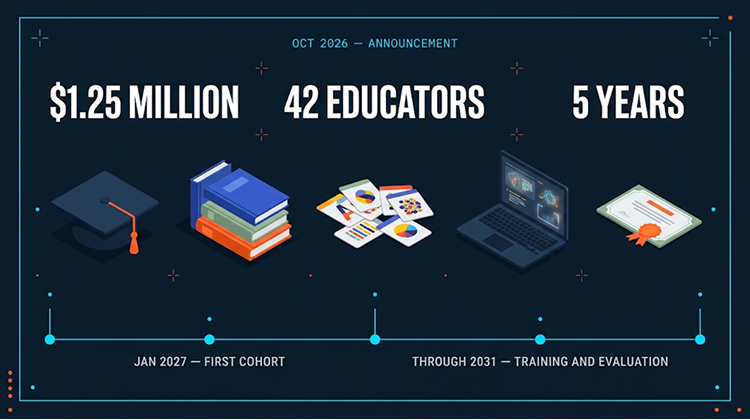
Project BRIDGE: Key Facts About the $1.25 Million Initiative
Federal grant funding
$1.25M
Educators to be trained
42
Project duration
5 years
First cohort begins
Jan. 2027
Project BRIDGE will offer participants a pathway to earn a master’s degree in special education and a structured literacy intervention certificate.
The program is designed to strengthen both academic knowledge and practical instructional skills. Participating educators will study how reading develops, why some students experience persistent difficulties, and how to apply structured interventions in school settings.
The initiative focuses on building specialized teaching capacity within the Houston area, where trained educators can support students with diverse learning needs.
A key distinction is that the 42-teacher figure represents the project’s planned training capacity. It does not mean that 42 teachers have already graduated or received certification.
Who Is Leading Project BRIDGE at the University of Houston?
Project BRIDGE stands for Building Reading Instruction and Dyslexia Guidance Expertise. It brings together faculty members from the University of Houston’s College of Education and Department of Psychology.
The university has identified six members of the project’s leadership and evaluation team.
| Researcher | Position and responsibility |
|---|---|
| Kristi Santi | Professor of Special Populations and principal investigator |
| Hope Rigby-Wills | Clinical assistant professor and co-principal investigator; leads structured literacy instruction |
| Heather Dulas | Assistant professor and co-principal investigator |
| Charlotte Carp | Clinical associate professor and co-investigator |
| Kristen Hassett | Clinical professor and co-investigator |
| Coleen Carlson | Research associate professor in psychology and external evaluator |
Santi wants participating teachers to become reading specialists who can share their knowledge throughout their school districts, reaching students beyond their own classrooms.
Rigby-Wills brings expertise in literacy development and dyslexia, particularly instructional strategies that help students connect written letters with speech sounds, decode words, and develop reading comprehension.
Dulas brings a classroom perspective shaped by 21 years as a high school special education teacher in Texas and Minnesota. Her experience reflects the difficulties schools encounter when students require reading intervention but qualified specialists are in short supply.
The university’s announcement emphasizes that Project BRIDGE is intended to develop educators who can make instructional decisions based on student data and research-supported practices. University of Houston
Why Texas Needs More Teachers Trained in Dyslexia Intervention
Texas has made early literacy a major education priority, but reading achievement remains a concern.
According to the University of Houston’s October announcement, research indicates that approximately half of Texas students are not reading at grade level by third grade.
That figure illustrates the scale of the challenge, although it should not be interpreted as the percentage of students with dyslexia. Children experience reading difficulties for many different reasons, including gaps in instruction, language-development needs, and specific learning disabilities.
The university also identifies a persistent shortage of qualified special education teachers as a central motivation for Project BRIDGE.
When schools have too few specialists, existing educators may face larger caseloads, limited time for individualized instruction, and fewer opportunities to collaborate with general education teachers.
A shortage of specialized personnel can also complicate the delivery of intensive reading interventions.
Project BRIDGE addresses these challenges by helping experienced educators develop additional expertise rather than relying exclusively on recruiting new teachers into the profession.
Why third-grade reading matters
By third grade, students are expected to use increasingly sophisticated reading skills across subjects.
Reading affects their ability to understand science explanations, follow written mathematics problems, interpret historical information, and complete independent assignments.
Students who continue to struggle with word recognition or reading fluency may find these academic demands especially difficult.
Early intervention can help educators identify specific reading needs and provide targeted instruction before difficulties become more persistent.
However, effective reading support is not limited to kindergarten through third grade. Older students with dyslexia or other reading disabilities may also require specialized instruction, which makes Project BRIDGE’s broader K–12 focus significant.
What Is Structured Literacy, and How Does It Help Students With Dyslexia?
Structured literacy is an instructional approach that teaches the relationships between spoken language and written language explicitly, systematically, and cumulatively.
Rather than expecting students to infer reading patterns independently, educators directly teach the skills needed to recognize, decode, spell, and understand words.
Structured literacy generally addresses several essential areas:
- Phonemic awareness: Recognizing and manipulating individual sounds within spoken words.
- Phonics: Learning how letters and letter combinations represent speech sounds.
- Decoding: Applying letter-sound knowledge to read unfamiliar words.
- Encoding and spelling: Translating sounds into written words.
- Reading fluency: Developing accurate and increasingly automatic reading.
- Vocabulary and comprehension: Understanding word meanings, sentences, and connected text.
For example, a teacher might introduce the sound represented by the letters sh, demonstrate how it appears in words such as ship and shop, and guide students through reading and spelling exercises.
As students become more confident, the teacher can introduce increasingly complex patterns while reviewing previously learned material.
This approach is especially relevant for students with dyslexia, who often experience persistent difficulties with accurate or fluent word reading and spelling.
Why explicit instruction is important
Some students acquire foundational reading skills relatively quickly through ordinary classroom instruction. Others require more direct explanation, repeated practice, and carefully sequenced lessons.
Students with dyslexia may need instruction that is more intensive and individualized than the general classroom reading program provides.
The Texas Education Agency emphasizes explicit, systematic, evidence-based instruction for students with dyslexia. Its guidance also addresses instructional intensity, educator qualifications, and the importance of implementing interventions consistently. Texas Education Agency
Structured literacy is not a single commercial curriculum, nor does it eliminate literature, vocabulary development, or reading comprehension.
It provides an instructional framework that can help educators teach foundational skills while continuing to build students’ broader language and literacy abilities.
How Project BRIDGE Will Prepare Teachers for Specialized Reading Instruction
The University of Houston’s program combines graduate coursework with specialized literacy preparation.
Participants will work toward two qualifications: a Master of Education in Special Education and the BRIDGE Certificate in structured literacy intervention.
The training is designed to help educators connect academic research with practical instructional decisions.

1. Understanding the science of reading
Teachers will study how children learn to read and how reading difficulties develop.
This knowledge can help educators distinguish between different instructional needs and select appropriate teaching strategies.
2. Identifying dyslexia and related reading difficulties
Participants will develop expertise in dyslexia identification and intervention.
That includes understanding the relationship between reading assessments, instructional planning, and the processes schools use to evaluate students for additional support.
3. Delivering structured literacy interventions
Teachers will strengthen their ability to provide explicit instruction in foundational reading skills.
The goal is to help educators support students who need more intensive instruction than they receive through the general classroom curriculum.
4. Using student data to guide instruction
Effective intervention requires ongoing assessment.
Teachers need to determine which skills students have mastered, where difficulties remain, and whether instructional adjustments are producing progress.
5. Sharing expertise with colleagues
Project BRIDGE also aims to create a broader instructional impact.
Participating teachers may become resources for other educators in their districts, helping spread evidence-based literacy practices across general and special education classrooms.
This potential wider influence is a program objective, not a measured outcome. The university has not yet reported how many additional teachers or students will benefit indirectly. University of Houston
Who Can Apply for the University of Houston’s Project BRIDGE?
The initiative is intended for experienced educators working in Houston-area schools.
According to the university, applicants must meet several requirements.
Project BRIDGE Application Requirements
- Hold a bachelor’s degree.
- Have a minimum undergraduate GPA of 3.0.
- Possess a valid teaching certificate.
- Have at least two years of classroom teaching experience.
- Submit a statement of intent.
- Provide three letters of recommendation, including one from a current supervisor.
First application deadline
November 15, 2026
Next announced deadline
April 1, 2027
The April 2027 deadline applies to the cohort scheduled to begin in fall 2027. Applicants should confirm requirements directly with the university.
The graduate program will be offered online, allowing eligible working educators to pursue additional qualifications without necessarily leaving their teaching positions.
The grant covers full tuition and some associated program expenses. It should not be assumed to cover every possible personal or educational expense.
The project is scheduled to operate through 2031. University of Houston
How Project BRIDGE Fits Into Texas Dyslexia Education Requirements
Project BRIDGE also connects with the broader framework governing dyslexia identification and instruction in Texas public schools.
The Texas State Board of Education adopted updated dyslexia requirements that took effect on June 30, 2024.
These requirements are incorporated into the state’s Dyslexia Handbook: Procedures Concerning Dyslexia and Related Disorders.
The handbook provides guidance on screening, evaluation, identification, instructional services, and educator qualifications.
Texas schools are required to screen students in kindergarten and first grade for risk of dyslexia and related reading difficulties.
When a school suspects dyslexia and a possible disability under the Individuals with Disabilities Education Act, it must follow applicable special education evaluation procedures.
Under the updated framework, dyslexia instruction for students who need it is considered specially designed instruction within special education services.
That makes qualified personnel especially important.
Project BRIDGE’s emphasis on structured literacy, special education, and dyslexia expertise aligns with the instructional knowledge schools need to implement these requirements. However, completing the university’s certificate should not automatically be assumed to satisfy every separate professional credential or district employment requirement. Texas Education
What Could 42 Specialized Teachers Mean for Houston-Area Schools?
At first glance, training 42 educators may seem modest compared with the size of the Houston metropolitan area’s school systems.
But Project BRIDGE is designed around a potential multiplier effect.
An educator who develops expertise in structured literacy may provide more effective instruction to students on an individual caseload. That educator may also collaborate with classroom teachers, support intervention planning, and share instructional strategies with colleagues.
Over several years, this could extend the program’s influence beyond its initial participants.
The actual reach will depend on where graduates work, whether they remain in education, and how school districts use their new expertise.
Project BRIDGE: Planned Training Timeline
- October 2026 — Grant announcementUniversity of Houston announces $1.25 million in federal funding.
- January 2027 — First cohortEligible educators begin the online graduate program.
- Fall 2027 — Additional cohortAnother announced entry point for participating educators.
- Through 2031 — Training and evaluationThe five-year project aims to prepare up to 42 specialized educators.
The project also provides an opportunity to study how graduate-level professional development translates into classroom practice.
That distinction matters because completing a training program does not automatically guarantee improved student outcomes.
How Will the University of Houston Measure Project BRIDGE’s Success?
The university has identified Coleen Carlson, a research associate professor in the Department of Psychology, as the project’s external evaluator.
An evaluation component is important because the project’s long-term value will depend on more than enrollment numbers.
Several questions could help determine its effectiveness:
- How many of the 42 participating educators complete the graduate program and certificate?
- Do participants demonstrate stronger knowledge of dyslexia identification and structured literacy?
- How effectively do graduates apply their training in classrooms and intervention settings?
- Do participating educators remain in special education or related instructional roles?
- Do students receiving instruction from these educators demonstrate measurable improvements in reading skills?
The university’s announcement establishes the program’s goals and structure, but it does not yet provide evidence of improved reading scores resulting from Project BRIDGE.
Future reporting should distinguish teacher training outcomes from student achievement outcomes and account for other factors that influence reading progress.
What Project BRIDGE Means for Parents of Children With Dyslexia
For families, the initiative highlights the importance of teachers who understand the specific needs of students with reading disabilities.
Parents concerned about a child’s reading development can ask schools how reading difficulties are identified, which instructional approaches are used, and how progress is monitored.
A child who has persistent difficulty decoding words, spelling familiar patterns, or reading fluently may need additional evaluation and specialized support.
Dyslexia is not a reflection of intelligence or motivation, and children with dyslexia can make meaningful progress with appropriate instruction.
Families should also understand that a reading screener is not the same as a formal diagnosis. When concerns persist, schools may need to conduct a more comprehensive evaluation under applicable state and federal requirements.
The Texas Education Agency provides resources for families seeking information about dyslexia, evaluations, and special education services.
Project BRIDGE will not directly enroll children or provide a new statewide screening service. Its contribution is to prepare educators who may be better equipped to deliver these services within their schools.
Frequently Asked Questions
What is Project BRIDGE at the University of Houston?
Project BRIDGE is a federally funded initiative designed to train Houston-area educators in special education, dyslexia identification, and structured literacy intervention.
How much funding did the University of Houston receive?
The university received a $1.25 million grant from the U.S. Department of Education’s Office of Special Education Programs.
How many teachers will participate?
The program aims to train up to 42 educators over five years.
Does Project BRIDGE provide free graduate tuition?
The grant covers full tuition and some associated program costs for selected participants. Applicants should verify which expenses are covered.
When does Project BRIDGE begin?
The first cohort is scheduled to begin in January 2027. The first application deadline is November 15, 2026.
Is Project BRIDGE only for teachers who work with students with dyslexia?
The program focuses on special education and structured literacy, including dyslexia identification and intervention. Its broader goal is to improve educators’ capacity to support students with reading difficulties across K–12 settings.
Will Project BRIDGE improve reading scores in Houston schools?
Improved literacy instruction is a stated goal, but the project has not yet produced reported student achievement results. Its effectiveness will need to be evaluated as participating educators complete their training and apply their knowledge.
Conclusion: Investing in Teachers to Improve Early Literacy
The University of Houston’s $1.25 million Project BRIDGE initiative represents a targeted investment in one of the most important resources available to students with reading difficulties: knowledgeable, well-prepared teachers.
By supporting 42 Houston-area educators through graduate study and specialized literacy training, the university aims to address both the shortage of qualified special education personnel and the need for effective dyslexia intervention.
The project’s emphasis on structured literacy, evidence-based instruction, and collaboration may also help participating educators share their expertise with colleagues throughout local school districts.
Its long-term success will depend on how effectively teachers apply their training, whether schools provide the resources necessary for consistent intervention, and whether students demonstrate measurable progress.
For education leaders and families, Project BRIDGE reinforces a central principle of literacy improvement: effective reading interventions depend not only on choosing the right instructional methods, but also on preparing teachers to deliver them successfully.
