
The University of Texas at Austin is partnering with the Permian Strategic Partnership to strengthen kindergarten through second-grade reading instruction in West Texas. The $5.5 million initiative will bring evidence-based literacy coaching, classroom interventions, and data-informed teaching support directly into schools.
Austin, Texas — The University of Texas at Austin has announced a $5.5 million early literacy initiative designed to improve foundational reading instruction for young students in West Texas, with particular attention to children who need additional support and emerging bilingual learners.
Announced on October 15, 2026, the project will be led by researchers at the university’s Meadows Center for Preventing Educational Risk, part of the College of Education.
The initiative is supported by the Permian Strategic Partnership (PSP), a coalition of energy companies working to strengthen education, healthcare, infrastructure, and workforce development in the Permian Basin.
Unlike traditional professional development programs that rely primarily on occasional training sessions, the new initiative will place literacy coaches directly in participating schools to work alongside teachers.
The approach will emphasize sustained instructional support, evidence-based reading practices, early intervention, and the use of student assessment data to guide classroom decisions.
Researchers Letti Romero Grimaldo, Sharon Vaughn, and Shannon Giroir will contribute expertise in literacy development, educational interventions, and teacher professional learning.
The program will initially work with two major West Texas school districts, focusing on kindergarten through second grade—a critical period when children develop the foundational skills needed for later reading success.
The initiative also recognizes the region’s linguistic diversity. Many students in West Texas are developing literacy skills in English while also using Spanish or another language at home.
For teachers, the project offers an opportunity to receive more consistent instructional guidance. For families, it represents a new investment in helping children become confident readers before they reach third grade.
The central question is whether sustained, classroom-based literacy coaching can produce stronger instructional practices and measurable improvements in early reading achievement.
University of Texas’ $5.5 Million Literacy Initiative: Key Facts
Initiative funding
$5.5M
Participating districts
2
Target grades
K–2
Announcement
Oct. 15, 2026
Source: University of Texas at Austin, College of Education, October 15, 2026. These figures describe the announced initiative, not measured student achievement outcomes.
| Project detail | Announced information |
|---|---|
| Lead university | University of Texas at Austin |
| Research center | Meadows Center for Preventing Educational Risk |
| Funding partner | Permian Strategic Partnership |
| Investment | $5.5 million |
| Geographic focus | Permian Basin, West Texas |
| Initial school partners | Two major school districts |
| Target students | Kindergarten through second grade |
| Key researchers | Letti Romero Grimaldo, Sharon Vaughn, Shannon Giroir |
| Main instructional approach | Embedded literacy coaching and evidence-based reading instruction |
| Additional priorities | Early intervention, bilingual assessment, teacher development, school leadership |
| Announcement date | October 15, 2026 |
The university’s announcement establishes the project’s funding, regional focus, and instructional priorities.
It does not establish that the initiative has already improved reading scores or that every elementary school in the Permian Basin will participate.
Those distinctions are important because the investment is intended to support implementation and improvement over time.
Why West Texas Is Investing in Early Literacy
The Permian Basin is one of the United States’ most economically significant energy-producing regions, spanning parts of West Texas and southeastern New Mexico.
Its communities include large urban centers, smaller cities, and rural school districts with different educational needs.
Economic growth and population changes can create challenges for schools, including demand for qualified teachers, instructional resources, and specialized academic support.
Early literacy is particularly important because reading difficulties that emerge during the first years of school can become more difficult to address when children encounter increasingly complex academic material.
Why kindergarten through second grade matters
During kindergarten, students typically begin developing foundational skills such as phonemic awareness, alphabet knowledge, and basic decoding.
First-grade instruction builds on those skills through more systematic word reading, spelling, connected-text practice, and early comprehension.
By second grade, students are expected to read increasingly complex words and passages while strengthening fluency, vocabulary, and understanding.
Children who have not developed reliable foundational skills may struggle as classroom instruction shifts toward learning information through reading.
This is why early identification and targeted support are central to the University of Texas initiative.
The project seeks to help teachers recognize emerging reading difficulties and respond before students fall further behind.
Why regional partnerships matter
The Permian Strategic Partnership works with public institutions and community organizations to address long-term challenges in the region.
Its investment in early literacy reflects the connection between educational opportunity and community development.
Children who acquire strong reading skills are better positioned to participate in later academic learning, while schools with effective instructional systems may be better equipped to support students with diverse needs.
However, improving literacy is a long-term educational objective.
The $5.5 million investment should be understood as funding for an intervention and professional development initiative, not a guaranteed improvement in regional reading performance.
The Two Participating Districts: Midland ISD and Ector County ISD
The university’s October announcement describes two participating West Texas districts. Earlier official project announcements identify them as Midland Independent School District (MISD) and Ector County Independent School District (ECISD).
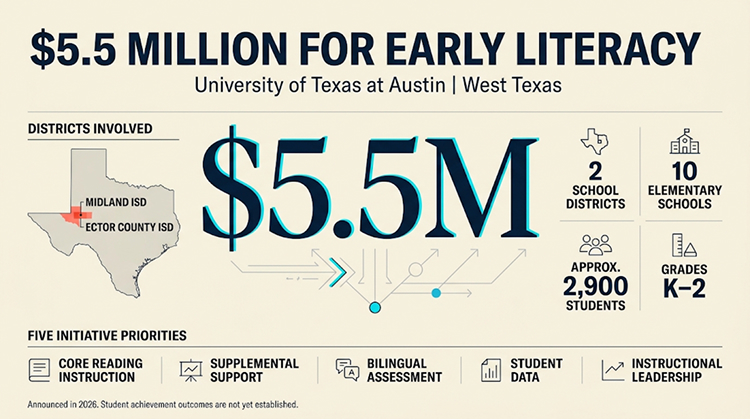
Together, they will host a pilot involving approximately 2,900 kindergarten through second-grade students across 10 elementary schools. The initial project is therefore more targeted than a region-wide rollout. Midland ISD
Midland, Texas
The district has already prioritized structured literacy and phonics-based reading instruction. The partnership will reinforce those efforts through coaching and instructional support.
Home Foundation Repair, Soil Stabilization & More In Odessa, TX
Ector County ISD
Odessa, Texas
The district will work with Meadows Center researchers to strengthen teacher professional learning and provide evidence-based classroom support.
Midland ISD: Building on existing structured literacy practices
Dr. Stephanie Howard, superintendent of Midland ISD, has explained that the district began strengthening structured literacy instruction and returning to phonics-based approaches several years ago.
The new partnership is designed to support this ongoing work rather than replace the district’s existing reading curriculum.
Teachers will receive additional coaching and opportunities to examine student learning data.
The initiative may also help instructional leaders identify where current practices are working and where teachers need additional support.
Ector County ISD: Strengthening teacher preparation and classroom instruction
Dr. Keeley Boyer, superintendent of Ector County ISD, has emphasized the value of connecting university research with the practical needs of teachers.
The partnership will provide access to research-informed professional learning, instructional resources, and classroom-based coaching.
For schools serving students with different language backgrounds and academic needs, these supports could help teachers deliver more responsive literacy instruction.
Both districts will participate in selecting and implementing appropriate instructional strategies, rather than receiving a completely separate curriculum imposed by an external organization.
How the Meadows Center Will Bring Literacy Coaching Into Classrooms
One of the initiative’s defining features is its job-embedded professional learning model.
Traditional teacher professional development often takes place through workshops, conferences, or training sessions outside the classroom.
These experiences can introduce educators to new research and instructional strategies.
However, teachers may encounter challenges when attempting to apply what they learned to students with different skill levels, language backgrounds, and learning needs.
The Meadows Center’s approach is designed to address that gap.
According to the university’s earlier project announcement, instructional coaches and researchers will work in participating schools twice a month, observing instruction, teaching alongside educators, and helping teachers plan lessons.
This creates opportunities for feedback based on actual classroom experiences. UT News
What job-embedded literacy coaching looks like
A classroom-based coaching cycle could include the following steps.
A Typical Literacy Coaching Cycle
- Review student reading dataTeachers and coaches examine assessment results to identify foundational reading skills requiring additional attention.
- Plan targeted instructionThey select appropriate teaching strategies, instructional materials, and opportunities for guided practice.
- Model or observe a lessonA coach may demonstrate an instructional technique or observe how the teacher delivers a reading lesson.
- Discuss instructional decisionsThe teacher and coach review student responses, discuss challenges, and identify adjustments.
- Monitor progress and refine instructionSubsequent assessments and classroom observations help determine whether students are responding to instruction.
Illustrative coaching cycle based on the project’s announced professional learning approach; not a published mandatory five-step protocol.
Why ongoing coaching may be more useful than isolated workshops
A teacher attending a one-day phonics workshop may understand a new instructional strategy but still need support applying it effectively.
For example, a coach may help a first-grade teacher determine how to introduce a new spelling pattern, organize guided practice, and respond when students make decoding errors.
Follow-up visits allow educators to revisit the strategy and refine their instruction.
The University of Texas initiative will test how sustained coaching can strengthen classroom practice within existing district systems.
Its effectiveness should ultimately be measured through instructional changes and student reading outcomes, not simply the number of coaching visits completed.
Five Core Components of the West Texas Early Literacy Initiative
The University of Texas identified five central priorities for the program in its October 15 announcement. UT Austin
1. High-quality core reading instruction
Strengthening everyday classroom instruction through evidence-based practices aligned with the Science of Reading.
2. Strong supplemental instruction
Providing additional targeted teaching for students who need more support than regular classroom lessons alone.
3. Linguistically aligned assessment
Using assessment practices that better account for the language development of emergent bilingual students.
4. Systematic use of student data
Helping teachers interpret assessment results and adjust instruction based on students’ demonstrated needs.
5. Instructional leadership development

Building the capacity of school and district leaders to maintain effective literacy practices over time.
These five components work together.
Strong classroom instruction establishes a foundation for all students. Supplemental interventions provide additional help when needed.
Appropriate assessments help teachers understand student progress, while school leaders create the conditions necessary to maintain consistent instructional practices.
The initiative is therefore designed to strengthen an entire instructional system rather than introduce a single reading intervention.
Why Emergent Bilingual Students Are an Important Focus
West Texas schools serve many children who are learning English while developing language and literacy skills in Spanish or other home languages.
These students may demonstrate different strengths across their languages.
A child might understand a concept in Spanish but not yet know the corresponding English vocabulary.
Another student may recognize certain spelling patterns in one language while still learning how those patterns work in English.
Effective literacy assessment should distinguish between normal second-language development and difficulties that may require targeted reading intervention.
What linguistically aligned assessment means
A linguistically aligned approach considers how a student’s language background affects the interpretation of assessment results.
For example, teachers may need to examine whether a child is struggling with an unfamiliar English vocabulary word or experiencing a more fundamental decoding difficulty.
Assessments should be appropriate for the student’s instructional context and language development.
The University of Texas initiative identifies this area as one of its five major priorities.
However, the university has not publicly established that every participating student will receive bilingual assessments in both English and Spanish.
The specific assessment procedures will depend on implementation within the partner districts.
Supporting bilingualism without lowering expectations
Emergent bilingual students should have access to rigorous literacy instruction.
Their home languages can provide valuable linguistic knowledge, cultural resources, and opportunities for family engagement.
At the same time, students need explicit instruction in the sound-letter relationships, vocabulary, and language structures necessary to read successfully in English.
The project aims to help teachers make instructional decisions that account for these needs rather than treating linguistic diversity as a learning deficit.
Who Is Leading the University of Texas Literacy Research?
The initiative draws on researchers associated with the Meadows Center for Preventing Educational Risk.
| Researcher | Institution | Area of contribution |
|---|---|---|
| Letti Romero Grimaldo | University of Texas at Austin | Project management and early literacy implementation |
| Sharon Vaughn | University of Texas at Austin | Reading research, intervention, and educational risk prevention |
| Shannon Giroir | University of Texas at Austin | Literacy research and instructional support |
The university names all three researchers in its October 15 announcement. UT Austin
Letti Romero Grimaldo: Supporting classroom implementation
Dr. Letti Romero Grimaldo, senior project manager at the Meadows Center, is involved in coordinating the initiative.
Her work focuses on translating educational research into practical support for teachers and school leaders.
The project will require close collaboration between university researchers, district administrators, instructional coaches, and classroom educators.
Sharon Vaughn: Research on reading difficulties and intervention
Dr. Sharon Vaughn is executive director of the Meadows Center for Preventing Educational Risk.
Her research has contributed to understanding how to support students who struggle with reading, including the development and evaluation of instructional interventions.
Her involvement connects the West Texas initiative with the center’s broader work on evidence-based literacy instruction.
Shannon Giroir: Literacy research and professional learning
Shannon Giroir is also identified as a member of the University of Texas research team.
Her involvement supports the initiative’s emphasis on improving instruction through research-informed professional learning and classroom collaboration.
The project’s success will depend not only on the researchers’ expertise but also on how effectively the partner districts integrate the support into their existing instructional systems.
The Permian Strategic Partnership’s Role in Funding Early Literacy
The Permian Strategic Partnership is a coalition of major energy companies and university systems working with communities across West Texas and southeastern New Mexico.
Its investments address education, healthcare, workforce development, and other regional priorities.
For the literacy initiative, PSP has committed $5.5 million to support a multiyear pilot developed by the Meadows Center.
Tracee Bentley, president and CEO of the Permian Strategic Partnership, has emphasized the importance of supporting educational growth throughout the region.
The investment is intended to strengthen existing school systems by providing professional learning, coaching, and leadership development.
Importantly, the initiative is not primarily a curriculum replacement program.
Instead, researchers will work with participating districts to improve how teachers implement evidence-based reading instruction within their existing educational structures. Permian Strategic Partnership
Why a regional investment could have a lasting effect
Teacher development programs sometimes depend on external specialists who provide support for a limited period.
Once that support ends, schools may struggle to maintain the same level of instructional quality.
The West Texas initiative attempts to address this problem by developing instructional leadership within participating districts.
Teachers, coaches, principals, and district leaders will have opportunities to build shared knowledge about effective literacy instruction.
If that knowledge becomes part of routine instructional planning and professional development, participating schools may be better positioned to sustain improvements.
However, the project will need to demonstrate that these changes continue beyond the initial coaching period.
When Will the West Texas Literacy Initiative Be Implemented?
Although the University of Texas published its latest announcement on October 15, 2026, the initiative was publicly introduced earlier in the year.
The Permian Strategic Partnership announced the investment in June 2026, and the university published a more detailed explanation on August 27.
The October announcement highlighted the Meadows Center’s work and identified the project’s five instructional priorities.
The program follows a phased implementation model.
Permian Basin Literacy Initiative Timeline
- June 2026 — Funding announcementThe Permian Strategic Partnership announces its $5.5 million investment in the multiyear literacy initiative.
- Summer 2026 — First implementation phaseThe initial phase begins, with participating schools receiving instructional support and professional learning.
- October 15, 2026 — University research updateUT Austin highlights the Meadows Center’s leadership and the initiative’s five priorities for improving early reading instruction.
- Summer 2027 — Second implementation phaseA second phase is planned to expand the pilot’s implementation within the participating districts.
- Following implementation — EvaluationResearchers plan to analyze student reading outcomes, implementation quality, and the potential for sustaining or expanding the model.
Sources: Permian Strategic Partnership and University of Texas at Austin. The project has not announced a specific publication date for its final student-outcome evaluation. UT News+1
Why the phased approach matters
Introducing instructional changes across multiple schools simultaneously can create logistical challenges.
Teachers may have different professional learning needs, and schools may vary in their existing reading programs.
A phased approach allows researchers and district leaders to examine implementation, identify obstacles, and make adjustments.
It also creates opportunities to evaluate whether the model is practical before considering expansion to additional campuses.
The initial pilot’s 10 elementary schools should therefore be understood as a starting point rather than the full geographic scope of any future initiative.
How Will Researchers Measure Whether the $5.5 Million Investment Works?
The Permian Strategic Partnership has stated that the initiative includes measurable goals, ongoing evaluation, and an analysis of student outcomes.
These components are essential for determining whether the investment produces meaningful educational improvements.
A successful literacy initiative should demonstrate more than increased participation in professional development.
It should also examine whether classroom instruction improves and whether students develop stronger reading skills.
| Evaluation area | Questions researchers should examine |
|---|---|
| Foundational reading skills | Are students improving in phonemic awareness, decoding, and word recognition? |
| Reading fluency | Are students becoming more accurate and efficient readers? |
| Supplemental intervention | Are students with reading difficulties responding to additional instruction? |
| Emergent bilingual learners | Are assessments and interventions appropriate for students’ language development? |
| Teacher practice | Are educators consistently applying evidence-based instructional strategies? |
| Instructional coaching | Does ongoing classroom support improve teachers’ instructional decisions? |
| Leadership capacity | Can principals and instructional leaders sustain effective practices? |
| Long-term sustainability | Can participating districts maintain improvements after external support decreases? |
These are relevant measures for evaluating the initiative, not published results from the pilot.
Why reading improvement must be measured carefully
Student reading scores can change for many reasons.
Children develop at different rates, and achievement may be influenced by attendance, prior instruction, language development, access to interventions, and other factors.
Researchers will need to consider these influences when evaluating the initiative.
They should also distinguish between improvement within participating schools and evidence that the program itself caused that improvement.
Where appropriate, comparisons with similar students or schools may help researchers better understand the program’s effects.
As of November 5, 2026, the project has not published a final evaluation demonstrating that the $5.5 million initiative has improved student reading achievement.
What the Initiative Means for Teachers in Midland and Odessa
For participating educators, the project may provide a different professional learning experience from traditional training workshops.
Instead of receiving information during a single session and returning to classrooms without follow-up support, teachers will have opportunities to work directly with literacy coaches.
That support could help educators refine phonics instruction, interpret assessment results, and identify students who need additional intervention.
Supporting teachers without replacing their expertise
The initiative’s model recognizes that teachers are central to instructional improvement.
Coaches can provide research-based guidance, demonstrate lessons, and help analyze student progress.
However, classroom teachers remain responsible for understanding their students and making instructional decisions.
Effective professional learning should strengthen teacher expertise rather than create dependence on external specialists.
Helping school leaders sustain improvements
Principals and instructional leaders also have an important role.
They influence how professional development is scheduled, how instructional time is protected, and how teachers collaborate.
If school leaders understand evidence-based literacy practices, they may be better equipped to support consistent instruction across grade levels.
This is one reason leadership development is included among the project’s five priorities.
What Families Should Know About Early Reading Development
For parents and caregivers in Midland, Odessa, and surrounding communities, the initiative highlights the importance of monitoring children’s early reading progress.
Families do not need specialized training to support positive literacy experiences at home.
Reading aloud, discussing stories, practicing familiar letter-sound relationships, and encouraging children to talk about books can complement classroom instruction.
However, these activities should not be viewed as substitutes for systematic reading instruction or specialized intervention when needed.
Signs that a child may need additional reading support
Children develop literacy skills at different rates, but persistent difficulties may warrant a conversation with a teacher.
Potential concerns include ongoing difficulty recognizing letters, connecting letters with sounds, blending sounds into words, or reading words that have already been taught.
Older early elementary students may also struggle with reading accuracy, fluency, or understanding connected text.
A single difficulty does not establish that a child has dyslexia or another learning disability.
Teachers and specialists can use appropriate assessments to determine whether additional instruction or evaluation is needed.
Families can ask schools how reading progress is monitored, what interventions are available, and how they can reinforce classroom learning at home.
Frequently Asked Questions
How much is the University of Texas investing in West Texas literacy?
The initiative is supported by a $5.5 million investment from the Permian Strategic Partnership. The University of Texas at Austin’s Meadows Center for Preventing Educational Risk is leading the educational work.
Which school districts are participating?
The initial pilot includes Midland Independent School District and Ector County Independent School District, serving communities in Midland and Odessa, Texas.
How many students will the initiative reach?
The project is designed to support approximately 2,900 kindergarten through second-grade students across 10 elementary schools.
Who is leading the research?
The University of Texas identifies Letti Romero Grimaldo, Sharon Vaughn, and Shannon Giroir as researchers involved in the initiative.
What is job-embedded literacy coaching?
It is a professional learning approach in which instructional coaches work directly with teachers in their schools. Activities may include classroom observations, lesson modeling, instructional planning, feedback, and student data analysis.
Will schools receive a completely new reading curriculum?
The initiative is designed primarily to strengthen evidence-based instruction within existing district systems rather than introduce a replacement curriculum.
How will the program support bilingual students?
One of its five priorities is linguistically aligned assessment for emergent bilingual students, helping teachers interpret reading development in ways that consider students’ language backgrounds.
When did the program begin?
The initial phase was scheduled to launch in summer 2026, with a second phase planned for summer 2027. UT Austin published its latest project update on October 15, 2026.
Has the initiative already improved reading scores?
A final student-outcome evaluation has not been published. Researchers plan to assess instructional implementation and student reading achievement as the initiative progresses.
Could the program expand beyond the initial schools?
The project includes evaluation and planning intended to inform possible future expansion. No statewide rollout has been confirmed.
Conclusion: A $5.5 Million Investment in Better Early Reading Instruction
The University of Texas at Austin’s new early literacy initiative represents a substantial investment in improving how young children learn to read in West Texas.
Supported by $5.5 million from the Permian Strategic Partnership, the project will bring sustained literacy coaching, evidence-based instructional support, and data-informed teaching practices to Midland ISD and Ector County ISD.
Approximately 2,900 kindergarten through second-grade students across 10 elementary schools are expected to benefit from the initial pilot.
The initiative’s distinguishing feature is its focus on improving instruction through direct collaboration with teachers rather than relying solely on new materials or isolated professional development sessions.
Its priorities also address important challenges in early literacy, including supplemental interventions, bilingual assessment, and school leadership.
The coming years will determine whether this approach produces measurable improvements in classroom instruction and student reading achievement.
For educators, the project offers opportunities to strengthen their instructional expertise. For families, it represents a commitment to helping children build essential reading skills during their earliest school years.
The initiative’s long-term value will depend not simply on the amount invested, but on whether its coaching model helps teachers deliver stronger reading instruction—and whether students demonstrate lasting literacy gains.
