
The University of Pittsburgh has secured a five-year federal research grant to investigate whether systematic phonics instruction can help adolescents who continue to struggle with reading. The project could provide new evidence about how schools support older students who have not mastered foundational literacy skills.
Pittsburgh, Pennsylvania — The University of Pittsburgh has received a $3,112,738 federal research grant to investigate whether systematic, accessible phonics instruction can improve reading skills among adolescents who continue to experience significant literacy difficulties.
Announced on October 5, 2026, the five-year project is funded by the Eunice Kennedy Shriver National Institute of Child Health and Human Development (NICHD), part of the National Institutes of Health (NIH).
The research will be led by Dr. Julie Fiez, Distinguished Professor of Psychology and senior scientist at the university’s Learning Research & Development Center (LRDC).
She will work alongside co-investigators Dr. Scott Fraundorf, associate professor of psychology and LRDC research scientist, and Cheryl Sandora, LRDC research associate and English language arts fellow at the university’s Institute for Learning.
The project, officially titled Testing the Effectiveness of Systematic and Accessible Phonics Interventions for Adolescents with Poor Reading, will run from September 15, 2026, through August 31, 2031.
Its central objective is to determine whether structured phonics instruction can help older students strengthen the word-reading skills they may not have fully developed during elementary school.
The study addresses a significant challenge in American education: reading instruction changes as students progress through school, but not every student develops the foundational skills needed to keep pace.
By middle and high school, students are expected to read increasingly complex material in science, history, mathematics, and English language arts.
Those who still struggle to recognize and decode unfamiliar words may have difficulty accessing the academic content they are expected to learn.
Although systematic phonics instruction is commonly associated with kindergarten through third grade, some adolescents continue to need explicit instruction in how written letters and spelling patterns correspond to spoken language.
The Pittsburgh project will investigate how such instruction can be adapted for older learners and delivered in ways that are practical and accessible.
The study’s broader question is whether schools can provide effective foundational reading intervention after the elementary years—and what forms of instruction are most useful for adolescents who have fallen behind.
University of Pittsburgh’s $3.1 Million Literacy Study: Key Facts
Total research award
$3.11M
First-year funding
$645,848
Project duration
5 years
Scheduled completion
August 2031
Source: University of Pittsburgh Learning Research & Development Center, October 5, 2026. These figures describe the research award and planned study, not demonstrated improvements in student reading achievement.
| Research detail | Verified information |
|---|---|
| Lead institution | University of Pittsburgh |
| Research center | Learning Research & Development Center |
| Federal funding agency | Eunice Kennedy Shriver National Institute of Child Health and Human Development |
| Grant mechanism | NIH Research Project Grant (R01) |
| Total funding | $3,112,738 |
| Initial first-year funding | $645,848 |
| Principal investigator | Julie Fiez |
| Co-investigators | Scott Fraundorf and Cheryl Sandora |
| Project start | September 15, 2026 |
| Project end | August 31, 2031 |
| Target population | Adolescents experiencing significant reading difficulties |
| Research focus | Systematic, accessible phonics interventions |
| NIH award number | R01HD123265 |
| Public announcement | October 5, 2026 |
The university has not publicly established a final sample size, a complete list of participating schools, or specific student recruitment dates in its October announcement.
Those details should not be inferred from the grant amount or project duration.
Why Teenagers Still Need Foundational Reading Instruction
Reading is often discussed as an elementary school responsibility.
Young children learn to recognize letters, connect written symbols with sounds, decode words, and gradually develop reading fluency.
As students move into upper elementary and secondary grades, instruction increasingly emphasizes comprehension, interpretation, vocabulary, and subject-area knowledge.
However, the transition from learning to read toward reading to learn is not equally smooth for every student.
Some adolescents enter middle or high school with persistent weaknesses in decoding, word recognition, or reading fluency.
These difficulties can affect their ability to read academic texts independently.
What happens when foundational skills remain weak?
A seventh-grade student may understand a science concept when a teacher explains it aloud but struggle to read the corresponding textbook passage.
Another student may have strong verbal reasoning skills yet read slowly because unfamiliar words require considerable effort to decode.
A teenager who spends substantial attention identifying individual words may have fewer cognitive resources available for understanding the passage as a whole.
This does not mean every adolescent reading difficulty is caused by poor phonics knowledge.
Vocabulary, background knowledge, language comprehension, attention, learning disabilities, and other factors can also affect reading performance.
The University of Pittsburgh study focuses specifically on whether strengthening foundational word-reading skills can benefit adolescents who demonstrate weaknesses in that area.
Why older students have fewer opportunities to learn phonics
By secondary school, reading instruction is often embedded within English, science, history, and other subjects.
Teachers may reasonably expect students to have mastered common letter-sound relationships and spelling patterns during earlier grades.
As a result, explicit foundational reading instruction can become less available.
Students who continue to need it may receive specialized interventions, but the availability, intensity, and instructional approach vary across schools.
The Pittsburgh researchers aim to investigate interventions that are both systematic and accessible, addressing not only whether instruction works but also how it might reach older students who need it.
What Is Systematic Phonics Instruction for Adolescents?
Phonics instruction teaches the relationships between written letters or letter combinations and the sounds they represent.
Systematic phonics introduces these relationships through an organized sequence rather than relying on students to discover patterns incidentally.
Although the principles of phonics remain relevant across ages, effective instruction for adolescents must account for their existing knowledge, academic expectations, and social development.
A 14-year-old with reading difficulties should not automatically receive the same materials or instructional presentation designed for a five-year-old.
Instead, teachers may need to use age-respectful content while directly addressing the foundational skills that remain underdeveloped.
Four instructional areas that may matter
| Instructional area | Skill addressed | Example of age-appropriate practice |
|---|---|---|
| Sound-symbol relationships | Connecting spelling patterns with speech sounds | Analyzing common vowel and consonant patterns |
| Word decoding | Accurately reading unfamiliar printed words | Practicing increasingly complex words in a planned sequence |
| Word analysis | Recognizing meaningful word parts and spelling structures | Examining prefixes, suffixes, and recurring letter patterns |
| Reading fluency | Improving accuracy and efficiency in connected text | Guided reading of appropriately challenging passages |
These are illustrative areas of adolescent foundational reading instruction, not a published four-part protocol for the new NIH study.
The precise intervention procedures and comparison conditions will need to be established through the researchers’ study materials and eventual publications.
Why phonics is not the same as reading comprehension
Decoding and comprehension are related but distinct.
A student can accurately pronounce a word without understanding its meaning.
Likewise, a student may understand a spoken explanation but struggle to read the same information independently.
Improving word recognition may make academic reading more accessible, but it does not eliminate the need for vocabulary development, background knowledge, comprehension strategies, and subject-specific instruction.
For older students, a comprehensive literacy response may need to address several areas simultaneously.
The Pittsburgh project is important because it examines one foundational component that can be overlooked when schools focus primarily on higher-level comprehension.
Meet the University of Pittsburgh Researchers Leading the Study
The five-year initiative brings together specialists in cognitive psychology, reading development, learning research, and English language arts.
Their combined expertise is particularly relevant because adolescent reading difficulties involve both the cognitive processes underlying word recognition and the practical challenges of delivering instruction in schools.
Dr. Julie Fiez: Understanding how the brain learns to read
Dr. Julie Fiez is the study’s principal investigator.
She is a Distinguished Professor at the University of Pittsburgh and a senior scientist at the Learning Research & Development Center.
Her research examines the cognitive and neural mechanisms involved in language, reading, working memory, and learning.
Fiez also directs the university’s Mind and Brain Lab, which investigates how brain systems contribute to cognitive performance and how those findings can inform educational interventions.
On September 1, 2026, the university announced her appointment as Distinguished Professor of Psychology, recognizing her contributions to research on human behavior and learning.
Her work connects basic research on reading processes with applied questions about how instruction can help people who experience literacy difficulties.
Dr. Scott Fraundorf: Research on language, memory, and learning
Dr. Scott Fraundorf is an associate professor of psychology and an LRDC research scientist.
He joins the project as a co-investigator.
His involvement adds expertise in how people process, remember, and learn information.
For adolescent reading research, understanding learning processes is important because an intervention must do more than produce short-term improvements during practice.
Researchers also need to investigate whether students retain new skills and apply them when encountering unfamiliar words or connected academic text.
Cheryl Sandora: Connecting research with classroom instruction
Cheryl Sandora is an LRDC research associate and an English language arts fellow at the University of Pittsburgh’s Institute for Learning.
Her work connects the research team with the instructional realities of literacy education.
That perspective matters because an intervention may demonstrate promise under carefully controlled conditions yet prove difficult to implement in ordinary schools.
Secondary educators face constraints involving instructional time, staffing, curriculum requirements, and students’ different academic needs.
A study of accessible phonics interventions must consider these practical issues alongside reading outcomes.
Research Team at a Glance
| Researcher | Verified role | Contribution |
|---|---|---|
| Julie Fiez | Principal investigator | Reading, language, and cognitive neuroscience |
| Scott Fraundorf | Co-investigator | Psychology, learning, and cognitive research |
| Cheryl Sandora | Co-investigator | Literacy instruction and educational practice |
Source: University of Pittsburgh LRDC, October 5, 2026. Learning Research & Development Center
Earlier Pittsburgh Research Provides a Foundation for the New Study
The October 2026 grant follows earlier University of Pittsburgh research examining whether phonics-based instruction can be adapted for older struggling readers.
A study published in the journal Dyslexia in August 2026 investigated an online version of the Glass-Analysis reading intervention.
The research was conducted by Corrine Durisko, Kailee Lear, Isabel Beck, Cheryl Sandora, and Julie Fiez.
It explored whether individualized instruction delivered online by non-specialist tutors could support students with persistent reading difficulties.
The study provides useful background for understanding why the new federal award emphasizes both systematic instruction and accessibility.
What the 2026 pilot examined
The earlier research involved 34 fifth- and sixth-grade students with poor reading skills.
Participants were assigned alternately to an intervention group or a waitlist comparison group.
Students receiving the intervention completed individualized sessions over 11 to 19 weeks.
The researchers used standardized reading assessments, including the Woodcock Reading Mastery Tests and the Test of Word Reading Efficiency, to examine changes in reading performance.
The study tested the feasibility of delivering a phonics-based intervention online using lay tutors rather than requiring every session to be conducted by a specialized reading professional. PMC+1
Why this earlier study matters
The pilot addressed a practical challenge in adolescent literacy intervention: access to trained specialists.
Schools may struggle to provide intensive individualized instruction to every older student who needs it.
An intervention that can be delivered effectively through accessible formats could potentially expand the number of students receiving support.
However, accessibility must not come at the expense of instructional quality.
Tutors need appropriate preparation, materials, supervision, and procedures for monitoring progress.
The earlier study was also relatively small.
Its findings should not be interpreted as conclusive evidence that a particular online phonics program will work for all adolescents.
The new NIH-funded project creates an opportunity for further investigation with a larger research investment and a longer evaluation period.
How the Five-Year NIH Study Could Advance Adolescent Literacy Research
The new grant is an NIH Research Project Grant, commonly known as an R01.
R01 awards support defined research projects intended to advance scientific knowledge.
The University of Pittsburgh’s project will investigate the effectiveness of systematic, accessible phonics interventions for adolescents with poor reading skills.
The official announcement identifies the research objective, investigators, funding, and project dates.
It does not provide a complete public protocol describing every intervention condition, participant group, assessment, or statistical method.
Consequently, the following areas represent important research questions rather than confirmed features of the study design.
1. Can adolescents improve foundational decoding skills?
The first question concerns whether students who continue to struggle with word recognition can make meaningful progress through systematic phonics instruction.
Researchers will need to determine whether students improve on measures that reflect genuine reading development rather than simply becoming familiar with practiced words.
2. Can students apply what they learn to unfamiliar words?
Effective phonics instruction should help readers recognize spelling patterns and apply them to new words.
For older students, this ability matters because academic subjects introduce increasingly specialized vocabulary.
Improvement on practiced exercises is useful, but transfer to unfamiliar words would provide stronger evidence that students are developing generalizable skills.
3. Can interventions be delivered accessibly?
Accessibility may involve instructional format, tutor preparation, scheduling, cost, or other practical considerations.
The university’s announcement does not specify which delivery models will be compared.
Nevertheless, the project’s emphasis on accessibility makes implementation an important consideration.
A reading intervention that requires resources unavailable to most schools may be difficult to scale, even if it produces positive results in a controlled setting.
4. Will reading improvements persist?
Short-term gains do not necessarily indicate lasting improvements.
Longer-term assessment can help determine whether students retain skills and continue using them after intervention sessions end.
The project’s five-year duration provides time for substantial research, although it does not automatically establish that individual students will be followed for five years.
5. Which students benefit most?
Adolescents with reading difficulties are not a uniform group.
Some may struggle primarily with decoding, while others experience difficulties involving fluency, vocabulary, comprehension, or multiple areas.
Understanding which students respond to a particular intervention can help schools allocate instructional support more effectively.
University of Pittsburgh’s Research Funding and Timeline
The project spans nearly five years, beginning in September 2026 and concluding in August 2031.
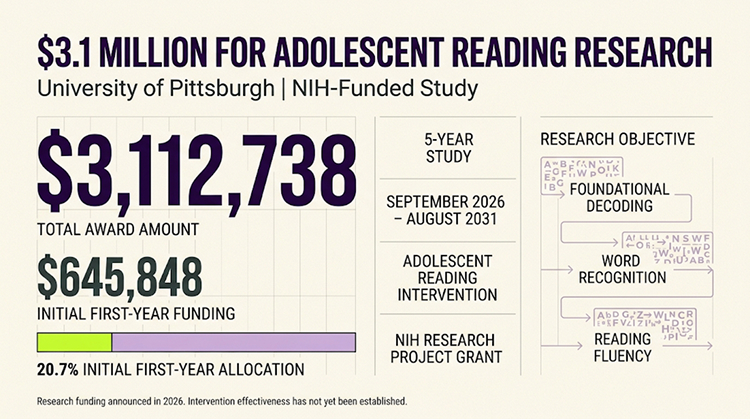
Its total announced funding is $3,112,738, with $645,848 allocated for the first year.
Research Funding Overview
Total five-year award
$3,112,738
Initial first-year funding
$645,848
20.7% initial first-year allocation
79.3% remainder of announced total
The graphic compares the initial first-year amount with the total announced award. It does not represent a published year-by-year spending plan. Learning Research & Development Center
Project timeline
- September 15, 2026 — Project beginsThe official NIH-funded research period starts.
- October 5, 2026 — University announces the awardLRDC publicly identifies the research team, funding, and study objective.
- 2027–2030 — Continuing research periodThe project is scheduled to continue. Specific recruitment, intervention, and reporting milestones have not been publicly established in the announcement.
- August 31, 2031 — Scheduled project completionThe announced grant period ends, subject to any future administrative changes.
Only the start date, announcement date, and scheduled end date are confirmed milestones. The intervening years describe the grant period, not a published implementation schedule.
The university has not announced a date for publication of the project’s final findings.
Scientific research may also produce individual publications before the end of a grant period.
For that reason, the scheduled completion date should not be treated as a guaranteed date for a final public report.
Why Adolescent Literacy Intervention Is Different From Elementary Reading Instruction
Teaching foundational reading skills to teenagers presents challenges that differ from those encountered in kindergarten or first grade.
Older students have more developed language abilities, broader background knowledge, and established experiences with school.
They may also be more conscious of their reading difficulties and less comfortable receiving instruction that appears designed for much younger children.

An effective intervention must therefore address both academic needs and the learning environment.
Age-appropriate materials matter
A ninth-grade student who struggles with decoding should not automatically be given picture books intended for beginning kindergarten readers.
Instruction can focus on foundational skills while using vocabulary, examples, and reading materials that respect the student’s age and interests.
This distinction can help educators avoid confusing instructional skill level with intellectual ability.
A teenager may need explicit practice with spelling patterns while still being capable of sophisticated discussion about science, history, or literature.
Reading difficulties can affect multiple subjects
Secondary students must read across the curriculum.
A student struggling to decode unfamiliar words may experience difficulty in several academic settings.
| Subject | Potential reading challenge | Relevant support |
|---|---|---|
| English language arts | Reading unfamiliar words in complex passages | Decoding and fluency instruction |
| Science | Recognizing technical vocabulary | Word analysis and explicit vocabulary teaching |
| History | Reading dense informational texts | Vocabulary, background knowledge, and comprehension support |
| Mathematics | Understanding written explanations and word problems | Academic language and reading comprehension support |
| Career and technical education | Reading specialized terminology and instructions | Word recognition and subject-specific vocabulary |
Phonics alone cannot resolve every difficulty in these subjects.
However, stronger word recognition may reduce one barrier that prevents students from accessing academic content.
Instruction must protect student dignity
Older struggling readers may have experienced years of frustration or repeated academic setbacks.
Effective intervention should avoid labeling students as incapable or treating foundational instruction as a punishment.
Teachers can provide clear goals, appropriately challenging materials, constructive feedback, and opportunities for students to recognize their progress.
The Pittsburgh research may eventually help schools understand which approaches are effective, but the study’s announced objectives do not yet establish a particular motivational or classroom management model.
What the Research Could Mean for Students With Dyslexia
Some adolescents with persistent reading difficulties have dyslexia, a learning disability commonly associated with difficulties in accurate or fluent word recognition, spelling, and decoding.
Others experience reading difficulties for different reasons.
The University of Pittsburgh’s study focuses on adolescents with poor reading skills, and the October announcement does not state that participation will be restricted to students diagnosed with dyslexia.
This distinction matters.
A student does not necessarily need a formal dyslexia diagnosis to benefit from appropriately selected reading intervention.
At the same time, a reading intervention should not be treated as a substitute for a comprehensive evaluation when a disability is suspected.
Why explicit word-reading instruction may be relevant
Students with dyslexia often benefit from systematic, explicit instruction addressing the relationships between sounds, letters, and spelling patterns.
For older students, instruction may need to address longstanding gaps while also helping them manage current academic demands.
A carefully evaluated adolescent phonics intervention could contribute useful evidence about how to support these learners.
However, the new $3.1 million study has not yet demonstrated that its interventions are effective for students with dyslexia or for adolescents generally.
Those conclusions must await the results of the research.
How Schools Could Use the Findings
If the University of Pittsburgh research identifies effective, practical interventions, its findings could help secondary schools make more informed decisions about literacy support.
Potential applications include developing targeted reading programs, improving intervention materials, strengthening tutor training, and identifying students who need additional foundational instruction.
The implications could extend beyond traditional English language arts classrooms.
Middle and high schools increasingly recognize that students may require literacy support across multiple subjects.
What school leaders should evaluate
Before adopting an adolescent reading intervention, schools should consider several questions:
- Does the program match the specific reading difficulties identified through assessment?
- Is the instructional approach supported by credible research involving students of similar ages and needs?
- Can educators deliver the program with sufficient consistency and intensity?
- Are students making measurable progress on appropriate reading assessments?
- Can the school sustain the intervention without sacrificing access to grade-level academic content?
The new NIH-funded study may eventually contribute evidence to these decisions.
For now, schools should continue relying on established assessment practices, appropriately trained educators, and the best available research rather than waiting for a single new study to resolve every question about adolescent literacy.
Why This Study Matters for the National Science of Reading Conversation
Much of the public discussion about the Science of Reading focuses on early elementary instruction.
States have invested in phonics training, structured literacy materials, reading assessments, and teacher preparation reforms intended to improve instruction in kindergarten through third grade.
These initiatives are important because preventing reading difficulties can reduce the need for later intervention.
However, they do not eliminate the needs of students who are already in middle or high school.
An education system that focuses exclusively on preventing future reading difficulties risks overlooking adolescents who need support now.
Early literacy reform and adolescent intervention serve different purposes
| Early literacy initiatives | Adolescent reading interventions |
|---|---|
| Focus on preventing or identifying reading difficulties early | Address persistent reading difficulties in older students |
| Often emphasize kindergarten through third grade | Serve students in upper elementary and secondary grades |
| Build foundational reading skills from the beginning | Identify and address skills that remain underdeveloped |
| Integrate instruction into early-grade literacy blocks | Must fit within more specialized secondary schedules |
| Aim to establish reading proficiency before later academic demands | Help students access increasingly complex academic texts |
Both approaches can be part of a comprehensive literacy strategy.
The Pittsburgh study is particularly relevant because it addresses a population that can receive less attention in discussions about foundational reading instruction.
It also brings cognitive science and educational practice together to investigate an unresolved instructional question.
How Should the Study’s Success Be Evaluated?
A five-year research project of this scale creates expectations for meaningful evidence.
However, the value of the research will depend on its methods, findings, and transparency—not simply its funding amount.
Several evaluation areas will be especially important.
| Evaluation area | Key research question |
|---|---|
| Decoding accuracy | Can students read unfamiliar words more accurately? |
| Word-reading efficiency | Can students recognize words more quickly and reliably? |
| Reading fluency | Do improvements extend to connected text? |
| Skill transfer | Can students apply learned patterns to words they have not practiced? |
| Long-term retention | Are improvements maintained after instruction? |
| Accessibility | Can interventions be delivered in practical educational settings? |
| Student differences | Which groups of struggling readers benefit most? |
| Implementation | What training, supervision, and instructional resources are necessary? |
These are suggested criteria for interpreting future findings, not a confirmed list of the project’s official outcome measures.
Researchers will also need to consider whether improvements are educationally meaningful.
A statistically significant result may not always represent a large enough change to affect a student’s everyday reading experience.
Conversely, a modest improvement in foundational skills may be important for a student who has struggled for years.
The most useful findings will explain both whether an intervention works and the circumstances under which it can be implemented effectively.
What Parents and Educators Can Do While Research Continues
Families and educators do not need to wait until 2031 to address persistent reading difficulties.
A teenager who struggles to read unfamiliar words, reads unusually slowly, or avoids reading because of repeated frustration may benefit from an assessment of specific literacy skills.
Teachers can examine decoding, word recognition, fluency, vocabulary, and comprehension to better understand the student’s needs.
For families, conversations with schools can focus on what reading assessments show, which interventions are available, and how progress will be monitored.
Older students should also continue receiving opportunities to engage with age-appropriate academic content.
Support for foundational reading skills should expand access to learning, not unnecessarily limit participation in challenging coursework.
Frequently Asked Questions
How much funding did the University of Pittsburgh receive?
The university received a $3,112,738 NIH Research Project Grant, including $645,848 in initial first-year funding, to investigate phonics interventions for adolescents with reading difficulties.
Who is funding the research?
The project is funded by the Eunice Kennedy Shriver National Institute of Child Health and Human Development, part of the National Institutes of Health.
Who is leading the study?
Dr. Julie Fiez is the principal investigator. Dr. Scott Fraundorf and Cheryl Sandora are co-investigators.
When does the project begin and end?
The official project period runs from September 15, 2026, through August 31, 2031.
Why would teenagers need phonics instruction?
Some adolescents have not fully developed the decoding and word-recognition skills typically taught during elementary school. Targeted phonics instruction may help address those remaining difficulties.
Is phonics instruction appropriate for high school students?
It may be appropriate when assessment identifies weaknesses in foundational word-reading skills. Instruction should be age-respectful and matched to the student’s needs.
Does the study focus only on students with dyslexia?
The university describes the target population as adolescents with poor reading skills. Its October announcement does not state that participation is limited to students with a dyslexia diagnosis.
Will the intervention be delivered online?
The research team has previously investigated an online phonics intervention delivered by lay tutors. However, the October 2026 announcement does not confirm that the new five-year study will use only an online delivery model.
How many students will participate?
The official October announcement does not specify a final participant count.
Has the new intervention already been proven effective?
No. The NIH grant supports research designed to evaluate intervention effectiveness. Results from earlier pilot work should not be confused with findings from the newly funded study.
Conclusion: Addressing Reading Difficulties Beyond Elementary School
The University of Pittsburgh’s $3.1 million federal research award represents a significant investment in understanding how to help adolescents who continue to struggle with reading.
Led by Julie Fiez, Scott Fraundorf, and Cheryl Sandora, the five-year project will examine whether systematic, accessible phonics interventions can strengthen foundational word-reading skills among older students.
Its importance extends beyond a single university research program.
As American schools continue investing in early literacy instruction, they must also consider the needs of students who have already progressed into secondary education without mastering essential reading skills.
The Pittsburgh initiative addresses that challenge directly.
Previous research by members of the team has explored the feasibility of adapting phonics instruction for older learners, including online tutoring approaches.
The new NIH award provides an opportunity to investigate intervention effectiveness more extensively.
The findings could eventually inform how schools organize adolescent literacy support, train intervention providers, and select instructional approaches.
For now, the central distinction remains clear: the research has been funded, but the effectiveness of the newly proposed interventions has not yet been established.
The next five years will help determine whether systematic phonics instruction can offer more adolescents a practical path toward stronger reading skills and greater academic independence.
