
Trying to get students engaged today is tough. It’s like trying to explain Inception to a room full of cats. I’ve been there, and it’s not easy.
Educator Chris Merlo says something important. Today’s students haven’t seen Ghostbusters. Their view of learning is very different from ours.
Another teacher, Semma, had a moment that stood out. A student called her “mom.” It showed how disconnected they felt from the old teaching ways.
This article is your guide to connecting with today’s students. We’re moving away from old teaching methods. We’ll share strategies that make learning fun and engaging.
Think of it as a class on making learning exciting. We’re going to make reading competitive and fun. Get ready to learn about the power of reading games.
The Value of Playful Reading
What if the secret to unlocking a student’s mind isn’t more rigor, but more play? We’ve all seen the classic scene: rows of silent students, eyes glazing over a static page. It’s like a screensaver in class. But, as researchers like Merlo show, interactive strategies change everything. Engagement, participation, and long-term retention all go up.
This isn’t about replacing Macbeth with a clown. The value of playful reading is about making learning stick, not just looking good. It’s like going from memorizing facts to creating a mad scientist’s lab. One is just data, the other is a full-body workout for the brain, making knowledge last.
Think of Merlo’s introverted students, suddenly “off to the races” with an open-ended question. That’s the magic. The play is mentally engaging. It challenges thinking and turns passive learners into active creators of meaning. Experts like child psychiatrist Jean Clinton say we must embrace playful learning from the start. This idea works for all ages.
So, what does this look like in practice? It’s about moving from quiet compliance to a lively, productive atmosphere. Group literacy activities are key. They build teamwork, clarify ideas, and make learning a team effort. Learning sticks because it’s based on real experiences.
| Cognitive Aspect | Passive Reading | Playful/Interactive Reading |
|---|---|---|
| Engagement | Compliance-based; often superficial. | Intrinsic; driven by curiosity and challenge. |
| Retention | Relies on repetition; easily forgotten. | Contextual & experiential; acts like cognitive Velcro. |
| Critical Thinking | Limited to author’s presented logic. | Students debate, predict, and analyze gaps. |
| Social-Emotional Learning | Isolated; individual performance focus. | Collaborative; builds communication and empathy. |
| Example Activity | Silently read Chapter 4. | In groups, stage a “talk show” with characters from Chapter 4. |
The table isn’t just theory. It’s a plan for changing a classroom or living room. The right side isn’t easier. It’s harder in a good way. It makes students build understanding, not just recognize it. This is where long-term retention happens.
Lastly, treating reading as a solemn ritual misses the point. The goal isn’t to show respect for the text, but to have a dynamic relationship with it. Playful, interactive methods—like well-designed group literacy activities—create that bond. They turn reading from a one-way conversation to a dialogue, where real learning starts.
Group Reading Games (Classroom/Family)
A great heist film is all about the team, each with their own skill. Group reading games work the same way. They turn solo reading into a team effort, where everyone works together to understand.
“Find the Flaw” is not just about grammar. It’s a detective game. Students search for errors in texts, competing to find the most. It’s like auditing a text with your friends.
“Robot Drawing” is all about clear communication. One person writes instructions, and another follows them exactly. The funny mistakes show how important clear instructions are.
The think-pair-square method is key for group discussions. It starts with individual thoughts, then pairs, and ends with a group discussion. This way, everyone’s ideas are heard and built upon.
Think-pair-square is great for debates. It prepares teams to discuss topics like character motives. The game helps them learn to argue based on facts.
Make discussions active with a gallery walk. Post questions around the room. Groups move around, adding their thoughts. You can have different games at each station.
These games are perfect for any group. “Find the Flaw” is fun at family dinners or in class. They show that learning together is the best way to understand.
Digital and App-Based Activities
The screen isn’t the enemy of reading; boredom is. In the digital world, interactive reading activities turn from just turning pages into full experiences. It’s not about scrolling aimlessly. It’s about using digital tools to connect deeply with text.
Remember the old VHS cart? Today, a quick YouTube search can teach you a lot in just three minutes. A video comparing Romeo and Juliet to a modern feud can make old drama seem as timely as a trending topic. Ask students to find a podcast that explores a book theme. This adds an auditory layer, building knowledge before they start reading.
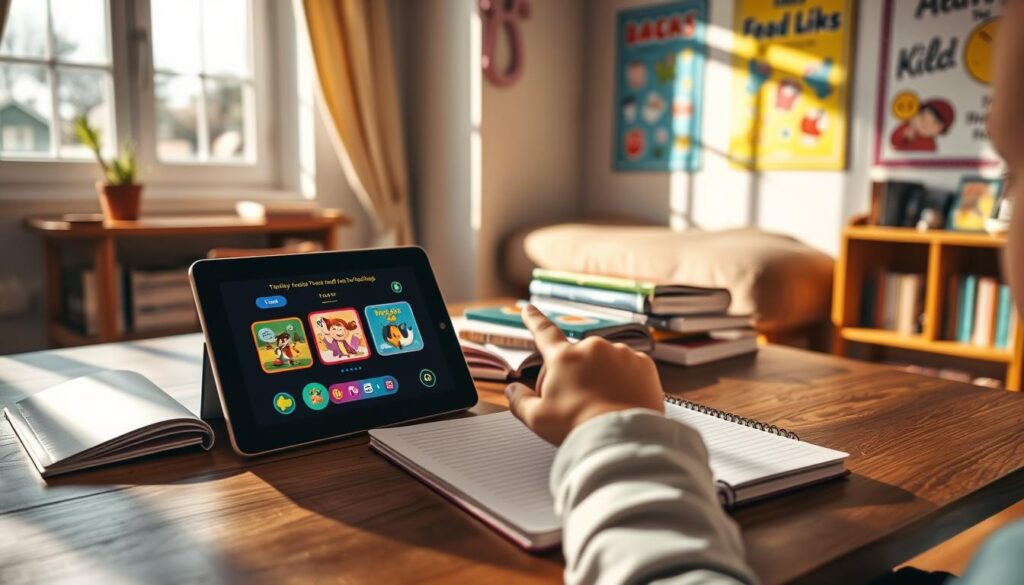
Now, it’s time to build. Forget just highlighting. Tools like Google Docs or a Zoom whiteboard become interactive maps. Students can work together to organize themes and plot twists. For personal notes, an app like Notability lets them draw on the text, combining analysis with creativity.
When students become creators, magic happens. Imagine Hamlet texting Ophelia? An app like Texting Story lets them write and film that conversation. For nonfiction, they can make an infographic in Canva. Suddenly, making connections isn’t just a task; it’s a challenge.
These app-based activities come together in great ways. Host an online debate where students take on different roles. This lets everyone have a say, even the quietest. The goal is to meet students where they are and make reading more engaging.
Here’s a menu for your next digital lesson:
- Primer: Curated YouTube clip or podcast episode.
- Annotation: Collaborative concept map or visual sketchnotes.
- Creation: Character texting narrative or thematic infographic.
- Discussion: Structured online debate or podcast panel.
The idea is simple. We use tech to build, not distract. It’s about turning passive reading into active creation. That’s how you win the reading games today.
Drama, Roleplay, and Storytelling
Forget the silent study carrel; the most profound reading comprehension happens when students literally step into the story. This isn’t about putting on a Broadway production. It’s about transforming text from a passive artifact into a living, breathing experience. When a student embodies Scout Finch’s confusion or argues as Atticus Finch, the words cease to be ink. They become intention, emotion, and consequence.
Let’s start with the raw power of roleplay. Acting out a moral dilemma from a novel—like whether to turn in a friend for cheating—forces a student to navigate the gray area in real time. They’re not just analyzing “what the character should do.” They’re feeling the social pressure, weighing loyalty against ethics, and defending their choice. This is empathy built through muscle memory, not just highlighted text.
Never underestimate the teacher read-aloud, even for jaded high schoolers. When you perform a passage, you’re not just reciting. You’re modeling pacing, tone, and subtext. You become a conduit for the author’s voice. A well-delivered monologue from Macbeth can make ambition feel chillingly tangible. This shared auditory experience creates a common reference point, a piece of literature felt by the room simultaneously.
Then there’s the detective work of close reading. Treat a single, dense paragraph like a crime scene. What’s the word choice hiding? Why this metaphor and not another? Students become textual forensic teams, dissecting clauses for clues about character or theme. This granular focus turns ambiguity from a frustration into an invitation for deeper hands-on reading lessons in analysis.
But understanding isn’t always verbal. Enter the visual interpreters: sketch notes and one-pagers. Asking students to map a chapter’s key themes, symbols, and quotes visually engages a different part of the brain. A sketched dagger dripping with quotes about guilt can encapsulate Macbeth more efficiently than a five-paragraph essay for some learners. It’s a non-linear, personal synthesis of text.
Photographs are another potent, silent partner. Show a stark Dorothea Lange image before reading Steinbeck. Use a mysterious scene as a narrative prompt. A picture can unlock a student’s own storytelling voice, providing an emotional or thematic bridge into a more complex text. It asks: “What story does this tell?” before they even encounter the author’s words.
| Technique | Best For Age Group | Core Skills Developed | Prep Time Needed |
|---|---|---|---|
| Moral Dilemma Roleplay | Middle School & High School | Empathy, Ethical Reasoning, Persuasive Speech | Low (Select scene, define roles) |
| Teacher Dramatic Read-Aloud | All Ages (seriously!) | Listening Comprehension, Understanding Tone & Subtext | Medium (Practice reading for performance) |
| Close Reading “Text Autopsy” | High School | Analytical Thinking, Attention to Detail, Inference | Low (Choose rich text excerpt) |
| Sketch Note / One-Pager Summary | Elementary through High School | Synthesis, Visual-Spatial Thinking, Concise Communication | Medium (Provide templates/examples) |
| Photograph Analysis & Prompt | All Ages | Inferential Thinking, Creative Writing, Making Connections | Low (Curate relevant images) |
The throughline here is embodiment. Whether through physical movement, vocal performance, visual mapping, or detective work, the goal is to get the text off the page and into the gut. These methods reject the idea that reading is a solitary, silent act. They reclaim it as a communal, multi-sensory exploration. The best hands-on reading lessons remind us that every story was born from a human experience, and it demands a human response.
Creative Writing Integration
Let’s face it, “writing about reading” often means boring book reports and essays. We’re here to change that. Creative writing is where the magic happens, turning reading into a vibrant dialogue.
Forget the five-paragraph essay trap. We aim to make writing an exciting part of reading. How? By starting with what students love. That’s where the Passion Blog comes in.
It all starts with a “heart map.” Students map out their passions, like pheasant hunting or sneaker design. This isn’t just brainstorming; it’s finding the spark for their writing. Then, they explore sources to deepen their knowledge.
Writing becomes a mission, not a chore. They’re creating a blog post to share with others. This is where you show them the messy, joyful struggle of writing. Share your drafts and rewrites with excitement.
Collaboration makes it even more special. They share their blog drafts with peers for feedback. This turns a solo task into a team effort. Students learn to improve each other’s work.
This method teaches valuable writing skills naturally. Writing a blog post? That’s about organization. Asking for an expert interview? That’s about email etiquette and communication. It’s all about real-world skills.
The result is a sense of ownership. When writing comes from passion and is reviewed by peers, students’ voices shine. They learn to analyze texts by first creating their own.
This approach—passion projects, genius hours, real publishing—is the best way to learn. It turns literacy from just reading to creating, making writing the most engaging group literacy activity you can offer.
Remote/Hybrid Adaptations
When your classroom turns into a grid of faces, the real challenge isn’t the tech. It’s making a live book club feel real through a screen. The distance from a fiber-optic connection can feel huge. Our goal is to make sure everyone feels connected and engaged.
Breakout rooms are key to digital friendship. Zoom or Google Meet breakout rooms are your secret weapon. Use them for debates or small group discussions on a digital whiteboard like Miro or Jamboard. This way, even shy students can shine.
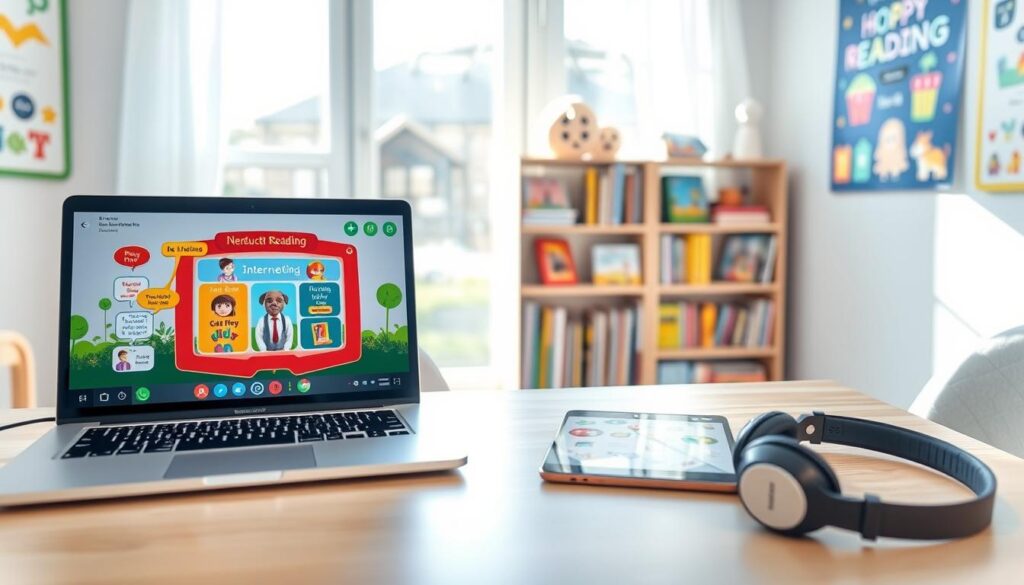
Using tech wisely is important. Instead of static PDFs, use a shared Google Slide deck. Students can post reaction GIFs that capture the chapter’s mood. Tools like Padlet help with discussions on moral dilemmas, sparking honest conversations.
Discussions shouldn’t stop when class ends. A Slack or Discord channel dedicated to the book is a 24/7 literary salon. Ask a question at the end of class, and watch the thread grow overnight.
Here’s a quick guide to making classic reading games work online:
| Traditional Activity | Remote/Hybrid Adaptation | Tech Tool of Choice |
|---|---|---|
| Live Character Hot-Seat | Pre-recorded “interview” videos posted to Flipgrid; peers respond with video questions. | Flipgrid, Loom |
| Pass-the-Paper Story Building | Collaborative Google Doc with “Suggesting Mode” enabled; each student adds a paragraph in a timed session. | Google Docs |
| Tableau (Frozen Scene) | Digital photo submission with students posing at home; compile into a shared slideshow with captions. | Google Slides, Canva |
| Quick-Fire Vocabulary Review | Live quiz game using Kahoot! or Blooket during synchronous time. | Kahoot!, Blooket |
| Silent Discussion (Written on Posters) | Asynchronous annotation using hypothesis.is or shared margin comments in Google Docs. | Hypothesis, Google Docs |
The goal is to make online learning more interactive, not less. It’s about creating many ways for students to participate. A student might not speak up in class, but they’ll share their thoughts online.
Successful online reading games are about careful design. You’re not just moving activities online; you’re using digital tools to build a new kind of community. The connection starts with Wi-Fi but ends with a shared love for the story.
Templates to Try
Think of a great hands-on reading lesson like a perfect cocktail. The magic is in the recipe, not in starting from scratch. Here are the blueprints for your teaching magic.
The Entry and Exit Ticket are great for classroom diagnostics. The Entry Ticket is like a cover charge. Ask a question when students arrive: “Based on last night’s reading, what’s one question you’re burning to ask?” or “Predict the protagonist’s next big mistake.”
The Exit Slip is the debrief. Ask a reflective question at the end of class: “What’s the most important sentence you read today, and why?” or “Summarize the main conflict in exactly 15 words.” It gives a clear view of what worked and what didn’t.
Consider the Flipped Classroom model. You make the students do the hard work at home. Class time is for the fun stuff: application, debate, and creation.
It might seem like a lot of work, but it’s not. You use existing resources for homework. Then, in class, you focus on problem-solving steps:
- Assessment: “Okay, team. Based on the video, what was the core argument?” (Quick group discussion).
- Diagnosis: “Where did that argument fall short? What evidence was missing?” (Critical analysis).
- Action: “Now, in your groups, storyboard a 60-second rebuttal or create a meme that captures the counterpoint.” (Synthesis and creation). The reading becomes the foundation, not the finale.
For dense texts, use chunking. Break the text into smaller, thematic parts. Assign a “chunk” with a specific task.
For example: “Group A, your chunk is pages 10-15. Your job is to find all the metaphors related to ‘entrapment’ and be ready to perform them as a silent tableau. Group B, pages 16-20—map the shifting power dynamics between these two characters on a simple graph.” This makes complex text manageable.
Give students visual tools. Create graphic organizers and anchor charts together. It’s not about handing out worksheets. It’s about building a shared language.
As you discuss a story’s plot, draw a simple “story mountain” on the board. Have students shout out where key events fall. Analyzing argumentative text? Sketch a “claim-evidence-reasoning” table together. These documents become student references, making connections clear.
These templates are your flashy rims. They’re not about rigidity; they’re about providing a scaffold for creativity. Your unique content and students’ ideas provide the horsepower. The template just gives it a sleek frame.
Teacher and Parent Reflections
Interactive activities are like fireworks, leaving a lasting impression. The applause fades, and laptops shut. This is when learning becomes personal.
This moment is all about reflection. It’s when we ask, “What did it do to us?” Not just “what did we do?” Real insights come from listening to students’ stories.
The “Laws of Life” essay is more than a writing task. It opens a door to personal beliefs. Students connect fictional stories to their own values. It makes characters’ lessons feel real.
Identity portraits are about showing the unseen. Students use symbols and colors to express themselves. It’s a way to build empathy by seeing others’ perspectives.
Simple inventories reveal hidden talents. A “get-to-know-you” sheet can show who’s an engineer or a poet. This information helps in planning future activities.
The “Three Cool Things I’ve Seen” practice highlights learning approaches. Students share moments of understanding or confusion. It focuses on the journey, not just the destination.
The review ball is a simple yet effective tool. Students share their thoughts, showing what they get and what puzzles them. It reveals the class’s mood and understanding.
The key is to listen to students. These practices are essential, not extra. They turn activity into valuable insights. They respect each student’s voice, fueling future engagement.
Conclusion
Finding ways to engage students can seem like searching for a magic solution. But, it’s more like having a set of tools at your disposal. It’s not about just pleasing them. It’s about understanding how they learn best.
We’ve learned that we need to keep changing our approach. The best way is to mix fun with hard work and let students take charge. These hands-on reading lessons work well because they use both teamwork and quiet time. They turn reading into a fun, meaningful discussion.
Imagine a classroom full of students working together. Or a living room where everyone laughs over a drawing. This is what happens when reading is done together. It’s the result of those hands-on reading lessons that look like fun.
The aim is clear. We need to go from talking about it to actually doing it. Build your toolkit. Be the teacher your students need, and watch the learning start.
