
Many professionals feel stuck in a daily routine. They finish their tasks but don’t feel like they’re moving forward. The problem often lies in how they plan.
Starting with reflection is key. Before setting goals, pick 3–5 main areas to focus on for the year. For each area, set 1–2 important outcomes. This way, you focus on making a real difference, not just doing tasks.
OKRs (Objectives and Key Results) and SMART goals are powerful tools. OKRs set clear goals for each quarter. SMART goals make sure those goals are achievable.
Quarterly planning helps you focus on your big goals. It connects your yearly vision to your daily work. Adding a monthly review makes your planning system dynamic and adaptable. Your planner and tracker become essential tools, not just a notebook. For more on using these frameworks, check out our practical guide to OKRs.
Translate Vision Into Quarters: themes, OKRs, SMART goals
To avoid vague resolutions, successful goal-setters focus on 90-day themes. This approach turns big dreams into clear, doable plans. Every three months, you need to ask two key questions.
Which goals do I want to move forward this quarter? What milestones would make the next 90 days a success? Your answers guide a meaningful quarter.
Choose one to three themes for the next 90 days. These themes come from your yearly goals. For example, “improve physical health” might lead to “establish consistent strength training” as a quarterly theme.
For each theme, write a single, inspiring Objective. This is a qualitative, motivational statement. Then, define two to three Key Results (OKRs) to measure success.
They answer, “How will I know I’ve achieved my Objective?” A good Key Result is specific and has a deadline.
- Objective: Rebuild foundational strength and mobility.
- Key Result 1: Increase deadlift personal record by 15%.
- Key Result 2: Attend three coached mobility sessions per week.
- Key Result 3: Reduce lower back discomfort score from 7/10 to 3/10.
Next, break each Key Result into SMART goals. These are your quarterly projects. SMART means Specific, Measurable, Achievable, Relevant, and Time-bound.
For “Increase deadlift by 15%,” a SMART goal could be: “Complete a 12-week progressive overload lifting program, logging all sessions, by the end of the quarter.” This mirrors the strategy of breaking down big goals into smaller ones for clarity.
Use a “Quarter View” to map these elements. A simple table helps keep things balanced and prevents feeling overwhelmed.
| Theme | Objective | Key Result (KR) | SMART Goal Project |
|---|---|---|---|
| Fitness Foundation | Rebuild foundational strength and mobility. | Increase deadlift PR by 15%. | Complete 12-week lifting program with full logs. |
| Content Creation | Grow authority in the niche. | Publish 6 long-form SEO articles. | Write and edit one article every two weeks. |
| Financial Health | Reduce unnecessary spending. | Lower discretionary spending by 20%. | Implement and track a zero-based budget weekly. |
This layout ensures your quarterly goals are realistic and cover different areas of life. It turns your annual vision into a strategic plan.
This plan makes your monthly review and weekly planning meaningful, not just reactive. Your months now have clear goals from your quarterly KRs. Each monthly review checks progress toward these big targets.
Remember, the quarterly plan includes Subgoals for clarity, Habits to build momentum, and Tasks for action. This structured approach is key to turning vision into action.
Monthly Focus: constraints, mini-milestones, celebrations
A monthly review helps connect your long-term goals with daily habits. It keeps your big plans from feeling too far away. It makes your strategy real and doable.
Start each month with a quick but powerful review. Look at the last four weeks. What progress did you make? What challenges did you face? Then, think about your quarterly focus. Ask yourself: “What’s the most important thing to do this month?”
The key to good monthly planning is setting constraints. Instead of trying to do everything, pick just one or two big mini-milestones. These are clear, measurable goals from your quarterly plan.
Setting constraints helps you focus on what really matters. It saves you from feeling overwhelmed. You avoid the stress of too many choices.
For example, if you want to launch a new website, a monthly goal could be “finalize all homepage copy and design mockups.” This is a clear, reachable goal that moves you forward.
Here’s a simple way to reset each month:
- Review: Check how you did last month.
- Reconnect: Align with your quarterly goals.
- Select: Pick 1-2 key mini-milestones for the next month.
- Toggle: Turn on or off habits based on your new focus.
It’s also important to plan your celebrations. When you reach a mini-milestone, celebrate. This links your hard work to reward, boosting motivation. Celebrate with something small, like a special coffee or a night off.
This monthly cycle makes your goals dynamic. You reset each month, making changes based on real progress. This keeps your goals fresh and your momentum strong, turning dreams into real, celebrated actions.
Weekly Sprints: planning, buffer time, review prompts
Think of your week as a sprint for productivity. It’s a short cycle that turns big plans into doable steps. It’s where your dreams meet reality.
Start your week by looking at your monthly goals. Ask yourself: “What one outcome must progress this week to stay on track?” Then, set aside time for deep work. This time is non-negotiable.
Use the ‘Upcoming view’ to plan your work into weeks. Then, fill those blocks with specific tasks.
Always include buffer time in your plan. It helps you deal with unexpected things. Treat it like any important meeting.
Not all tasks need the same buffer. Use this guide to plan your buffer time wisely.
| Task Category | Suggested Buffer | Primary Reason |
|---|---|---|
| Deep Work Sessions | 10-15% | Allows for mental ramp-up and context switching. |
| Administrative Tasks | 20-25% | Accounts for unforeseen complications and communication. |
| Meetings & Calls | 30-40% | Provides gaps for notes, action items, and possible overruns. |
| Creative Thinking / Planning | 25-35% | Gives space for ideas to grow without pressure. |
| General Task Overflow | 15-20% | Catches any tasks left over from the day before. |
End your week with a quick review. This helps you learn and improve. Research shows daily checks and weekly improvements build habits.
Set aside 20 minutes for a weekly review. Ask yourself a few key questions.
Keep your review questions short and to the point. Here are three important ones:
- What moved the needle? Find the 2-3 actions that made the most progress.
- What drained my energy? Identify tasks or distractions that wasted time or energy.
- What one adjustment will I make next week? Based on your review, plan one change for next week.
This cycle of planning, executing, and reviewing makes you effective. By Friday, you’ll see your progress and plan better for next week.
Habit Design: cues, friction, habit stacking, identity-based goals
The science of habit formation shows a clear pattern, called the habit loop. This pattern helps you change your habits. It turns big goals into daily actions.
Every habit loop has four parts: cue, craving, response, and reward. The cue starts the process. The craving motivates you. The response is your action. The reward makes you want to do it again.

Start with the cue. Make cues for good habits clear and hard to ignore. For example, keep your running shoes by the bed. For bad habits, hide the cues. Store your phone in another room at night to reduce scrolling.
Friction is another key tool. Make good habits easy and bad habits hard. Prep your gym bag the night before. Use a budgeting app with one-click logging. Small changes can make a big difference.
Habit stacking is a smart way to build new habits. Attach a new habit to an existing one. For example, stretch after brushing your teeth. This uses your brain’s existing paths.
Changing your identity is the most powerful shift. Instead of “running five times a week,” aim to “become a runner.” This change motivates you deeply. It shows who you are through your actions.
Research shows habit trackers are key. They make your progress clear. Seeing your progress motivates you. A tracker helps you stick to your daily routines.
| Strategy | Core Principle | Pro-Tip Example | Best For |
|---|---|---|---|
| Cue Design | Make triggers for good habits obvious and for bad habits invisible. | Place a book on your pillow to cue reading before sleep. | Starting a new habit or breaking an old one. |
| Friction Manipulation | Reduce steps for desired actions; add steps for undesired ones. | Program a one-touch coffee maker to make morning easier. | Making habits effortless or difficult. |
| Habit Stacking | Anchor a new behavior to an established routine. | “After my lunch break, I will plan the next day’s tasks.” | Integrating habits into a busy schedule seamlessly. |
| Identity-Based Goals | Focus on who you wish to become, not just what you want to do. | See yourself as a “writer” and write daily, even just a few lines. | Sustaining long-term motivation and personal growth. |
Mastering habit design turns goals into automatic actions. The habit loop is the framework. Practical strategies are the tools. With a visual tracker, you create a system for lasting change. Your identity grows with each small action.
Tracking Methods: grids, wheels, heat maps, chains, apps
There are many ways to track habits, from simple paper grids to advanced apps. Each method helps you see your progress every day. This section looks at some of the most effective ways to track your habits.
We’ll compare each system to help you find the best one for your goals.
Checkbox Grids are easy to use. You make a chart with habits on one side and days on the other. Each day you do a habit, you mark it with a check or an “X.”
This method is great for habits that are yes or no. It’s clear and easy to see your progress. Many free templates use this layout because it works well.
Wheel Charts track different areas of your life at once. You draw a circle with sections for health, finance, and learning. Each day, you color in a section based on how well you did.
This method shows how balanced your life is. It helps you not focus too much on one thing and ignore others.
Heat Maps show your consistency over time with color. A calendar grid uses shades for each day. Dark green means you did great, light green is okay, and blank spaces mean you missed a day.
This method is great for seeing your streaks. It helps you spot weeks when you struggled. It’s perfect for tracking mood and sleep.
Chain Methods help you build streaks. You mark each day you succeed on a calendar. The goal is to keep the chain going without breaking it.
This method is a strong motivator. The fear of breaking the chain keeps you going. It turns doing habits into a game.
The bullet journal system is very flexible. It lets you mix different tracking methods in one notebook. You can create your own trackers using its quick logging method.
This approach is perfect for those who like to plan by hand. The bullet journal fits any goal. It’s great for tracking habits, mood, and projects all in one place.
Dedicated Habit-Tracking Apps make tracking easy. Apps like Habitica or Streaks remind you and give you data. They also have social features to keep you accountable.
These apps are great for people who love data. They save you from drawing charts. Your progress is always up to date on all your devices.
| Method | Best For | Visual Format | Key Advantage |
|---|---|---|---|
| Checkbox Grid | Binary, daily habits | Simple table or calendar | Instant clarity and simplicity |
| Wheel Chart | Life balance & multiple domains | Divided circle (pie chart) | Holistic view of progress |
| Heat Map | Spotting consistency patterns | Color-coded calendar | Visualizes streaks and gaps over time |
| Chain Method | Building motivation through streaks | Linked marks on a calendar | Acts as a powerful streak tracker |
| Bullet Journal | Customizable, all-in-one analog system | Mixed (grids, logs, collections) | Total flexibility and personalization |
| Dedicated App | Tech-savvy users wanting analytics | Digital charts & notifications | Automation and detailed data insights |
Your choice depends on your style. If you like paper, try a bullet journal or printed templates. If you prefer tech, an app might be better.
The best tracker is the one you’ll use every day. Try out a few methods from the table. Seeing your progress can really motivate you.
Evidence Logs: metrics, photos, check-ins, accountability
What if your goal tracker could tell a richer story than just completed or missed days? An evidence log is that narrative tool. It moves beyond basic checkmarks to document the concrete proof of your progress. This dedicated space, whether in your planner or a digital app, becomes your personal archive of achievement.
This log is your strongest defense against the discouragement that creeps in during solo work. When motivation dips, visual and quantitative proof of forward motion provides a powerful psychological boost.
- Quantitative Metrics: Hard numbers don’t lie. Record sales figures, words written, miles run, or money saved. This data creates an objective timeline of improvement.
- Qualitative Photos: A picture is worth a thousand checkmarks. Snap a photo of your clean desk, a finished project prototype, or your completed workout. These images capture the qualitative feel of progress.
- Check-In Notes: Use brief weekly notes to add context. Jot down what worked, a small win, or a lesson learned. These notes turn data points into a learning journey.
This combination fights the “invisible progress” fallacy. You have a tangible record to review, proving that your daily actions compound into real results.
The second critical function of an evidence log is to bridge the accountability gap. Data shows low accountability is a major hurdle for professionals working solo. Your log shifts accountability from a vague intention to a shareable record.
You can leverage this record in several powerful ways:
- Commitment Contracts: Publicly declare a goal and share periodic log updates. The social cost of not following through increases your commitment.
- Mastermind Groups: Share your evidence log within a trusted peer group. This transforms solitary effort into a collaborative review, where others can offer insights and celebrate your wins.
- Coaching Relationships: A coach can use your evidence log to provide targeted feedback and skill-building guidance, moving you from stuck to strategic.
Incorporating reflection journal prompts into your weekly check-ins supercharges this process. Prompt yourself with questions like: “What was my biggest win this week?” or “What one lesson will I apply next?” This structured reflection turns activity into insight.
Ultimately, an evidence log makes your progress social and visible. It provides the community and coaching framework needed to sustain momentum. Your goals are no longer privately managed but externally reinforced, creating a system where proof and people power your success.
Review Cadence: monthly and quarterly retros with questions
Monthly and quarterly retrospectives are key to moving forward. They turn activity into valuable insights. Without them, even the best tracking systems are just logs.
These deeper sessions are like upgrades for your system. They are recurring rituals you must keep on your calendar. Treat them as important meetings with your future self.
The monthly retrospective is a tactical check-in. Set aside 60-90 minutes at the end of the month. Go beyond just checking off tasks. Ask questions that reveal value and alignment:
- Which single quarterly OKR did my efforts serve best this month?
- What habit delivered the most tangible value or momentum?
- Where did I encounter unexpected friction or resistance?
- What one constraint or distraction should I eliminate next month?
- Which small win deserves a genuine celebration?
This inquiry helps you see beyond what you did. It connects your daily actions to your quarterly goals.
The quarterly retrospective is a strategic review. Take half a day as one quarter ends and the next begins. Here, you evaluate the entire 90-day cycle against your vision. Decide what to keep, adjust, or drop.
Use these questions to guide your quarterly review:
- Did my quarterly theme stay relevant and motivating?
- Which OKRs were achieved, and what were the key drivers?
- Which habits became automatic, and which ones consistently failed?
- What external factors or new information changed the landscape?
- Based on this evidence, what are my focus themes for the next quarter?
This process keeps your system fresh. It adapts as your goals and circumstances change. The quarterly retro is your chance to pivot with purpose, not just push harder on a broken plan.
Scheduling these retros is essential, but often skipped. They are not optional. A goal system without a review cadence is like a car without a steering wheel. You might be moving, but you’re not driving toward your chosen destination. Make the monthly and quarterly retrospective a sacred ritual. This discipline is what turns activity into achievement and effort into expertise.
Visual Dashboards: color-coding, KPI bars, progress rings
Leave behind the scattered notes and create a central hub for your goals with a one-page visual dashboard. This single view gives you a clear overview of your goals, from quarterly OKRs to daily habits. It turns vague plans into real, motivating visuals.
A well-designed dashboard helps you see where you need to improve and track your progress. It’s like a Goal Timeline. It uses visual streaks from habit tracking to show your overall progress. You’ll know right away if you’re on track or need to make changes.
To design your dashboard, use three key methods. First, use color-coding to sort items by area or project. Second, use simple KPI bars to show progress toward goals. Third, add progress rings to display daily or weekly habit completion.
For instance, a wellness-focused dashboard might use progress rings for sleep, water, and meditation. Green rings fill up as you meet daily targets, giving you a sense of accomplishment. This makes it easy to see your consistency.
On the other hand, a personal finance tracker dashboard could use KPI bars. One bar might track your monthly savings toward a quarterly goal. Another could show your decreasing credit card debt. Seeing these bars grow or shrink gives you instant feedback.
Whether you make it on paper, a whiteboard, or a digital tool, this dashboard is your system’s core. It brings together your tracking methods and evidence logs into one motivating page. You’ll have control and clarity, turning data into action.
Examples: fitness, writing, budgeting, home projects
Let’s see how this works in real life. We’ll look at four examples. From a student to a manager, this system fits. We’ll apply it to common goals.
Fitness: Training for a Half-Marathon
Your theme is Health. Your goal is to run a half-marathon. Each month, you aim to increase your long run by a few miles.
Every week, you run three times, do strength training once, and rest twice. You also plan time for recovery. To make it a habit, you run right after your morning coffee and prepare your gear the night before.
Use a habit tracker to mark your workouts. Keep a log of your progress and take a photo of your shoes each month.
Writing: Drafting a Manuscript
Your theme is Create. You aim to write a 50,000-word draft. Break it down into smaller goals for each month.
Plan to write for two hours every weekday morning. Each Friday, ask yourself, “What distracted me this week?” Focus on writing every day, not just the word count.
This helps you see yourself as a writer. Keep track of your word count and save your best paragraphs.
This quarter, your theme is Financial Freedom. You want to save $2,000 for emergencies. Aim to save $667 each month.
Every Sunday, log all your expenses. Review your subscriptions weekly. Have a “no-spend day” to stay mindful. Track your daily spending.
Use a dashboard to see your savings. Review your spending each month. Celebrate when you reach your savings goal.
Home Project: Renovating a Room
Your theme is Space. You aim to renovate your home office. Break it down into phases for each month.
Make a weekly to-do list from your monthly plan. Plan for extra time in case of delays. Use a simple grid to track your progress.
Keep a log of before-and-after photos. Ask yourself, “What’s the next step?” each week. This makes the big project manageable.
| Goal Area | Quarterly Theme | Primary OKR | Key Monthly Milestone | Core Weekly Action | Habit Tracker Focus |
|---|---|---|---|---|---|
| Fitness | Health | Complete a half-marathon | Increase long run to 8 miles | Execute 3 run days | Workout consistency streak |
| Writing | Create | Draft 50,000-word manuscript | Write 20,000 words | Protect 2-hour morning blocks | Daily writing session |
| Budgeting | Financial Freedom | Save $2,000 | Save $667 | Log all expenses | Daily spend under limit |
| Home Project | Space | Renovate home office | Complete drywall & painting | Check off 5 project tasks | Daily progress action |
This system is flexible. A freelancer can use it for deadlines, and a student for study sessions. The core idea of themes, milestones, and tracking works for any goal. Start with one goal and build your quarterly and monthly goal systems from there.
Gift Bundles: habit planner + pens + reward cards
Eliminate decision fatigue and instantly operationalize your goal system with a thoughtfully assembled habit-tracking bundle. The right tools transform your plan from a concept into a consistent practice.
Curated gift bundles provide a beautiful, functional start. They remove the stress of sourcing individual items. A complete kit ensures every component works in harmony.
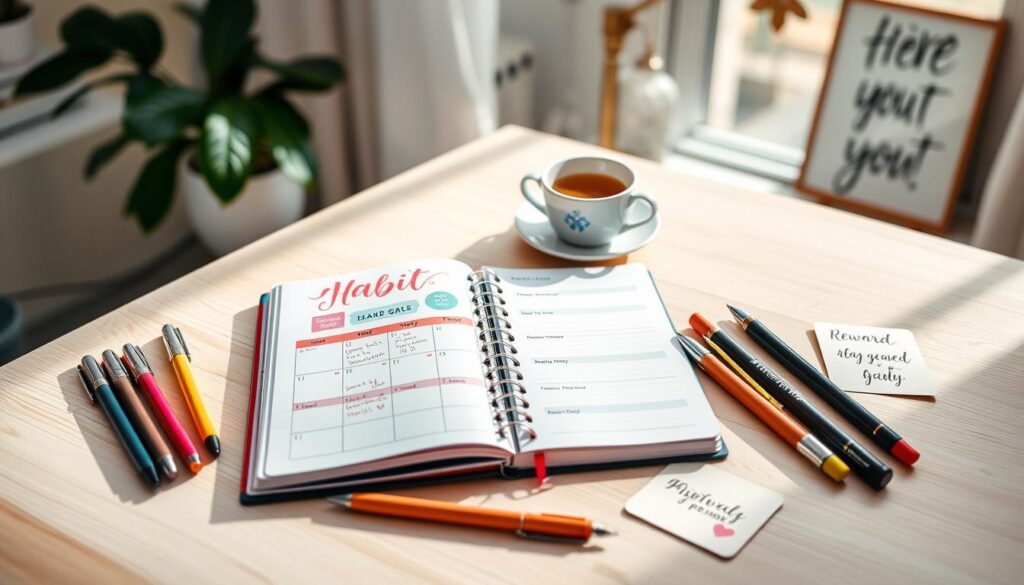
- A Premium Habit Planner: This is your command center. Look for layouts that support quarterly themes, monthly focuses, and weekly sprints.
- High-Quality Pens: Smooth-writing instruments make the act of tracking a pleasure, not a chore. They reduce friction and encourage daily use.
- Pre-Printed Reward Cards: This is where theory meets action. These cards make the celebration concept tangible. You can immediately reward a completed weekly sprint or a monthly milestone.
These bundles are perfect for gifting to a motivated colleague or as a personal investment in your success. They signal a serious commitment to growth.
For those seeking a more complete system, all-in-one systems take bundling further. Brands like Silk + Sonder offer a membership model. You receive a guided self-care journal, trackers, and community support delivered monthly.
This approach builds a lasting habit-tracking ritual. Other systems, like The Elevate Planner or The Life Workbook, are one-time purchases. They offer a complete framework in a single, durable package.
| Product Type | Purchase Model | Key Components | Best For |
|---|---|---|---|
| Guided Journal Membership | Monthly/Annual Subscription | Fresh themed journals, trackers, community access, digital tools | Individuals who value novelty, guidance, and ongoing support |
| Premium Planner System | One-Time Purchase | Durable binder or book, goal-setting frameworks, habit trackers, instructional guide | Professionals who prefer a permanent, all-in-one system and lifetime use |
| Starter Gift Bundle | One-Time Purchase | Planner, writing tools, reward cards, stickers, pouch | Beginners or gift-givers wanting a beautiful, ready-to-use kit |
Choosing a curated bundle aligns perfectly with a mission to empower professionals. It provides actionable tools from day one. You bypass the research phase and jump straight into building your quarterly and monthly goal systems.
Whether you select a subscription for renewed inspiration or a one-time kit for lasting structure, these bundles turn intention into action. They are the physical foundation of your success framework.
Printable Pack: goal canvas, tracker variants, review sheets
A dedicated printable pack is a great way to start. It comes with a goal canvas for planning your year and quarters. You’ll also find different trackers like grids and wheels for logging habits. Plus, there are review sheets for weekly and monthly check-ins.
You can get these templates in both physical and digital forms. They’re free, making it easy to get started. Print them for a binder or use them digitally in apps like GoodNotes or Notability. This way, you can try them out before buying a premium planner.
The real success comes from using the system regularly. The cycle of planning and tracking helps you stay on track. Whether you use a notebook, printable sheets, or a bundle with pens and rewards, what’s important is your commitment.
Now, it’s time to choose your tool and pick a quarterly theme. Plan your monthly goals and the habits to support them. Start tracking, collect evidence, and schedule your reviews. The right system can turn your dreams into reality.
