
New reading assessment data show improvements in all five elementary grades at Hartford Public Schools, where 11 schools are implementing the Connecticut Literacy Model. With 29 of 30 reported reading comparisons showing progress, educators are examining whether structured literacy instruction, classroom coaching, and targeted interventions can help more children develop essential reading skills.
Hartford, Connecticut — Elementary school students in Hartford Public Schools are showing encouraging early reading gains during the 2026–27 academic year, according to new data presented to the Connecticut State Board of Education.
The results, reported on November 10, 2026, show that 29 of 30 year-over-year reading comparisons improved across participating schools and grade levels.
A particularly important finding involves the DIBELS Composite benchmark, a widely used measure of foundational reading skills.
The percentage of students meeting or exceeding this benchmark increased in every grade from first through fifth when fall 2026 results were compared with fall 2025.
Third grade recorded the largest increase, rising from 39% to 48%, a gain of nine percentage points.
First grade improved from 35% to 43%, while fifth grade rose from 28% to 35%.
The findings come as 11 Hartford schools implement the Connecticut Literacy Model, an initiative designed to strengthen evidence-based reading instruction through professional development, instructional coaching, schoolwide literacy planning, and targeted support for struggling readers.
Connecticut Deputy Education Commissioner for Academics and Innovation Charles Hewes presented the results at the November 4, 2026, State Board of Education meeting.
Hartford Superintendent Dr. Andraé Townsel also welcomed the improvements, recognizing the contributions of teachers, school leaders, families, and students.
The data offer an encouraging indication of progress, but they also reveal a continuing challenge: in every grade measured, fewer than half of students met or exceeded the beginning-of-year DIBELS Composite benchmark.
The central question is whether Hartford can sustain its recent improvements and help more children become proficient readers as the school year progresses.
Hartford’s Reading Gains: Key Facts
Schools using the literacy model
11
Comparisons showing gains
29 of 30
Largest benchmark increase
+9 pts
Grades showing improvement
5 of 5
Figures reflect fall 2026 reading assessment comparisons with fall 2025, as reported by CT Insider on November 10, 2026. The 29-of-30 figure covers multiple reading measures, not 30 schools or 30 students. Connecticut Post
| Key detail | Verified information |
|---|---|
| School district | Hartford Public Schools |
| Location | Hartford, Connecticut |
| Literacy initiative | Connecticut Literacy Model |
| Participating Hartford schools | 11 |
| Grades in the reported benchmark comparison | Grades 1–5 |
| Reading assessment | DIBELS Composite |
| Comparison periods | Beginning of 2025–26 and 2026–27 |
| Positive reading comparisons | 29 of 30 |
| Largest benchmark gain | Third grade, +9 percentage points |
| Only reported decline | Fourth-grade maze comprehension, −1 percentage point |
| State official presenting results | Charles Hewes |
| Superintendent | Dr. Andraé Townsel |
| State board presentation | November 4, 2026 |
| News report | November 10, 2026 |
These findings concern the percentage of students meeting specific reading benchmarks.
They do not establish that every individual student improved, nor do they prove that the Connecticut Literacy Model alone caused the gains.
Reading Scores Improve in Every Grade From First Through Fifth
The most important finding is the consistent improvement in the percentage of students meeting or exceeding the DIBELS Composite benchmark.
The reported fall-to-fall comparisons show gains ranging from four to nine percentage points.
Hartford reading benchmark results: Fall 2025 vs. Fall 2026
Students Meeting or Exceeding DIBELS Composite Benchmark
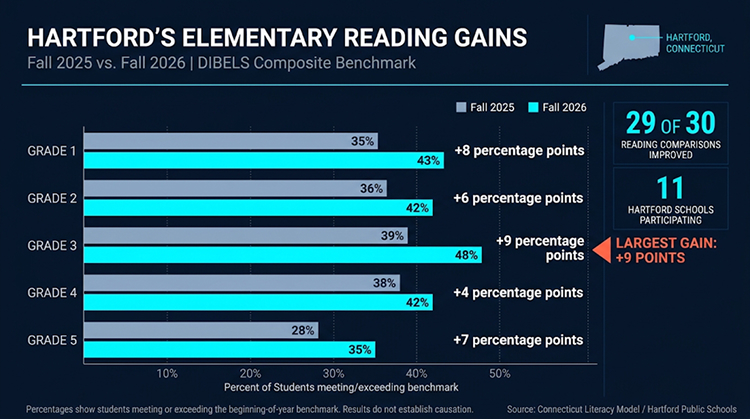
Percentage of students at or above benchmark at the beginning of each school year. Source: CT Insider, November 10, 2026.
Fall 2025
Fall 2026
0%15%30%45%60%Grade 1Grade 2Grade 3Grade 4Grade 5
| Grade | Fall 2025 | Fall 2026 | Change |
|---|---|---|---|
| Grade 1 | 35% | 43% | +8 percentage points |
| Grade 2 | 36% | 42% | +6 percentage points |
| Grade 3 | 39% | 48% | +9 percentage points |
| Grade 4 | 38% | 42% | +4 percentage points |
| Grade 5 | 28% | 35% | +7 percentage points |
Source: Connecticut reading data reported by CT Insider, November 10, 2026. These are percentages of students meeting or exceeding the benchmark, not average test scores. Connecticut Post
The results reveal several noteworthy trends.
Third grade records the largest improvement
Third-grade benchmark attainment increased from 39% to 48%.
That nine-percentage-point gain was the largest among the five grades.
Third grade is particularly important because students increasingly encounter longer texts, more complex vocabulary, and academic reading requirements across subjects.
Children who have difficulty decoding words or reading fluently may struggle to understand material in science, social studies, and mathematics.
The improvement suggests that more third-grade students entered the school year meeting the reading benchmark.
However, the data also indicate that 52% remained below the benchmark at the beginning of the year.
First grade improves by eight percentage points
First-grade benchmark attainment increased from 35% to 43%.
This improvement is significant because first grade is a foundational period for developing letter-sound knowledge, decoding skills, word recognition, and early reading fluency.
Effective instruction at this stage can help students establish the skills they will use throughout elementary school.
Still, 57% of first-grade students were below the benchmark in the reported fall assessment.
That finding reinforces the importance of continued instructional support.
Fifth grade makes progress but faces substantial challenges
Fifth grade improved from 28% to 35%, a seven-percentage-point increase.
Despite this progress, fifth grade had the lowest benchmark attainment among the five grades.
Approximately 65% of fifth-grade students were below the reported benchmark.
This is an important reminder that reading difficulties do not disappear automatically as children grow older.
Students who enter upper elementary grades with weak foundational skills may need continued intervention alongside increasingly demanding classroom instruction.
Third- and Fourth-Grade Results Exceed Last Year’s Spring Benchmarks
The data also provide a comparison with the end of the previous school year.
For third and fourth grades, fall 2026 benchmark attainment was higher than the percentages recorded at the end of 2025–26.
| Grade | Spring 2026 | Fall 2026 | Change |
|---|---|---|---|
| Grade 3 | 46% | 48% | +2 percentage points |
| Grade 4 | 39% | 42% | +3 percentage points |
These comparisons are encouraging because the new academic year has only recently begun.
However, they should be interpreted carefully.
The spring and fall results may represent different groups of students because children advance to the next grade each year.
They should not be treated as evidence that the same individual students maintained or increased their reading performance over the summer.
The figures instead show that the share of students meeting the benchmark in those grade-level groups was higher in fall 2026 than in the corresponding grades at the previous school year’s end. Connecticut Post
What Does the 29-of-30 Improvement Figure Actually Mean?
One of the most attention-grabbing findings is that 29 of 30 reported reading comparisons improved.
That represents approximately 96.7% of the reported comparisons.
But the statistic requires context.
It does not mean that 96.7% of Hartford students improved their reading skills.
Nor does it mean that 29 of 30 schools showed gains.
The number refers to 30 comparisons across reported reading measures and grades.
Of those comparisons, 29 were positive.
The sole reported decline was a one-percentage-point decrease in fourth-grade maze comprehension.
What is maze comprehension?
Maze comprehension is a reading assessment in which students read a passage and select words that make sense within the text.
It is designed to provide information about how effectively students understand connected written material.
Because it involves reading comprehension under timed conditions, it measures a different aspect of literacy from assessments focused primarily on recognizing letters, decoding words, or reading aloud.
A small decline in one measure does not negate the improvements elsewhere.
However, it highlights why schools need to examine multiple aspects of reading development rather than relying on a single overall score.
Why multiple reading measures matter
Reading involves several interconnected skills.
A student may improve in decoding but continue to struggle with vocabulary.
Another student may recognize words accurately but have difficulty understanding longer passages.
Schools therefore need assessments that provide information about different reading processes.
Hartford’s reported data are encouraging because improvements appeared across most comparisons.
But further analysis is needed to determine how these gains translate into stronger comprehension, sustained achievement, and long-term academic performance.
What Is the Connecticut Literacy Model?
The Connecticut Literacy Model is a statewide school improvement approach designed to strengthen reading instruction and reduce persistent literacy gaps.
Rather than introducing a single textbook or requiring schools to replace every existing instructional resource, the model helps educators improve how reading instruction is planned, delivered, monitored, and supported.
According to the Connecticut State Department of Education and the Connecticut Partnership for Literacy Success, participating schools receive assistance from reading coaches, professional learning specialists, and evaluators.
The model emphasizes foundational reading instruction in kindergarten through third grade, while its effects and related assessment data can extend into later elementary grades.
Its core priorities include high-quality classroom instruction, schoolwide literacy planning, instructional leadership, and intensive interventions for students who need additional support. Connecticut Post
Five components of the Connecticut Literacy Model
- Evidence-based classroom reading instructionHelp educators apply research-informed approaches to foundational literacy, including explicit teaching and appropriate reading practice.
- Instructional coachingProvide teachers with job-embedded professional learning, feedback, and assistance with classroom implementation.
- Schoolwide literacy planningAlign instruction, assessment, intervention, and improvement priorities across classrooms and grade levels.
- Literacy leadershipSupport principals and instructional leaders in creating the conditions needed for effective reading instruction.
- Targeted reading interventionIdentify students who need additional support and provide instruction responsive to their specific reading difficulties.
These components are designed to work together.
Teachers need knowledge of effective reading instruction, but they also need appropriate materials, time to plan, useful assessment information, and support from school leaders.
A comprehensive literacy improvement model addresses these connected requirements rather than focusing exclusively on one teaching technique.
The 11 Hartford Schools Implementing the Literacy Model
According to the Connecticut Partnership for Literacy Success, 11 Hartford schools are participating in the Connecticut Literacy Model.
They include neighborhood schools, magnet schools, and a school serving students beyond the earliest elementary grades.

| Participating school | Location |
|---|---|
| Burns School | Hartford, Connecticut |
| MD Fox School | Hartford, Connecticut |
| Kennelly School | Hartford, Connecticut |
| Rawson School | Hartford, Connecticut |
| Parkville School | Hartford, Connecticut |
| Naylor School | Hartford, Connecticut |
| Wish School | Hartford, Connecticut |
| Noah Webster School | Hartford, Connecticut |
| Environmental Sciences Magnet School at Mary Hooker | Hartford, Connecticut |
| Montessori Magnet at Batchelder | Hartford, Connecticut |
| West Middle School | Hartford, Connecticut |
The schools are identified in the November 10 report. The published grade-level percentages should not be interpreted as separate performance results for each individual school. Connecticut Post
Why working across multiple schools matters
Literacy reform becomes more challenging when a district must support schools with different student populations, staffing arrangements, and instructional needs.
Some schools may have more experienced reading specialists.
Others may need additional support implementing assessments, organizing intervention groups, or training teachers.
A coordinated model can help schools share instructional expectations while allowing educators to respond to local circumstances.
The Hartford initiative also creates opportunities for district leaders to compare implementation experiences and identify barriers that affect reading instruction.
However, the publicly reported data do not yet establish which individual school practices contributed most to the observed gains.
How Reading Coaches Help Teachers Improve Instruction
Instructional coaching is one of the central features of the Connecticut Literacy Model.
Reading coaches work with educators to strengthen classroom practices and support the implementation of evidence-based instruction.
Unlike professional development delivered exclusively through occasional workshops, coaching can take place within the context of teachers’ regular work.
What classroom coaching can involve
A literacy coach might help a teacher review reading assessment data, plan a phonics lesson, or identify students who need additional decoding practice.
The coach could also observe a lesson and discuss whether students had sufficient opportunities to respond, practice new skills, and receive corrective feedback.
For example, a hypothetical second-grade teacher might discover that several students can recognize common words but struggle to decode unfamiliar multisyllabic words.
Working with a coach, the teacher could adjust instruction to provide more explicit practice with syllable patterns and word analysis.
The teacher could then review student progress to determine whether the additional support was effective.
This is an illustrative scenario, not a documented classroom observation from Hartford.
Why coaching may be more useful than training alone
A workshop can introduce educators to the research behind reading development.
However, teachers must apply that knowledge while managing classroom instruction, student behavior, different learning needs, and limited instructional time.
Coaching can help bridge the gap between understanding a teaching approach and implementing it consistently.
The Connecticut Literacy Model combines professional learning with practical support to help educators strengthen their instruction over time.
Whether coaching independently explains Hartford’s gains remains a research question.
The reported data do not isolate its effects from those of other district and state initiatives.
Science of Reading: The Research Behind Connecticut’s Approach
The Connecticut Literacy Model operates within the state’s broader commitment to evidence-based literacy instruction.
The Science of Reading refers to a substantial body of interdisciplinary research examining how people learn to read and which instructional approaches support reading development.
It draws on cognitive science, psychology, linguistics, education, and related fields.
The research emphasizes that successful reading involves multiple interconnected processes.
Foundational skills and reading comprehension
Early readers must learn to connect written symbols with spoken language.
They also need to develop accurate word recognition, fluency, vocabulary, language comprehension, and knowledge.
| Reading component | Why it matters |
|---|---|
| Phonemic awareness | Helps children recognize and work with individual sounds in spoken words |
| Phonics | Teaches relationships between letters and sounds |
| Decoding | Enables readers to identify unfamiliar written words |
| Word recognition | Supports increasingly accurate and efficient reading |
| Fluency | Helps readers read connected text with accuracy and appropriate pacing |
| Vocabulary | Supports understanding of words and ideas |
| Language comprehension | Enables readers to understand the meaning of text |
These components are complementary.
A child who can decode words accurately may still need support with vocabulary or comprehension.
Similarly, a student with strong oral language skills may struggle to read independently if word recognition remains difficult.
Effective literacy instruction must address the skills students need rather than assuming one method will resolve every reading difficulty.
Why explicit instruction is important
Research supports clear, systematic teaching of foundational reading skills, particularly for children who are beginning to read or who have persistent decoding difficulties.
Explicit instruction can involve explaining a skill, modeling how it works, providing guided practice, and checking whether students can apply it independently.
However, reading instruction also needs meaningful opportunities to develop vocabulary, comprehension, writing, and knowledge.
A strong literacy program combines foundational skill development with broader language and learning experiences.
Connecticut’s Right to Read Reforms Provide the Policy Background
Hartford’s progress is part of a broader Connecticut effort to strengthen literacy instruction.
The state’s Right to Read legislation and related initiatives have increased attention to research-based reading instruction, instructional materials, teacher preparation, and early intervention.
In an August 31, 2026 announcement, the Connecticut State Department of Education described several major investments:
| State initiative | Announced investment |
|---|---|
| K–3 literacy assessments and instructional materials | More than $24 million |
| Professional learning for educators and leaders | $15 million |
| Statewide literacy coaching initiative | $2 million |
| Federal grant supporting targeted reading intervention across 75 elementary schools | $10 million over five years |
| Additional investment in the Office of Dyslexia and Reading Disabilities | $500,000 |
These are separate statewide investments and initiatives. They should not be added together and described as funding awarded directly to Hartford’s 11 participating schools.
Why statewide support matters
Individual schools may struggle to implement major instructional changes without additional resources.
Teachers need access to professional learning, appropriate curricula, reliable assessments, and intervention materials.
School leaders need guidance on how to organize instruction and monitor progress.
State-level investment can help provide the infrastructure needed to support these activities.
Connecticut’s literacy strategy reflects an effort to connect classroom instruction with broader systems of professional learning and educational support.
Hartford’s results offer one example of how these reforms are being implemented locally.
Hartford’s Reading Progress Extends Beyond the Latest Fall Results
The November 2026 findings are not the district’s only reported literacy improvements.
Earlier in the year, Hartford Public Schools reported progress in elementary reading achievement.
In an October 9, 2026 superintendent update, the district stated that the percentage of K–5 students reading at or above expectations had increased from 41% to 49%.
The district also reported an 85.3% four-year graduation rate for its most recently reported graduating class.
These figures reflect different reporting periods and measures from the November DIBELS grade-level comparisons and should not be combined into a single performance trend without further methodological information. Hartford Public Schools
Why different literacy statistics should not be confused
Schools use several assessments to evaluate reading development.
A DIBELS Composite benchmark measures foundational reading performance at a particular assessment point.
Statewide English language arts assessments evaluate broader academic skills and typically serve different grade levels.
District-reported literacy proficiency figures may also use different assessment definitions or student populations.
Consequently, a reported increase in one measure does not necessarily represent the same improvement on another.
Responsible analysis requires identifying the assessment, grade level, student group, and comparison period for each statistic.
Connecticut’s Statewide Reading Results Show Both Progress and Persistent Gaps
The Hartford findings also come against a broader backdrop of gradual academic recovery across Connecticut.
In August 2026, the state reported improvement in English language arts performance during the 2025–26 academic year.
The statewide English language arts Connecticut Performance Index increased from 64.7 in 2025 to 65.0 in 2026.
However, it remained below the 2019 index of 67.7.
The state’s target index is 75.
Connecticut English Language Arts Performance Index
Statewide results for all students. The index is not a percentage of students proficient.
The same state report showed that students with disabilities, English learners, and students from lower-income households continued to face achievement gaps.
For example, the 2026 English language arts index was 47.1 for students with disabilities and 51.4 for English learners, compared with 65.0 for all students statewide.
These statewide figures are not directly comparable with Hartford’s DIBELS benchmark percentages.
They nevertheless illustrate why Connecticut continues to invest in reading instruction and targeted intervention.
Why early literacy gaps matter
Students who struggle with foundational reading skills may find it increasingly difficult to engage with academic material as they advance through school.
Reading difficulties can affect performance in subjects that require students to understand instructions, analyze information, and learn from textbooks.
Early identification and appropriate intervention can help address these challenges.
But improvements must also continue beyond the earliest grades.
Hartford’s fifth-grade results show why sustained literacy support remains important even after children complete kindergarten through third grade.
Hartford’s Reading Gains Are Encouraging, but Important Questions Remain
The latest findings show progress across multiple grades and reading measures.
However, several limitations are important when interpreting the results.
1. These are beginning-of-year results
The fall 2026 data provide an early snapshot of the academic year.
Students will need continued instruction and assessment to determine whether improvements persist through winter and spring.
A strong beginning-of-year result is encouraging, but it does not guarantee that students will maintain the same trajectory.
2. The comparisons do not prove causation
Hartford’s gains occurred while participating schools were implementing the Connecticut Literacy Model.
That timing is consistent with the possibility that the model is contributing to improved instruction.
However, the publicly reported comparisons do not establish that the model alone caused the improvements.
Other factors may include changes in school staffing, student attendance, curricula, interventions, family engagement, or the composition of grade-level groups.
A stronger causal evaluation would require additional research designed to distinguish the effects of the literacy model from those of other influences.
3. Most students remain below the reported benchmark
Although every grade improved, fewer than half of students met or exceeded the beginning-of-year DIBELS Composite benchmark.
The highest reported percentage was 48% in third grade.
The lowest was 35% in fifth grade.
This means Hartford has made progress while still facing substantial reading challenges.
4. School-level and student-group differences need further examination
The published figures do not provide a complete breakdown of progress by individual school, disability status, English learner classification, or economic disadvantage.
These details would help determine whether improvements are broadly shared.
District leaders will need to examine whether students with the greatest reading difficulties are making meaningful progress.
5. Long-term reading comprehension remains essential
Improved foundational reading skills are important, but students must also develop the ability to understand increasingly complex texts.
The small decline in fourth-grade maze comprehension reinforces the importance of monitoring comprehension alongside decoding and fluency.
What Hartford’s Education Leaders Are Saying
Connecticut Deputy Education Commissioner Charles Hewes presented the reading data at the November 4 State Board of Education meeting.
He characterized the beginning-of-year improvements across grades one through five as an encouraging indication associated with implementation of the literacy model, while emphasizing the need to continue monitoring results.
Hartford Superintendent Dr. Andraé Townsel praised the educators, school leaders, support staff, families, and students contributing to the district’s progress.
The district has also acknowledged that sustaining improvement will require continued financial and instructional support.
In its October 9 update, Hartford Public Schools identified financial pressures arising from rising costs, expiring grants, and structural funding challenges.
The district said it had eliminated more than 600 positions and reduced spending by more than $200 million over the preceding decade. Connecticut Post+1
Why funding stability could affect literacy progress
Effective literacy instruction depends on more than choosing an appropriate teaching method.
Schools need qualified teachers, reading specialists, instructional coaches, intervention time, and reliable assessment systems.
If financial pressures reduce staffing or professional learning opportunities, maintaining consistent support may become more difficult.
Hartford’s challenge is therefore both instructional and organizational.
The district must build on its reading gains while managing the resources required to sustain them.
What Other School Districts Can Learn From Hartford
The Connecticut Literacy Model is also being used in schools in other Connecticut districts, including East Hartford, Middletown, Norwalk, and Waterbury. Connecticut Post
Hartford’s experience offers several lessons worth examining, although its results should not yet be treated as proof of a universally successful intervention.
First, literacy improvement requires a coordinated approach. Classroom instruction, teacher coaching, assessment, leadership, and targeted interventions need to work together.
Second, schools should measure progress regularly. Beginning-of-year assessments provide information that educators can use to identify students requiring additional support.
Third, district leaders should examine more than one reading measure. Gains in decoding and word recognition need to be accompanied by progress in comprehension and broader academic literacy.
Finally, sustainability matters. Improvements are more valuable when schools can maintain effective practices despite changes in staffing, leadership, or funding.
What Parents Can Do With Their Child’s Reading Assessment Results
For families, reading assessment data can provide a useful starting point for conversations with teachers.
Parents can ask whether their child is meeting the expected reading benchmark and which specific skills need additional development.
A child struggling with letter-sound relationships may need different support from a student who reads words accurately but has difficulty understanding a passage.
Families can also ask how frequently progress is monitored and what interventions are available when a child falls below expectations.
Reading together, discussing stories, and encouraging age-appropriate independent reading can support literacy development at home.
However, these activities should complement rather than replace specialized school instruction when a child has persistent reading difficulties.
What Happens Next for Hartford’s Literacy Improvement Efforts?
The next major test will be whether the reported gains continue throughout the 2026–27 school year.
Winter and spring assessments may provide additional information about student progress.
Future evaluations could also examine whether schools implementing the Connecticut Literacy Model experience sustained improvements in foundational reading skills, comprehension, and academic achievement.
Literacy Progress Timeline
- Fall 2025 — Baseline comparisonBeginning-of-year DIBELS Composite benchmark results establish the previous year’s grade-level comparison.
- Spring 2026 — Previous school year endsThird-grade benchmark attainment reaches 46%, while fourth grade reaches 39%.
- Fall 2026 — New assessment resultsBenchmark attainment increases across grades one through five compared with fall 2025.
- November 4, 2026 — State Board presentationDeputy Commissioner Charles Hewes presents the literacy results to Connecticut education officials.
- November 10, 2026 — Findings publicly reportedCT Insider publishes the grade-level results and details of the Connecticut Literacy Model.
- Remainder of 2026–27 — Continued monitoringSchools and state officials are expected to monitor reading progress. Specific future results have not yet been reported.
Timeline based on the November 10, 2026 report. Future assessment outcomes are not yet known. Connecticut Post
Frequently Asked Questions
Did Hartford elementary school reading scores improve in 2026?
Yes. Fall 2026 DIBELS Composite benchmark results improved in every grade from first through fifth compared with fall 2025.
How many Hartford schools are using the Connecticut Literacy Model?
Eleven Hartford schools are participating in the model.
What percentage of reading comparisons showed improvement?
Of 30 reported comparisons, 29 improved. That is approximately 96.7% of the comparisons, not 96.7% of students.
Which grade showed the largest reading improvement?
Third grade recorded the largest increase in DIBELS Composite benchmark attainment, rising from 39% to 48%, a gain of nine percentage points.
What were the fifth-grade reading results?
The percentage of fifth-grade students meeting or exceeding the beginning-of-year benchmark increased from 28% in fall 2025 to 35% in fall 2026.
What is DIBELS?
DIBELS stands for Dynamic Indicators of Basic Early Literacy Skills. It is a set of standardized reading assessments used to screen foundational literacy skills and monitor progress.
What is the Connecticut Literacy Model?
It is a school improvement approach that supports evidence-based reading instruction through coaching, professional development, literacy leadership, schoolwide planning, and targeted interventions.
Who is Hartford Public Schools’ superintendent?
Dr. Andraé Townsel is the superintendent of Hartford Public Schools.
Who presented the results to Connecticut education officials?
Charles Hewes, Connecticut’s deputy commissioner for academics and innovation, presented the findings at the November 4, 2026, State Board of Education meeting.
Did every reading measure improve?
No. Of the 30 reported comparisons, one declined: fourth-grade maze comprehension decreased by one percentage point.
Does the data prove that the Connecticut Literacy Model caused the gains?
No. The results show improvement during implementation, but additional evaluation would be needed to establish the model’s causal impact.
Are most Hartford elementary students now meeting reading benchmarks?
Not yet. Despite the gains, fewer than half of students in each of the five reported grades met or exceeded the beginning-of-year DIBELS Composite benchmark.
Conclusion: Hartford’s Reading Gains Offer Hope, but Sustained Progress Is the Real Test
Hartford Public Schools’ latest reading data provide encouraging evidence of progress in early literacy.
Across 11 schools implementing the Connecticut Literacy Model, 29 of 30 reported reading comparisons improved, while the percentage of students meeting the DIBELS Composite benchmark increased in every grade from first through fifth.
Third grade recorded the largest gain, rising nine percentage points to 48%.
The results suggest that Hartford’s emphasis on evidence-based instruction, professional learning, classroom coaching, and targeted intervention may be helping schools strengthen reading performance.
However, the improvements remain preliminary.
Most students in the reported grades are still below the beginning-of-year benchmark, and the available comparisons cannot isolate the effects of the literacy model from other influences.
Hartford must also navigate financial pressures that could complicate its efforts to sustain instructional improvement.
The most important question is no longer simply whether Hartford’s reading scores are rising, but whether the district can turn those early gains into lasting literacy achievement for a substantially larger share of students.
If progress continues, Hartford could provide valuable lessons for other districts working to improve foundational reading skills through coordinated, research-based instruction.
