
The old way of teaching is outdated, like a card catalog. It’s time for a change.
We aim to break down the wall between books and labs. It’s not just about adding fun to schoolwork. It’s about changing how we learn.
Imagine a kid loving a story about robotics. Why should that excitement end with the book? We want to turn that interest into real experiments.
This section is your guide to change. We mix the best of literacy strategies with the fun of reading. Many resources support this, like Poetry Walks and Q&A Reports.
We focus on how to do it, not just why. With a careful eye, we’ll find science & math books that inspire action. They invite you to create, test, and discover.
Why Combine Reading and STEM?
The post-age-eight reading slump is not natural. It’s a failure to link reading to the real world kids live in. The Scholastic Kids & Family Reading Report shows a big drop in reading aloud after age eight. Is it just a coincidence, or is it because we see reading as a solo, passive skill?
Adding STEM to reading is a smart move. It answers kids’ big question: “When will I ever use this?” A survival story teaches physics and resource use. A tale about injustice can lead to a data project. This is cross-curricular literacy at its best.
This “Power Duo” has real benefits. First, it improves understanding because words are used, not just memorized. Knowing “fulcrum” is important when building a lever to save a character. Second, it makes learning feel real and connected to the world.
This method sparks true curiosity. It boosts critical thinking and problem-solving through stories. It also creates a special time for family bonding without screens. You’re not just listening; you’re working together on a mission.
To see the change, look at how reading changes from traditional to integrated.
| Aspect | Traditional Reading Approach | Reading + STEM Integration |
|---|---|---|
| Student Engagement | Often passive consumption; can lead to disinterest, even in older readers. | Active, problem-based engagement; reading is the first step in a hands-on mission. |
| Skill Development | Focuses mainly on decoding, fluency, and recall. | Builds analytical thinking, design process, and applied cross-curricular literacy at the same time. |
| Real-World Application | Frequently abstract or delayed; the “why” is often unclear. | Immediate and tangible. Comprehension is tested by whether the bridge you designed holds weight. |
| Assessment of Understanding | Measured by quizzes, worksheets, and book reports. | Measured by project success, iterative design, and the ability to explain the “how” and “why.” |
We aim to go beyond just feeding kids information. We want to teach them to hunt, cook, and innovate with it. That’s the true power of combining STEM and stories.
Recommended STEM-Themed Readers for Different Grades
Forget dusty textbooks; the real gateway to STEM curiosity lies within the pages of a well-chosen story. Curating the right book is the primer for the explosive device of curiosity. You wouldn’t use a sledgehammer to fix a watch, right? We need precision tools.
For the younger crowd (K-2), picture books are like covert engineering blueprints. The story is the Trojan horse, smuggling in concepts of cause, effect, and simple mechanics. A book about building the tallest block tower isn’t just a tale of competition—it’s a lesson in structural integrity and trial-and-error.
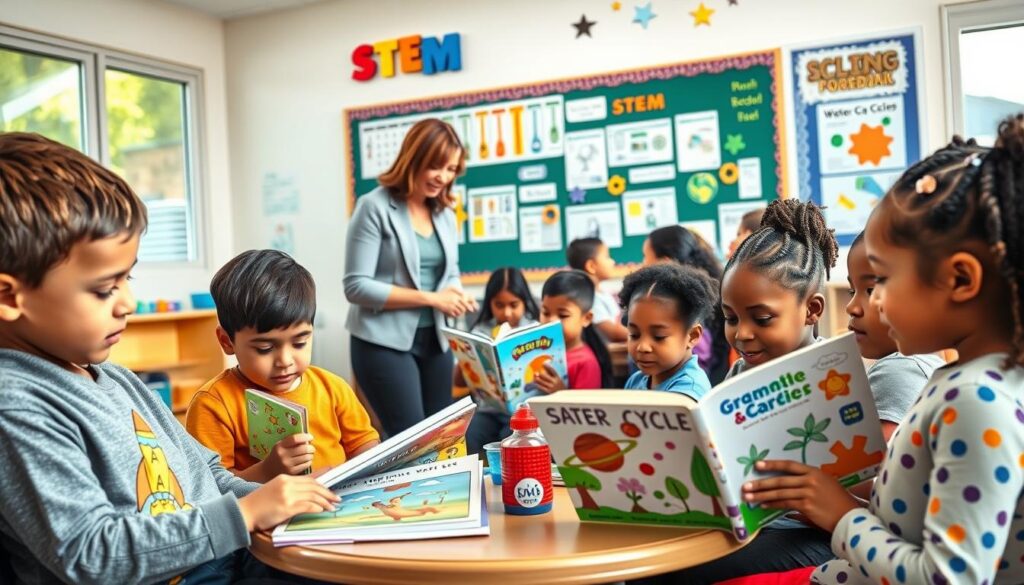
Middle grades (3-5) are ready for novels where the plot is the STEM challenge. Take Hatchet. It’s not merely a survival story. It’s a masterclass in resource management, biology, and physics. The protagonist’s struggle becomes the reader’s engineering puzzle.
For upper elementary and middle school (6-8), the complexity deepens. Fiction like The One and Only Ivan uses animal perspectives to explore habitat design and animal behavior science. The best science & math books in nonfiction ditch the lecture. They adopt a detective’s Q&A format, turning each page into an investigation.
The table below is your strategic arsenal. It matches grade-appropriate STEM-themed books with direct links to hands-on discovery.
| Grade Band | Book Title & Type | Core STEM Theme | Launchpad Activity |
|---|---|---|---|
| K-2 | Rosie Revere, Engineer (Picture Book) | Iterative Design, Perseverance | Build a simple flying machine from household items. |
| 3-5 | The Wild Robot (Fiction Novel) | Robotics, Environmental Integration | Design and draw a robot adapted to a specific ecosystem. |
| 3-5 | National Geographic Kids Why? (Nonfiction Q&A) | Scientific Inquiry, Earth Science | Formulate and research a new “why” question about the planet. |
| 6-8 | Hatchet (Fiction Novel) | Survival Science, Resourcefulness | Create a prioritized “supply list” for a wilderness scenario. |
| 6-8 | The Boy Who Harnessed the Wind (Young Reader Ed.) | Engineering, Renewable Energy | Build a simple model windmill from basic materials. |
This list isn’t just a reading log. It’s a launch sequence. Each title provides the narrative spark, while the suggested activity provides the oxygen. Together, they create the fire for genuine STEM reading activities. The goal is to move from “I read a book” to “I solved a problem the character faced.” That’s the alchemy we’re after.
Book-Based Projects and Experiments
Forget just reading. The real magic in STEM reading activities starts when you start making things. Students become engineers, using books as guides. They go from reading about Newton’s laws to making a marble run to show them.
How do you make this happen? A good method breaks it into six steps. It’s like the scientific method, but with stories.
- Read & Discuss: This isn’t just reading alone. It’s a group discussion. Why did a character build a bridge? What challenges would it face?
- Brainstorm: Here, your imagination runs free. Can we make a better home for a book’s animal? What machine could solve a problem?
- Plan & Design: Ideas meet reality. You start sketching, listing materials, and predicting results. This turns dreams into plans.
- Build & Experiment: This is the fun, messy part. You use materials like tape, cardboard, and maybe vinegar and baking soda to make things real.
- Test & Refine: Does it work? Why not? This phase builds determination as you try again and again, improving your design.
- Share & Celebrate: The final step. Presenting your project shows off what you’ve learned and turns a private effort into a public achievement.
Not every project needs to be long. Sometimes, the best STEM reading activities are quick tasks. If you finish a book about buildings, try designing a bookmark with paper and a paperclip. If you read about the ocean, sketch and build a home for a sea creature using recyclables. These small projects keep creativity flowing.
Other activities focus on analyzing what you read. A Poetry Walk isn’t about lab coats. After reading a poem about nature, go outside, note your observations, and write your own poem about the local ecosystem. It connects reading to real-world science. Making a timeline from a historical novel into a diagram helps kids understand events and cause and effect.
The goal is to turn readers into creators. A child who reads about dinosaurs and then does an “edible excavation” (using tools to get chocolate chips out of a cookie) learns about paleontology by doing it. The book gives context, but the hands-on experiment brings understanding.
These book-based projects teach more than just facts. They teach how to do things, how to keep trying, and the joy of using what you know. The baking soda volcano shows why ideas matter. Your bookshelf is full of energy waiting to be turned into learning.
Digital STEM Literacy Tools
In today’s world, ignoring digital tools in STEM literacy is like banning calculators from a math olympiad. We’re not here to commit the Luddite fallacy. The book is sacred, but the library has a brand-new, multimedia annex.
Digital tools are the secret sauce that extends the narrative of your favorite science & math books. Imagine a child reading about Newton’s laws and then using an app to animate the forces at play. Or exploring the solar system in a text and then manipulating a 3D model of it in real-time. This isn’t replacement; it’s enhancement.
Used wisely, these resources are intellectual force multipliers. They provide simulation and visualization that a baking-soda volcano simply can’t. A dynamic graph makes abstract data tangible. An interactive molecule builder turns a complex diagram into a plaything. This is the modern science notebook.
So, what’s in the toolbox? Not all screens are created equal. Here’s a breakdown of digital tool categories that serve as powerful companions to physical science & math books.
| Tool Type | Example / Popular Resource | Best For | Key Benefit |
|---|---|---|---|
| Simulation Apps | PhET Interactive Simulations (Univ. of Colorado), Algodoo | Physics, Chemistry, Engineering Concepts | Safe, repeatable experimentation with variables you can’t easily control in a home lab. |
| Interactive eBooks & Websites | NASA’s Eyes, PBS Kids Science Games | Astronomy, Earth Science, Foundational Skills | Pairs authoritative content with embedded videos, quizzes, and clickable models to deepen context. |
| Coding & Logic Platforms | Scratch (MIT), Code.org | Mathematical Reasoning, Computational Thinking | Transforms abstract logic and problem-solving into visual, story-based creation. |
| Data Visualization Tools | Google Earth Engine, Wolfram Alpha | Advanced Math, Environmental Science, Statistics | Brings massive datasets and complex equations to life with immediate, manipulable graphics. |
The trick is curation and connection. Don’t just hand over a tablet. Pair the digital experience directly with a chapter from their physical books. Set a clear mission: “Use this solar system app to find three facts about Jupiter that our book didn’t mention.” This creates a semantic bridge between media.
Think of it this way. The right digital tool doesn’t distract from the book; it argues with it, questions it, and brings its static images into glorious, interactive motion. Your child’s shelf of science & math books just got a whole lot smarter.
Ways to Engage Reluctant Readers
Getting a kid to see reading as fun can be tough. But, hiding literacy in a robot kit can change things. The reluctant reader isn’t broken; they just need the right spark. Traditional stories often miss the mark.
Our goal is to make them need to read. It’s not about forcing them to read. It’s about making them want to.
Imagine using a STEM activity as bait. The book becomes a secret guide. Reading is just a way to get to the cool stuff.
Source 2 showed us that STEM makes reading exciting. It’s about changing how we look at books. Instead of saying, “Let’s read about planets,” say, “We’re on a mission. This book is our guide.”
Here are some ways to make reading cool:
- High-Interest, Project-Based Books: Pick topics that kids love. Think robots, dinosaurs, or spy stories. The book is the plan for the adventure.
- Frame Reading as Intel Gathering: Make the text a source of clues. “We need to read page 22 to build the circuit.”
- Gamify the Process: Turn chapters into levels. Each part of the book is a step towards the goal.
- Embrace the “Delicious” Factor: Make learning fun. A chemistry book can teach you how to make slime. The results are real and fun.
Rebranding literacy is key. It’s not just sitting and reading. It’s a tool for creating and understanding the world. When kids see that words can make things happen, they start to love reading.
Let’s compare old ways of reading to our new approach. The difference is huge.
| Engagement Strategy | Core Activity | Reader Hook |
|---|---|---|
| Traditional Assignment | “Read Chapter 4. Answer questions.” | Compliance, grade. |
| STEM Reading Activities (Mission-Based) | “Use Chapter 4 to identify the three forces needed to design a stable bridge out of popsicle sticks.” | Solving a real problem, creating something. |
| Generic Science Book | Read about plant biology. | Academic curiosity. |
| Project-Linked STEM Reading | Read the same text to learn how to keep your classroom hydroponic garden alive. | Ownership, tangible results (food!). |
| Free Reading Time | Choose any book. | Personal interest (works for some). |
| Challenge-Based Reading | “Here’s a mystery box of parts. The book on the table is the only guide to assembling them into a working device.” | Puzzle-solving, urgency, tangible reward. |
This isn’t about making things simpler. It’s about making them smarter. We meet the critic where they are. We offer a mix of physical and mental challenges.
The real win is when they start reading on their own. They’ve learned that reading is the key to awesome stuff. That’s how we turn reluctance into excitement.
Tracking Growth
If a tree falls in a forest and no one documents it, did science happen? We love our data, but a child’s growth can’t be measured by just a test score. It’s like judging a novel by its word count.
The real story is messy and brilliant. It’s found in the margins, on stained pages, and in moments of success and failure. Your main tool for tracking this story is a simple science notebook.
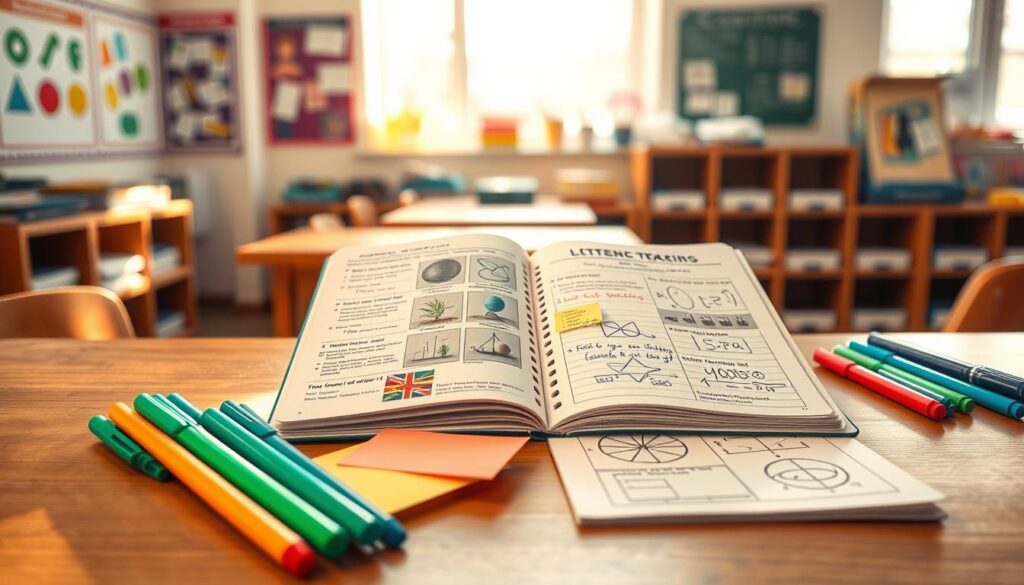
Think of it as a sacred text. Here, ideas are born, plans are made, and observations are recorded. You’re not just looking for the right answer. You’re checking if their questions are clear, their drawings precise, and their conclusions smart.
This shift needs a new way of seeing. Let’s compare the old way with the new approach.
| Assessment Aspect | Standardized Metric Mindset | Narrative Progress Mindset |
|---|---|---|
| Primary Tool | Bubble sheet, multiple-choice test | Science notebook, project journal, digital portfolio |
| What’s Measured | Factual recall at a single point in time | Evolution of thought, design iteration, and quality of reflection |
| Evidence of Literacy | Isolated vocabulary scores | Ability to communicate complex procedures and justify conclusions—true cross-curricular literacy |
| Role of Failure | Penalty; wrong answer | Data point; documented and analyzed for learning |
| Final Output | A grade or percentile | A rich artifact that tells the story of inquiry |
So, how do you assess this? Look at the whole journey, not just the end. Are their questions getting better? Is their design improving? This shows growth.
Documenting this journey is a key literacy skill. It’s about using the right language and arguing from evidence. It’s the skill of a scientist, engineer, and storyteller all in one.
You’re not just tracking progress. You’re teaching students to write their own learning stories. And that’s a story worth reading.
School & Homeschool Case Studies
Let’s dive into real-life examples. We’ll see how two educators made cross-curricular literacy a daily part of their teaching. It’s one thing to talk about it, but it’s another to make it happen.
How does this idea work in real classrooms? The answer is in the details, not just in theory.
Meet the public school teacher who turned a second-grade science lesson into a reading adventure. Instead of a textbook, she used a story about a robot building a house. This story was at the right reading level for her students.
She used flexible grouping to make it work. Students were grouped by reading level. Each group got a version of the story that matched their skill level.
For example, advanced students looked for cause-and-effect in the story. Others identified material properties from pictures and simple sentences. The lesson was 45 minutes long, with 15 minutes for reading, 25 for a building challenge, and 5 for wrapping up.
Now, let’s look at homeschooling. The kitchen table is the classroom. A parent inspired by “Chef’s Club” created a “Kitchen Chemistry” theme for a week. The main book was about how bread rises.
The approach was thematic immersion. Reading the book led to measuring ingredients (math), observing yeast fermentation (science), and writing a recipe (literacy). The schedule was flexible, covering the day.
Assessment was holistic. It included the child explaining the process, the recipe card, and the final product. This showed how cross-curricular literacy is part of everyday life, not just school subjects.
These two examples show that different settings can achieve the same goal. The table below compares their approaches.
| Dimension | Public School Classroom | Homeschool Environment |
|---|---|---|
| Setting | Fixed time blocks, 20+ students | Fluid schedule, 1-5 students |
| Core Strategy | Flexible grouping with leveled texts | Thematic, project-based immersion |
| Resource Focus | Curated text sets, standardized materials | Real-world items, subscription kits, library |
| Assessment Style | Quick checks, observation, standards-aligned | Portfolio, discussion, real-world outcome |
| Key Advantage | Scalability within system constraints | Deep, personalized integration |
So, what do we learn from these examples? Both show that cross-curricular literacy can work in different ways. The classroom teacher adapts to the system, while the homeschool parent focuses on deep learning.
The key is to find tactics that work for you. It’s not about following a strict plan. It’s about being flexible and making it happen in your own way.
Conclusion
We started by tearing down the old silo between the library and the lab. What we have now is not empty space. It’s a garden.
This journey shows us that combining reading and STEM learning is more than just a task. It’s a new way of seeing. All the data supports this, from school projects to homeschool studies. This mix is truly transformative.
A great STEM-themed reader is like a blueprint. It turns a book-based project into a real-world construction site. The digital tools are the power tools. For the reluctant reader, it’s not a lecture but an open-world game.
Tracking growth means listening. The question changes from “Did you finish the chapter?” to “What did you build after the chapter?” The real measure isn’t a score. It’s the questions a student asks next.
The story doesn’t end when the book closes. That’s when the real experiment starts.
