
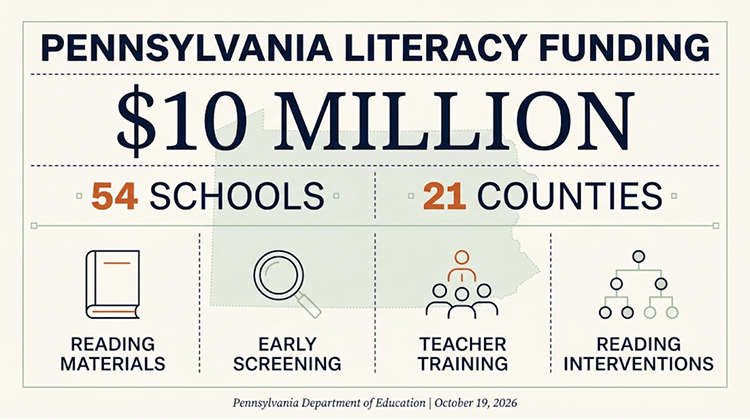
Pennsylvania has awarded $10 million in grants to 54 schools across 21 counties to strengthen early reading instruction. Announced on October 19, 2026, the funding will help schools adopt evidence-based literacy materials, train educators, screen young students for reading difficulties, and build support systems designed to improve reading outcomes.
Learning to read is one of the most important milestones in a child’s education. The ability to recognize words, connect letters with sounds, understand vocabulary, and make sense of written information influences how students learn across nearly every subject. Yet ensuring that children develop these skills requires more than access to books: schools also need effective instructional methods, trained teachers, and systems for identifying students who need additional help.
Pennsylvania is directing new funding toward those priorities. On October 19, 2026, Pennsylvania Department of Education (PDE) Secretary Dr. Carrie Rowe announced that the state had awarded $10 million in grants to 54 schools across 21 counties to support the implementation of structured literacy. The grants are intended to help schools develop the instructional capacity, resources, and systems needed to meet the state’s reading-instruction requirements.
The investment comes as Pennsylvania works to establish a consistent, evidence-based approach to reading instruction in kindergarten through third grade. Schools can use the funding for approved instructional materials, reading assessments, professional development, implementation planning, and systems that help educators respond when students struggle.
For teachers, families, and school leaders, the announcement raises an important question: how can targeted investments in reading instruction translate into measurable improvements in children’s literacy?
What Pennsylvania’s $10 Million Literacy Investment Includes
The Pennsylvania Department of Education announced the grants as part of a statewide effort to help schools implement structured literacy and prepare to meet requirements established under state law.
Pennsylvania structured literacy grants · October 19, 2026
$10 million
Total grant funding
54
Schools receiving grants
21
Pennsylvania counties
K–3
Core early literacy grades
According to the department, eligible uses include purchasing high-quality instructional materials aligned with structured literacy and the science of reading, acquiring approved universal reading screeners, and supporting educator participation in professional development. Schools can also use the grants to develop local implementation plans and strengthen literacy coaching, data-based decision-making, and intervention systems.
The funding is designed to support more than the purchase of a new reading program. Schools are expected to build the capacity to deliver instruction consistently, assess student needs, and adjust teaching when progress is not sufficient.
That distinction is important. New textbooks and assessments can provide useful resources, but their impact depends on how educators use them and whether schools have the time, training, and support needed to implement them effectively.
What Is Structured Literacy, and Why Does It Matter?
Structured literacy is an approach to reading instruction that teaches essential skills explicitly and systematically. Rather than expecting children to discover reading patterns on their own, teachers provide organized instruction in how written language works and help students apply those skills through practice.
Pennsylvania’s structured literacy framework emphasizes evidence-based reading instruction, professional preparation, curriculum materials, screening, and intervention. The state’s requirements build on legislation including Act 55 of 2022, Act 135 of 2024, and Act 47 of 2025.
Structured literacy commonly addresses several interconnected areas:
- Phonemic awareness: Recognizing and working with individual sounds in spoken words.
- Phonics and decoding: Understanding how letters and letter combinations represent sounds and using that knowledge to read unfamiliar words.
- Fluency: Reading accurately and smoothly, with appropriate pacing and expression.
- Vocabulary: Understanding the meanings of words encountered in speech and text.
- Language comprehension: Connecting words, sentences, background knowledge, and ideas to understand what is being read.
These skills reinforce one another. A student may recognize letters but struggle to blend sounds into words. Another may read words accurately but need help understanding complex sentences or unfamiliar vocabulary. Effective instruction helps teachers identify the specific difficulty rather than assuming every struggling reader needs the same intervention.
Structured literacy is not limited to children who already have reading difficulties. Systematic instruction can support the development of foundational reading skills across a classroom, while additional intervention can help students who need more intensive assistance.
The Pennsylvania Department of Education has published resources and guidance for schools implementing the state’s framework, including professional learning opportunities and curriculum-related materials through its Structured Literacy resource page.
Which Schools Are Receiving the Grants?
The new funding reaches elementary schools in communities across Pennsylvania, including districts in western, central, and southeastern parts of the state. The awards vary by school system and reflect the number of schools involved and the needs covered by each grant.
Several published awards illustrate how the investment is being distributed.
Penn Manor School District
$954,466
Lancaster County area
The award covers seven elementary schools: Central Manor, Conestoga, Eshleman, Hambright, Letort, Martic, and Pequea.
Mifflin County School District
$853,352
Central Pennsylvania
The grant supports four elementary schools: Easy Derry, Indian Valley, Lewistown, and Strodes Mills.
Armstrong School District
$821,794
Western Pennsylvania
Four schools are listed under the award: Elderton, Lenape, Shannock Valley, and West Hills Primary.
Penn-Delco School District
$536,485
Delaware County
The funding supports Aston, Coebourn, Parkside, and Pennell elementary schools. State representatives Leanne Krueger and Carol Kazeem discussed the award on October 20.
The Pennsylvania Department of Education’s 2026 Structured Literacy Grants page provides the full list of awardees and grant amounts.
The examples show that the funding is not confined to one major city or a single school district. Instead, grants are being distributed across a range of school systems, allowing participating districts to plan how structured literacy will work in their local classrooms.
However, the dollar amount alone does not indicate how much reading improvement a school will achieve. Results will depend on how the money is used, whether educators receive effective training, and whether students get the instruction and intervention they need.
How Schools Can Use the Funding to Improve Reading
The grants can support several parts of the literacy process, from selecting instructional materials to identifying students who need additional help. The state’s guidance emphasizes building a coherent system rather than treating these activities as unrelated purchases.

1. Adopt high-quality reading materials
Schools can use grant funds to purchase instructional materials aligned with structured literacy and the science of reading. These resources may include teacher guides, student reading materials, lesson sequences, and tools for practicing foundational skills.
When selecting materials, districts need to consider how well they align with state requirements and how effectively they serve their students. Teachers also need practical guidance on incorporating the materials into daily lessons.
2. Identify reading difficulties early
Universal reading screeners help schools identify students who may be experiencing difficulty with foundational literacy skills. Pennsylvania’s framework includes screening for students in kindergarten through third grade.
Screening is an early warning system, not a diagnosis. If a result suggests that a child may need help, teachers can use additional assessment and classroom observations to determine the next step.
Early identification gives schools an opportunity to respond before a student has accumulated months or years of difficulty. It also helps educators monitor whether additional instruction is making a difference.
3. Train teachers and reading specialists
Even strong instructional materials require knowledgeable educators. Professional development can help teachers understand the principles behind structured literacy, recognize reading difficulties, and apply evidence-based instructional methods.
The state’s grant guidance includes support for professional development approved by the Pennsylvania Department of Education. The broader legal framework also sets requirements for educator training in evidence-based reading instruction.
Training should connect directly to classroom practice. Educators benefit when they can observe lessons, practice teaching techniques, review student work, and receive feedback as they implement new methods.
4. Build coordinated reading interventions
Some students will need additional instruction beyond regular classroom lessons. Schools can use coaching, assessment information, and a Multi-Tiered System of Supports for reading, commonly known as MTSS-Reading, to organize that assistance.
A coordinated system allows educators to provide additional support based on student need, monitor progress, and make adjustments when an intervention is not producing sufficient improvement.
For example, a child who has difficulty decoding words may need focused practice with sound-letter relationships, while a child who reads accurately but struggles to understand a passage may need support with vocabulary and comprehension.
5. Strengthen collaboration across school teams
Literacy improvement is more sustainable when teachers, reading specialists, principals, and district leaders share responsibility for implementation.
Grant-funded planning can help schools establish clear instructional goals, agree on how student progress will be monitored, and decide how resources should be allocated. Regular collaboration can also help districts identify where teachers need more support.
The goal is to build a literacy system that continues to function after the initial grant funding has been spent.
Pennsylvania’s Reading Requirements: What Happens Next?
The $10 million announcement is part of a broader policy shift in Pennsylvania. State legislation establishes requirements for evidence-based reading instruction, instructional materials, educator preparation, and student screening.
Under Act 47 of 2025, school entities must adopt evidence-based reading curriculum materials for kindergarten through third grade by the beginning of the 2027–2028 school year. The law also sets timelines for selecting professional development programs and completing educator training.
These requirements create a deadline for districts to prepare their instructional systems. The grant funding is intended to help participating schools build the resources and capacity needed to meet those expectations.
The state’s guidance also makes clear that districts retain responsibility for choosing materials and implementation strategies that fit their local context, provided they comply with applicable requirements. This allows schools to adapt implementation to student needs while maintaining a common evidence-based foundation.
The challenge will be making the transition meaningful in the classroom. Purchasing materials and scheduling training are measurable administrative steps, but neither automatically guarantees improved reading outcomes. Schools will need to assess whether students are developing stronger foundational skills and adjust their approach when progress falls short.
How Will Pennsylvania Know Whether the Investment Works?
The ultimate measure of success is not the amount of money distributed or the number of schools receiving grants. It is whether students become stronger readers.
Schools and education leaders can look at several indicators as implementation moves forward:
- Reading-screening results: Are more students demonstrating age- and grade-appropriate foundational skills?
- Progress over time: Are students who initially need support improving after receiving additional instruction?
- Instructional consistency: Are educators using the adopted materials and strategies effectively?
- Access to intervention: Are students with identified needs receiving timely and appropriate help?
- Long-term reading performance: Do improvements in early skills correspond with stronger reading outcomes in later grades?
No single measure provides a complete picture. Screening data can help identify risk, while classroom assessments and longer-term achievement measures can show additional aspects of student learning.
It is also important to distinguish implementation from impact. The October 19 announcement confirms that grants were awarded; it does not yet demonstrate that the funded schools have improved their reading outcomes. Those results will need to be evaluated after schools have had time to implement the programs and monitor student progress.
For families, transparent reporting can make it easier to understand what schools are changing and whether those changes are helping children. For educators, ongoing evaluation can identify which approaches need refinement and where additional support may be necessary.
What This Investment Could Mean for Pennsylvania Families
For parents and caregivers, the funding could lead to changes in how schools teach reading, identify difficulties, and communicate about student progress.
Families may notice more consistent phonics instruction, clearer reading goals, additional screening, or more targeted support for children who struggle. The precise changes will vary by district because schools will select materials and implementation strategies appropriate to their needs.
Parents can help reinforce these efforts at home by reading with their children, discussing stories, practicing age-appropriate letter sounds, and asking teachers which skills their child is currently developing. Families should also feel comfortable asking how the school identifies reading difficulties and what happens when a child needs additional help.
These activities complement classroom instruction; they do not replace the responsibility of schools to provide effective teaching and appropriate support.
The initiative also has implications for children with disabilities and multilingual learners. Pennsylvania’s structured literacy framework includes roles for special education and English-language-learning educators, helping schools coordinate literacy instruction across different student needs.
A well-implemented literacy system should help educators recognize individual learning needs without assuming that every child will progress at the same pace or benefit from precisely the same intervention.
Frequently Asked Questions
How much money did Pennsylvania award for structured literacy?
On October 19, 2026, the Pennsylvania Department of Education announced $10 million in grants for 54 schools across 21 counties. The funding supports implementation of structured literacy, including instructional materials, reading assessments, professional development, and coordinated intervention systems.
Who announced the Pennsylvania literacy grants?
Dr. Carrie Rowe, secretary of the Pennsylvania Department of Education, announced the grants. The initiative is part of the Shapiro administration’s effort to strengthen evidence-based reading instruction across the commonwealth.
What is structured literacy?
Structured literacy is a systematic approach to reading instruction that explicitly teaches foundational skills such as phonemic awareness, phonics, decoding, fluency, vocabulary, and language comprehension. It supports all students and can help educators identify and address specific reading difficulties.
What can schools spend the grants on?
Eligible activities include purchasing high-quality instructional materials aligned with structured literacy, acquiring approved universal reading screeners for kindergarten through third grade, supporting approved educator training, developing implementation plans, and strengthening coaching and reading-intervention systems.
When must Pennsylvania schools adopt evidence-based reading materials?
Under Act 47 of 2025, school entities must adopt evidence-based reading curriculum materials for kindergarten through third grade by the beginning of the 2027–2028 school year. The law also establishes timelines for professional development and other implementation requirements.
Does the grant announcement prove that reading scores have improved?
No. The announcement confirms the distribution of funding, not improved student outcomes. Schools will need time to implement the funded programs and evaluate student progress to determine whether the investment is making a measurable difference.
Conclusion: Building a Stronger Foundation for Reading
Pennsylvania’s $10 million investment in structured literacy gives 54 schools across 21 counties additional resources to strengthen reading instruction and prepare for statewide requirements. Announced by Education Secretary Dr. Carrie Rowe on October 19, 2026, the grants support instructional materials, screening, teacher development, and coordinated interventions.
The initiative reflects an important principle of early education: children benefit when schools identify their learning needs, use evidence-based instructional practices, and provide appropriate support before reading difficulties become more persistent.
But funding is only the beginning. The lasting impact will depend on how schools use the grants, how effectively teachers apply what they learn, and whether students make measurable progress over time.
As Pennsylvania moves toward its 2027–2028 implementation deadline, educators and families will have an important role in monitoring the results. The ultimate goal is straightforward: to give more children the foundational reading skills they need to participate confidently in school and continue learning throughout their lives.
