
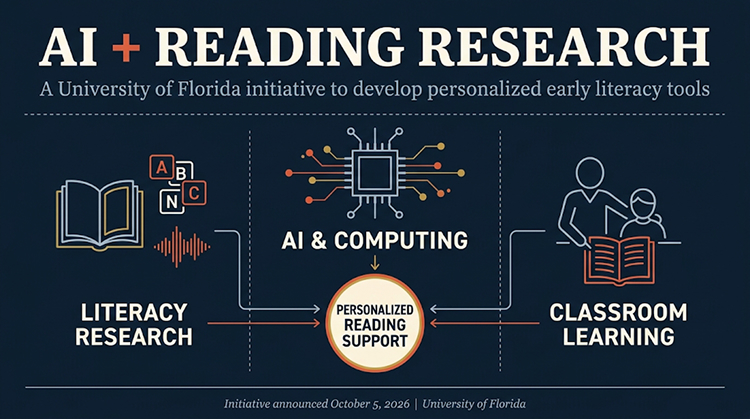
The Patsy Nelms Literacy Initiative combines literacy research, artificial intelligence, and teacher collaboration to develop personalized reading tools for children across Florida.
The University of Florida is bringing artificial intelligence into early literacy education with a new initiative designed to help more children become confident, capable readers. Announced on October 5, 2026, the Patsy Nelms Literacy Initiative brings together the university’s College of Education, the University of Florida Literacy Institute (UFLI), and the Herbert Wertheim College of Engineering to develop personalized, research-based tools for students and educators.
Funded by David and Daryl Nelms in honor of lifelong educator Patsy Nelms, the initiative aims to connect decades of reading research with advanced computing technology. The university plans to use its HiPerGator AI infrastructure to help develop interactive learning activities that adapt to students’ needs while supporting the work teachers do in classrooms.
The project reflects a growing question in education: Can AI help teachers provide more individualized reading support without losing the human guidance that children need to learn?
For schools, educators, and families, the initiative offers a new example of how technology may strengthen early literacy when it is built around research, classroom experience, and student learning rather than technology alone.
What Is the Patsy Nelms Literacy Initiative?
The Patsy Nelms Literacy Initiative is a University of Florida effort to improve early reading outcomes through collaboration among education researchers, engineers, teachers, and students.
The initiative was announced at a gathering at historic Norman Hall on the university’s Gainesville campus. It builds on the College of Education’s established literacy work while bringing in expertise in artificial intelligence and advanced computing.
The project has three central priorities:
- Personalized literacy activities: Develop AI-powered learning experiences that respond to students’ progress and support different stages of reading development.
- Research-based instruction: Ground the tools in established literacy research instead of relying on AI-generated activities without an instructional foundation.
- Teacher and student collaboration: Involve the people who will use the tools in their design and development so that the technology reflects real classroom needs.
The initiative is intended to create tools that can potentially scale across school districts, helping educators access additional ways to support children who are developing foundational reading skills.
However, the university’s announcement describes a development effort, not a completed intervention with demonstrated statewide results. Its ultimate impact will depend on how the tools perform in classrooms and whether they lead to measurable improvements in reading.
How Artificial Intelligence Could Support Early Reading
Learning to read involves multiple skills, including recognizing speech sounds, connecting letters with sounds, decoding unfamiliar words, building fluency, and understanding written language. Children develop these abilities at different rates, and teachers must often adjust instruction to address individual strengths and difficulties.
AI-powered literacy activities could help educators respond to those differences by offering more targeted practice and information about student progress.
For example, a learning tool might present activities at progressively more challenging levels, give students opportunities to practice specific skills, or help teachers identify areas where additional instruction may be needed. These are potential applications of the approach; the university has not announced that every feature will be included in the initiative’s final tools.
The project’s emphasis on personalized learning is particularly relevant in classrooms where teachers work with students who have a wide range of reading abilities.
Technology could provide additional practice opportunities, but it should not replace direct instruction, discussion, read-alouds, or relationships with educators. Teachers remain essential for interpreting students’ needs, selecting appropriate interventions, and ensuring that reading activities are accessible and meaningful.
The challenge for developers will be to make AI useful as an instructional support system—not simply an additional screen for children to use.
HiPerGator AI Connects Computing Power With Literacy Research
A major part of the initiative is the University of Florida’s HiPerGator AI infrastructure, which provides advanced computing capabilities for research and development.
By combining that infrastructure with expertise from education and engineering, UF hopes to create literacy activities that can be personalized and delivered at scale. The collaboration also brings together specialists who understand how children learn with researchers who develop AI technologies.
The university’s broader investment in AI provides a foundation for this work. UF has integrated AI across academic disciplines, emphasizing not only how to use the technology but also how to evaluate it and apply it responsibly.
For the literacy initiative, the important measure will not simply be how advanced the technology is. It will be whether the tools help teachers make better instructional decisions and give children effective opportunities to practice reading.
The People Behind the Initiative
The project draws on leadership and expertise from across the University of Florida.
Glenn Good — Dean, UF College of Education
Good highlighted the initiative’s focus on helping every child become a confident and capable reader. The College of Education leads the effort alongside university partners.
Jason Arnold, Ed.D. — Initiative lead
Arnold, senior director of E-Learning, Technology and Communications at the College of Education, is leading the effort to connect literacy research, classroom practice, and scalable technology.
Holly Lane, Ph.D. — Director of the University of Florida Literacy Institute
Lane’s work through UFLI centers on improving reading outcomes and preparing educators to use evidence-based instructional practices. The institute provides an established literacy-research foundation relevant to the university’s wider work.

University President Stuart Bell also emphasized the value of combining UF’s literacy expertise with its AI capabilities. David Nelms, whose family funded the initiative in honor of Patsy Nelms, said the family looked forward to seeing the project’s impact and long-term legacy.
Why the University’s Existing Literacy Work Matters
The new initiative does not begin from scratch. The University of Florida Literacy Institute has a long-standing focus on reader development and teacher development, including instructional resources, tutoring models, and professional learning for educators.
UFLI’s work is rooted in the science of reading: a body of research examining how people learn to read and which instructional approaches support that process. Its resources emphasize explicit, systematic instruction and opportunities for students to practice developing skills.
That foundation matters because AI-generated educational content can vary in quality. A tool designed to support early reading needs to be aligned with appropriate instructional methods, accurate in its feedback, and useful to the teachers and students who rely on it.
The initiative’s research-based approach offers a way to connect emerging technology with established educational knowledge. Its success, however, will need to be demonstrated through development, classroom use, and evaluation.
What This Could Mean for Teachers and Schools
If the tools developed through the initiative prove effective, teachers may gain additional ways to tailor reading activities to individual students.
Potential benefits could include:
- More targeted practice: Students may receive activities that align with the reading skills they are currently developing.
- Additional instructional insight: AI-supported tools could help educators identify patterns in student performance and determine where extra support may be needed.
- More flexible learning activities: Progressive levels of practice could provide students with different entry points and opportunities to build skills.
- Potential for broader access: Scalable digital resources could help extend research-based literacy support to additional classrooms and districts.
These are potential outcomes, not confirmed results. The October 5 announcement did not establish a quantified improvement in reading scores, specify a statewide implementation schedule, or report how many students would initially use the new tools.
School leaders considering AI for literacy should therefore look for evidence of effectiveness, clear implementation guidance, accessibility for students with disabilities, protection of student data, and professional development that helps teachers use the technology appropriately.
Human Teachers Remain Central to Reading Instruction
The growing use of AI in education raises an important question: How can schools use technology without diminishing the role of teachers?
Early literacy requires more than completing digital exercises. Students benefit from listening to fluent readers, discussing stories, receiving encouragement, practicing language, and getting timely help when they misunderstand a word or concept.
Teachers also interpret information that an automated system may not fully capture, including a student’s confidence, attention, language background, and response to different teaching approaches.
The Patsy Nelms Literacy Initiative’s collaboration with teachers and students during development is therefore an important part of its design. Involving classroom users can help researchers understand whether a tool is practical, understandable, and suited to real educational environments.
For AI to make a lasting contribution, it must strengthen educators’ ability to teach—not encourage schools to treat reading as a problem that software can solve independently.
How the Initiative Fits Into the Future of Early Literacy
The University of Florida’s announcement is part of a broader effort to explore how AI can support education while retaining evidence-based teaching practices.
In a separate project announced on February 9, 2026, UF researchers described a five-year, $2 million U.S. Department of Education grant for UFLI AI, a research effort with Project Read AI to develop learning analytics and individualized reading support for kindergarten through second-grade students. The planned system includes a teacher portal for analyzing spelling-test data and a practice tool intended to provide feedback as students read decodable text aloud.
That earlier project is distinct from the Patsy Nelms Literacy Initiative announced in October. Together, they illustrate the university’s interest in connecting literacy research, instructional decision-making, and AI-supported practice, but their funding, designs, and outcomes should not be conflated.
For educators and families, the most meaningful question is whether these approaches help children make measurable progress in foundational reading skills. Transparent evaluation, teacher feedback, and evidence from classroom implementation will be important to answering it.
Frequently Asked Questions
What is the Patsy Nelms Literacy Initiative?
It is a University of Florida initiative announced on October 5, 2026, to develop personalized, research-based literacy tools using AI and collaboration among education researchers, engineers, teachers, and students.
Who is funding the initiative?
The initiative is funded by David and Daryl Nelms in honor of Patsy Nelms, a lifelong educator whose commitment to literacy inspired the project.
How will AI be used to help children learn to read?
The initiative plans to develop AI-powered literacy activities organized across progressive learning levels. The goal is to support personalized learning and classroom instruction. Specific features and measurable results will depend on the tools developed and evaluated.
Will AI replace reading teachers?
The initiative is intended to support educators and students, not establish that AI can replace teachers. Educators remain central to instruction, assessment, motivation, and decisions about additional support.
Has the initiative already improved reading scores?
The university’s October 5 announcement describes the launch and goals of the initiative. It does not report measured improvements in student reading scores attributable to the new project.
Conclusion: Turning AI Research Into Better Reading Support
The University of Florida’s Patsy Nelms Literacy Initiative brings together literacy research, engineering expertise, and advanced AI infrastructure to address one of education’s most important tasks: helping children learn to read.
Its focus on personalized activities and collaboration with teachers and students could help researchers develop tools that fit the realities of early literacy classrooms. Yet the initiative’s value will ultimately depend on evidence that those tools improve learning, work for students with different needs, and strengthen rather than replace effective teaching.
For schools and families, the launch represents a promising research direction—not a guarantee of results. As the work develops, classroom evidence and measurable reading progress will be the clearest indicators of whether AI can make a meaningful difference for young readers.
