
Let’s talk about something different. Standardized tests are like judging a chef by a microwave dinner. They’re quick, uniform, but miss the real point of learning.
The portfolio & assessment is like a five-course tasting menu. It’s not just old homework. It’s a story of your growth and learning. Imagine it as your academic director’s cut, with extra commentary tracks.
Teachers are asking big questions. What’s the real purpose of these tests? Who are they for? Students are tired of being quiet when they want to show off their skills. They’re demanding something more meaningful.
This collection of work tells a story that no transcript can. It shows the journey, not just the end. For those evaluating, it’s like the difference between reading a movie summary and watching the film itself.
Key Takeaways
- Standardized tests provide a limited, uniform snapshot of student ability
- A well-curated portfolio offers a complete story of intellectual growth
- Teachers are questioning the purpose and audience of traditional assessments
- Students want evaluation methods that show their full abilities
- Portfolios provide context and depth that transcripts alone can’t
- The reflection part turns student work into a documented learning journey
- For colleges, portfolios offer richer evidence of readiness than test scores alone
What a Strong Portfolio Includes (by Grade Band)
If standardized testing is like a blurry photo, a portfolio is a detailed documentary. One shows a single moment. The other tells the whole story of learning.
So, what makes up this documentary? It’s not just every little thing. It’s about choosing the right pieces.
Start with the “buckets.” These are the main areas of learning. Think Critical Analysis, Creative Expression, Civic Engagement, Scientific Inquiry. Your child is building a strong case in these areas.
Then, think about what shows growth in each area. The answer changes as your child gets older.
The Elementary Years (K-5): Capturing the Spark
For young learners, evidence is hands-on and fun. We look for the spark, not perfect essays.
- A scribbled story next to a photo of a block tower. It’s not just playing. It’s about telling stories and understanding space.
- Audio recordings of them talking about their drawings. Listen for how they think: “I made the bridge curve so the troll couldn’t get across.”
- Nature journals with observations of backyard plants. It’s the start of scientific method.
- Math “in the wild” photos: measuring for cookies, making patterns with Legos.
The portfolio here is full of images and sounds. It says: “Look at this mind starting to connect dots!”
The Middle School Bridge (6-8): Building the Framework
This is a time of big change. Evidence should show the growth happening.
- First drafts vs. final drafts of writing. The magic is in the notes and questions that show how they improved.
- Lab reports from failed experiments. The real breakthrough is the next question they ask.
- Project planning timelines for a history fair or community service. It shows how they manage their work.
- Self-created study guides or mind maps. It shows how they think about learning.
A strong middle school portfolio shows they’re moving from doing assignments to managing their learning.
The High School Showcase (9-12): Demonstrating Mastery
Now, they’re building a case for adulthood. Artifacts need to show depth, rigor, and skill.
- The deep-dive research paper with sources and a reflection on bias.
- A portfolio within a portfolio: all versions of a coding project, from start to finish.
- Documented leadership: emails, budgets, and tutoring logs.
- Curated creative work: photos exploring a theme, with an artist’s statement.
At this level, a clear rubric is key. It’s not about checking boxes from a standardized testing company. It’s about defining what “analysis” or “effective communication” means here. Then, find the proof.
The question is never “What did you cover?” but “What can you now uncover?” The portfolio is your answer.
This approach flips the script. It’s not about matching work to a lesson. It’s about identifying important skills and letting the student show they’ve mastered them in their own way.
That photo of the block tower? In high school, the same skill might be shown through CAD drawings for robotics. The evidence grows as the student does. Learning is visible over time, something no standardized testing day can show.
The final secret? The student’s own voice. A brief reflection on each major piece shows why they chose it and what they learned. This turns a collection of items into a compelling story. It’s the difference between evidence and a tale well-told.
Setting Learning Objectives and Matching Evidence
Forget handing students a checklist; the real magic happens when you build that checklist together. This turns the portfolio from a chore to a personal statement. The old way, where teachers set all the goals, can feel empty.
Enter co-construction. It’s not about letting students do whatever they want. It’s a team effort, like a writer and editor working together. You set the rules (like state standards), and they add their own voice and interests.
This new way needs a special teaching process. It’s not just giving them a camera and saying “make art.” It’s teaching them how to make a movie. The process is simple but powerful:
- Collect: Students gather all their work, notes, and drafts. This shows the real learning process, not just the final product.
- Select: Students pick the best work that shows their growth. This is where your criteria help them choose wisely.
- Reflect: Students explain why they chose certain pieces. It’s not just “I liked this.” It’s about what they learned.
- Connect: Students show how their work connects to bigger goals and the world. This links their work to other subjects and real-life issues.
This turns a simple portfolio review into a deep analysis. Students aren’t just showing their work; they’re making a case for their learning. They become their own advocates.
Where does the official transcript fit in? Think of it as the official record of grades. The portfolio is like the director’s commentary, showing the whole story behind the grades. The transcript says “A in Biology.” The portfolio shows the journey, the struggles, and the successes.
When students help set goals, matching evidence becomes easy. If the goal is to show persuasive writing, the evidence includes drafts, feedback, and reflections. It shows the whole journey, not just the end result.
This approach does two great things. It makes learning deeper and more meaningful. It also builds a strong portfolio for evaluations or college apps. You’re not just gathering papers; you’re telling a story of growth.
Rubrics for Writing, Math Problem‑Solving, Projects
We often see rubrics as the rules of Monopoly—necessary but boring. But what if we viewed them as the rules of jazz improvisation? A great rubric sets the stage for creativity, defining the key, rhythm, and standards for excellence.
This new way of thinking is your secret weapon. In a world focused on standardized testing, a detailed rubric makes a portfolio stand out. It shows a student’s unique learning journey in a way that evaluators and colleges can understand.
A rubric is the ultimate translation device. It turns a student’s unique process into measurable achievement.
Look at higher education for inspiration. Programs like the University of Michigan’s CREES don’t just look for a “good research paper.” They use AAC&U VALUE Rubrics to assess “Integrative Learning” and “Intercultural Awareness.” These concepts show how ideas connect across disciplines and cultures.
Using this approach at home changes how you present evidence:
For a writing portfolio, your rubric should look beyond grammar. Include criteria for narrative voice, synthesis of sources, and emotional or intellectual impact. Does the essay change a reader’s mind? Does it tell a compelling story?
For a math portfolio, it’s not just about the answer. Create a rubric that values the problem-solving journey. Give points for multiple solution methods, clear explanations, and pattern identification.
For project-based learning, a rubric can assess research depth, design, and collaboration. It turns a cool science fair volcano into evidence of the scientific method and project management.

This method offers a real alternative to the testing industrial complex. The table below shows the big difference:
| Assessment Criteria | Standardized Testing | Rubric-Based Portfolio Assessment |
|---|---|---|
| What It Measures | Isolated facts, speed, test-taking strategy | Depth of understanding, process, creativity, application |
| Insight Provided | A single snapshot score | A multidimensional learning narrative |
| Flexibility | None. One size fits all. | Adapts to subject, project, and individual student goals |
| Primary Focus | The “right” answer | The quality of the thinking journey |
The power of a rubric is in its dual role. It guides students during their work and provides an objective framework for evaluators. It’s the rulebook for a better game.
Photos/Video as Evidence (Metadata and Storage)
If your child’s learning portfolio were a courtroom, photos and videos would be your star witnesses. They are irrefutable, dynamic evidence that leaps off the page. The dry transcript lists algebra credits; a time-lapse video shows the actual problem-solving process, complete with erased mistakes and eventual “aha!” moments. This is assessment in living color.
We’re not just documenting projects anymore. We’re building a multimedia time capsule of competency. A photo of a meticulously wired circuit board. A video of a persuasive speech, capturing tone, posture, and audience reaction. An audio clip of a Spanish dialogue, proving pronunciation beyond a written quiz. This evidence answers the skeptic’s silent question: “But can they actually do it?”
Yet with great pixels comes great responsibility. Enter metadata—the unsung hero of digital organization. Think of it as the caption, date stamp, and context label that prevents your “2025 Mars Rover Model.jpg” from becoming a mysterious, unidentifiable file in three years. For every piece of media, ask:
- What is this? (Science Fair Project: Hydroponic Herb Garden)
- What skill does it demonstrate? (Experimental design, data recording, sustainable agriculture concepts)
- When was it created? (April 2025)
- What was the learning objective? (Understand plant biology and controlled variables)
Without this digital paperwork, your evidence is a silent film with no subtitles. It’s essential for any meaningful portfolio review.
Next comes the housing question: where does this digital evidence live? This isn’t just tech support—it’s a lesson in digital citizenship and archival strategy. You have two main paths:
- The Local Fortress: External hard drives or dedicated family computers. You control the keys. The upside? Total privacy. The downside? It’s the modern equivalent of storing treasures under the mattress—vulnerable to physical damage, obsolescence, and “Mom, where did you save my robotics video?”
- The Cloud Library: Services like Google Drive, Dropbox, or dedicated e-portfolio platforms. The upside? Access from anywhere, built-in backup, and easy sharing for evaluations. The downside? You’re trusting a third party with your data. It requires vigilant privacy settings.
This choice directly impacts who has access. A video of your 14-year-old’s first public speech might be precious to you but potentially embarrassing if shared broadly. Your storage decision defines the audience.
Always ask the evaluator or college their preference. Some want curated links in a digital portfolio review. Others might accept a physical USB drive appended to a paper file. Clarifying this saves everyone time and technical headaches.
Ultimately, this multimedia layer transforms the static transcript into a vibrant narrative. The grades and credits tell the “what.” The photos and videos show the “how.” It’s the difference between reading a concert review and hearing the symphony yourself. By managing metadata and storage thoughtfully, you’re not just organizing files. You’re preserving proof of growth in its most authentic form.
Creating a High School Transcript (credit, GPA, course descriptions)
A transcript is like a movie trailer that gets you excited to learn more. It takes all your hard work and puts it into a format schools understand. But, you don’t have to stick to their rules.
Traditional transcripts are like airport boards: full of classes and grades. But yours should be like a museum guide, showing off your learning. It’s not just about looks; it’s about what you’ve learned.
The credit system was made in 1906 to help colleges know what you’ve learned. But it only counts time, not how well you understand the material. Why follow a system made for factories?
Competency-based credit is different. It says you earn credits when you master a subject. So, that project on local ecology? That’s science. And that novel you wrote? That’s English.
Your transcript shows what you can do, not just what you’ve been in class for.
The GPA system is based on A’s, B’s, and so on. But what about the hard work you put into a project? Or the months you spent mastering a tough concept?
A mastery-based GPA could include:
- How well you did in the end
- How much you grew from the start
- The complexity of what you learned
- How you used your own initiative
This isn’t just about getting better grades. It’s about showing how you got there.
Now, let’s talk about course descriptions. Most are boring and hard to understand. But yours should be exciting and clear.
Your descriptions should be like ads for interesting classes:
“Mathematical Modeling in Everyday Systems: Used algebraic functions to analyze personal finance budgets, sports statistics, and music rhythm patterns. Final project created a predictive model for local bird migration using regression analysis.”
Or:
“Literature of Social Change: Examined how narrative shapes movements through works like The Grapes of Wrath, Persepolis, and contemporary climate fiction. Created a multimedia presentation analyzing rhetoric in historical speeches versus modern social media activism.”
One shows you took a class. The other shows you think deeply.
This way, standardized testing seems old-fashioned. Why reduce your hard work to a few hours on a test day? As one student said, those tests measure stress more than talent.
Your transcript is your argument against judging you by one test. It shows your dedication and mastery over time.
The final transcript should have:
- A clear credit summary by subject
- A note explaining your GPA
- Short, exciting descriptions of each course
- Highlights of your most important work
- Details on how your grades were earned
Think of your transcript as a showcase of your learning. It’s not just a report card; it’s your introduction to the world.
When someone sees your transcript, they see your drive and curiosity. They see someone who doesn’t just learn; they create their own education.
Reimagining your transcript can change how you’re seen. It turns a boring requirement into your chance to shine.
Testing Options and When They Help
Imagine judging a symphony by just listening to the trumpet section. You’d miss the strings, woodwinds, and percussion. This shows the problem with using standardized testing as the only way to measure a student’s abilities.
The test isn’t as bad as some people make it out to be. The real question is when it’s useful.
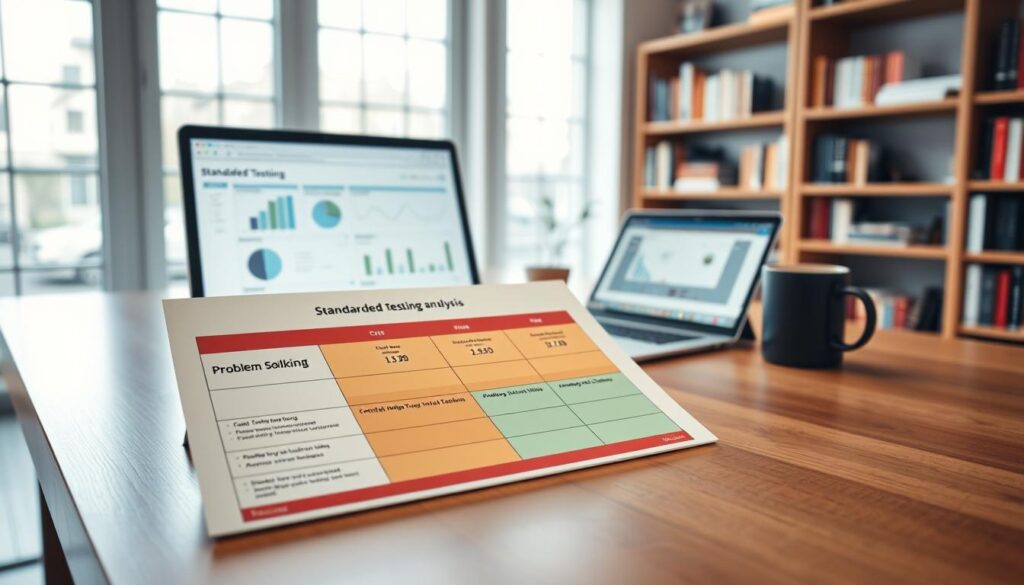
Let’s look at it critically. Standardized testing can be useful for checking specific skills. For example, language exams or certification tests. They give clear answers to specific questions.
But as a way to measure everything about a student? The evidence is against it.
The CREES study found student capstone papers showed “significantly higher levels of learning” than traditional exams. This was when using detailed evaluation rubrics.
This isn’t just a small difference. It’s a big change in what we see as deep understanding versus just remembering facts.
When the Test Actually Adds Value
Use tests as part of the process, not the whole thing. They work best in certain situations:
- Diagnostic Baselines: To see where students start in areas like math or reading.
- External Benchmarking: When programs or scholarships need to compare different applicants.
- Skill Certification: To prove you’ve mastered a specific skill, like coding or a language.
But outside these areas, tests can be more trouble than they’re worth. Students now see the digital SAT as unfair and stressful. The test’s bias and pressure can make it more about anxiety than learning.
The Rubric Reality Check
The rubric for a test is simple: pass or fail on a specific skill. Did you get X questions right? Yes or no.
The rubric for a person is much more complex. It looks at critical thinking, creativity, and more. A test score is just a snapshot; a portfolio shows the whole story.
Using only standardized testing is like judging a movie by its poster. You get the title and the main actor, but miss the plot and emotional depth.
Our view is to use tests wisely. Let them provide specific data when it’s useful. But never let a test be the only thing that matters in a student’s education. The real story is in projects and papers, not just a scantron sheet.
Showcasing Competency‑Based Progress
A portfolio without progress is like a movie with only the final scene—you miss the character development. We’ve been grading the climax while ignoring the entire second act. The real magic happens in the montage.
Enter the competency-based approach. It doesn’t just ask, “What can you do?” It demands, “Show me how you learned to do it.” This shifts the focus from product to process. From trophy case to training log.
I once saw a graduate program that required students to keep their earliest, most cringe-worthy attempts. The final thesis sat beside the stumbling first draft. The comparison wasn’t cruel—it was revelatory. You could see the thinking evolve. The arguments sharpen. The voice emerge.
This is the power of the process portfolio versus the product portfolio. The product portfolio is a highlight reel. The process portfolio is the director’s cut with commentary.
For homeschoolers, this means intentionally archiving work across years. That shaky paragraph from 9th grade next to the polished essay from 12th. The first clumsy attempt at solving for ‘x’ beside the elegant calculus proof. The growth becomes undeniable. To an evaluator or college admissions officer, this arc is more persuasive than any single A+.
One of the most potent practices is the student-led conference or exit presentation. Imagine a high school senior, not bubbling in Scantron ovals, but defending their learning journey. They walk an evaluator through their portfolio, explaining their stumbles, breakthroughs, and evolving goals. It’s a viva voce for their entire education.
This is where goal-setting transforms from administrative box-ticking to a metacognitive engine. Students set a goal, gather evidence, reflect, and set a new one. The portfolio becomes a living record of their aspirations. It’s the difference between being a passenger and being the navigator.
A consistent rubric is the secret weapon here. Using the same scoring guide across multiple years—for writing, problem-solving, or project design—creates a quantifiable growth chart. You’re not just seeing better work. You’re seeing more sophisticated thinking. The rubric makes the invisible visible.
Think of it as educational time-lapse photography. A single snapshot tells you little. A series reveals the pattern, the direction, the velocity of learning.
This approach turns the annual portfolio review into a strategic conversation. Instead of “Here’s what I did,” it becomes “Here’s how I grew, and here’s where I’m heading next.” The evaluator’s role shifts from judge to coach, witnessing a trajectory instead of auditing a checklist.
In a world obsessed with endpoints, showing competency-based progress is a rebellious act. It declares that learning is a verb, not a noun. The journey, with all its detours and discoveries, is the main event.
Digital Portfolios: Tools and Privacy Steps
Forget the dusty filing cabinet. Today, we use digital strategies with privacy in mind. We’ve moved from three-ring binders to cloud storage, from handwritten notes to multimedia archives.
The tool landscape is surprisingly diverse. You have sleek, education-focused platforms like Seesaw and Mahara designed for student portfolios. You also have versatile tools like Google Drive or Microsoft OneDrive. Even a well-organized website or blog can serve the purpose.
Choosing isn’t about chasing shiny features. It’s about longevity, accessibility, and presentation. Will this platform exist in five years when your student applies to college? Can evaluators access it without creating an account? Does it make the work look professional, not just stored?
Here’s where most people glaze over: the privacy fine print. This isn’t just about where files live. It’s about who owns the intellectual property. Is it the student, the parent, or the platform itself? Can the entire portfolio be downloaded as a backup, or are you locked in?
We need to model real digital literacy. A portfolio is a personal intellectual archive. You wouldn’t leave your financial records on a public server. Why treat your child’s academic journey any differently?
Set viewing permissions like a bouncer at an exclusive club. Future teacher? Maybe. Distant relative? Probably not. The entire internet? Absolutely not. This control is the digital equivalent of choosing who gets a key to your house.
This becomes critically important when that digital file transforms into a de facto transcript. Colleges increasingly accept digital portfolios as supplementary evidence. That beautifully curated website showing robotics projects or creative writing? It’s now part of the admissions package.
In an era of constant data breaches, building a portfolio means building a firewall. We’re creating a responsible alternative to the standardized testing mill. That system often treats student scores as commodities to be bought, sold, and analyzed.
Your digital portfolio should do the opposite. It protects data while showing growth. It’s a fortress that also has a very welcoming front door for the right visitors.
Consider these practical steps for your digital portfolio setup:
- Own Your Domain: If using a website, consider a personal domain name. It looks professional and stays with the student.
- Download Rights: Ensure you can export all data. Avoid platforms that lock your content in their ecosystem.
- Clear Metadata: For photos and videos, include descriptive metadata. What project was this? What skill does it demonstrate?
- Access Tiers: Create different access levels: full (family/evaluator), review (colleges), and public (selected samples only).
The goal is elegant simplicity. A digital portfolio should tell a compelling story of learning without exposing the entire narrative to the public web. It’s the 21st-century solution that gives students control over their own educational transcript.
This approach fundamentally rejects the impersonal data-harvesting of mass standardized testing. Instead, it says: “Here is my unique path. You’re invited to view it—on my terms.”
Preparing for Evaluations and College Admissions
Think of your final portfolio review as your TED Talk moment. It’s your chance to shine. You’ve spent months or years on your work. Now, it’s time to share it with others.
This is a big change. You’re moving from being a student to a scholar. It’s like going from taking a test to defending a thesis. Write a “professional essay” that ties everything together.
This essay connects your learning to your future goals. It answers the “so what?” question. It shows how your studies shape your future.
Next, get ready for the conversation. It’s not a pop quiz. It’s a chance to talk about your work. They might ask you to explain your thinking or what surprised you.
Your goal is to reflect and connect. Your teacher can help you prepare. They know your work and can guide you.
What’s the rubric for this? It’s about clarity, passion, and self-awareness. Can you explain complex ideas simply? Does your voice show your interest?
This evaluation rubric values thinking about your own thinking. It’s about how you got there and where you’re going next. This is what college admissions officers look for.
Practical preparation is key. Organize your portfolio well. Practice explaining your work. Time yourself and record your explanations. Listen back to see if you sound engaged.
A successful portfolio review is a demonstration, not a defense. You’re showing what you can do. This mindset changes everything. You’ll feel more confident and ready to show your work.
For more on structuring your portfolio, check out this guide. It helps you turn your work into a compelling story.
The goal is to leave the room having told a clear story about your growth. The evaluator should see your development, not just assignments. That’s the magic of a well-executed portfolio review.
You’re not just preparing for an evaluation. You’re practicing for future interviews and presentations. The skills you develop here are valuable for your career. This final act closes one chapter and opens another.
Templates: Portfolio Index, Transcript Builder, Rubrics
We’ve explored the theory. Now, let’s look at the tools. The best ideas need a solid foundation, unless you enjoy building intellectual houses in a hurricane.
We have three main templates. First, the portfolio index. It’s like your table of contents for this messy, glorious learning journey. It’s your map when you’re lost in the woods of your own projects.
The transcript builder is your translator. It turns competencies into credits and crafts clear course descriptions. It creates a document that speaks directly to admissions officers, showing more than a single standardized testing score report can.
Lastly, we have sample rubrics for reflection and major projects. Don’t think of these as cages. They are trellises. Structures designed to support wild, beautiful growth, not restrict it.
These templates make the whole process clear. They give you the power of documentation. The goal shifts from just being assessed to truly understanding your own learning. That’s a victory no bubble sheet will ever capture.
